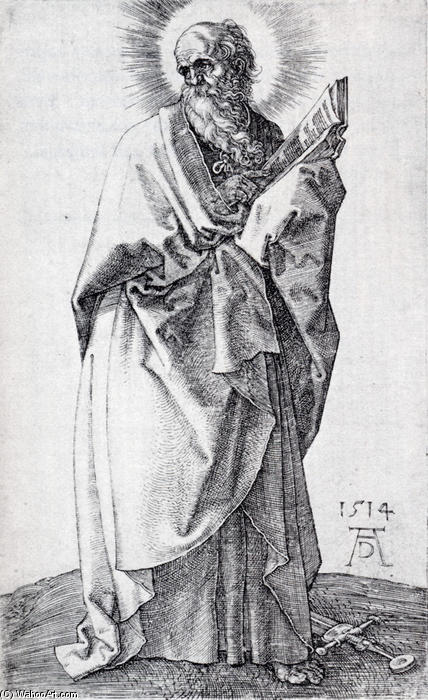
Albrecht Dürer’s "St. Paul (First State)" is a breathtaking monochrome woodcut print showcasing the Northern Renaissance master's meticulous detail and spiritual subject matter, offering a timeless depiction of Saint Paul through precise line work and dramatic lighting – discover this iconic artwork.
A Testament to Faith: Albrecht Dürer's "St. Paul (First State)"
Albrecht Dürer’s “St. Paul (First State),” executed in 1514, is more than a woodcut print; it’s a profound meditation on faith, knowledge, and the enduring power of human conviction. Created during the apex of the Northern Renaissance, this monochrome masterpiece exemplifies Dürer's unparalleled technical skill and his ability to infuse religious iconography with an intensely personal and emotionally resonant quality. The image depicts Saint Paul in profile, a posture that immediately conveys both dignity and introspection, as he holds open a book – a potent symbol of divine revelation and the pursuit of wisdom. The deliberate simplicity of the composition, dominated by vertical lines and a restrained color palette of grays, draws the viewer’s eye directly to the central figure, reinforcing his importance within the narrative.
Masterful Technique: The Art of Woodcut
- Carved Precision: Dürer's mastery lies in his meticulous approach to woodcut. He began with a pear or fruitwood block, painstakingly carving the intricate details of Paul’s robes, beard, and the book itself using specialized tools. The precision achieved through this process is astonishing, particularly considering the limitations of the medium.
- Line Density & Cross-Hatching: The print's remarkable tonal range isn't achieved through color but through a sophisticated manipulation of line density. Hatching – closely spaced parallel lines – and cross-hatching – intersecting sets of lines – create a rich texture, modeling light and shadow with breathtaking realism. This technique allows Dürer to simulate the appearance of fabric, skin, and even the reflective surface of the book’s pages.
- A Laborious Process: The creation of a single print involved applying ink to the carved block and then pressing it firmly against paper using a hand-operated press. This process demanded immense patience and control, highlighting Dürer's dedication to his craft.
Symbolism and Spiritual Resonance
“St. Paul (First State)” is rich in symbolic meaning. The open book represents not just the written word but also the path to enlightenment and salvation. The halo, a universal symbol of sainthood, signifies divine grace and holiness, elevating St. Paul to a position of reverence within Christian iconography. Dürer’s portrayal of Paul as a learned man, engaged in scholarly pursuits, reflects the Renaissance emphasis on human potential and the importance of intellectual faith. The figure's posture – upright and resolute – embodies strength and unwavering conviction, offering a timeless message of spiritual fortitude.
A Window into the Northern Renaissance
Dürer’s work is firmly rooted in the artistic traditions of the Northern Renaissance, characterized by its emphasis on realism, meticulous detail, and a profound understanding of human anatomy. This print exemplifies the period's fascination with religious subjects, rendered with an unprecedented level of technical skill. “St. Paul (First State)” provides a valuable glimpse into the intellectual and spiritual climate of 16th-century Nuremberg, a city that served as a vibrant center for artistic innovation during this transformative era. The flattened perspective, common in woodcut prints of the time, further emphasizes the figure's importance within the composition, drawing attention to his symbolic role.