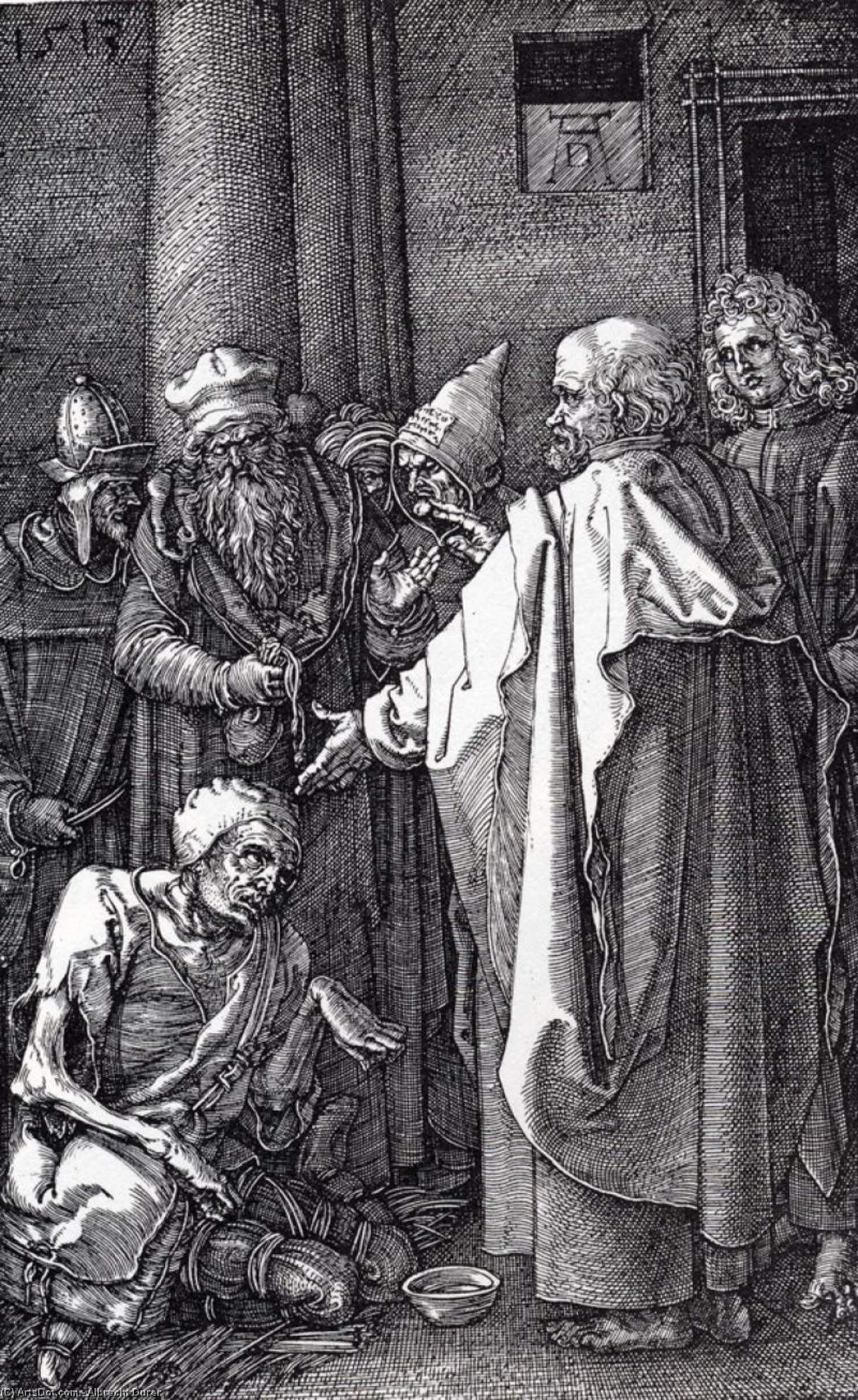
A Chronicle of Faith and Decay: Albrecht Dürer’s “St. Peter And St. John Healing The Cripple”
Albrecht Dürer's "St. Peter And St. John Healing The Cripple," executed in 1513, stands as a monumental achievement within the Northern Renaissance tradition – a testament to meticulous observation, profound spiritual understanding, and the mastery of printmaking’s most demanding techniques. This engraving, depicting a pivotal moment from biblical lore, transcends mere illustration; it is a carefully constructed narrative imbued with layers of symbolism and an undeniable emotional intensity. The scene, likely referencing the raising of Lazarus, unfolds within a darkened interior space, dominated by the stark contrast between the decaying form of Lazarus and the figures surrounding him – Jesus, Nicodemus, Joseph of Arimathea, and others – all engaged in the miraculous act of healing. Dürer’s genius lies not just in his technical prowess but in his ability to translate complex theological concepts into a visually arresting composition that continues to resonate with viewers centuries later.
The Language of Line: Technique and Style
- Northern Renaissance Precision: Dürer’s style is deeply rooted in the Northern Renaissance, particularly influenced by his own explorations and the innovations championed by Albrecht Dürer the Elder. This influence manifests in a rigorous attention to detail, a preference for monochrome imagery, and an emphasis on linear perspective – though flattened here for dramatic effect.
- Masterful Hatching and Cross-Hatching: The engraving’s remarkable tonal range is achieved through a complex interplay of hatching, cross-hatching, and stippling. These techniques, meticulously applied, create the illusion of volume, texture, and shadow with astonishing precision. The density of lines suggests the rough surface of Lazarus's body, while lighter lines delineate smoother areas – a testament to Dürer’s profound understanding of printmaking materials and processes.
- Geometric Forms and Organic Detail: While architectural elements are rendered with geometric clarity—rectangular walls and defined spaces—the human figures themselves are depicted with remarkable organic detail, capturing the nuances of emotion and gesture.
Symbolism Woven into the Narrative
Beyond its technical brilliance, “St. Peter And St. John Healing The Cripple” is rich in symbolic meaning. The central figure of Lazarus, lying prone and decaying, represents mortality itself – a stark reminder of human vulnerability and the inevitability of death. Yet, his resurrection signifies hope, redemption, and the triumph of divine power over earthly limitations. The surrounding figures—Jesus as the embodiment of grace and compassion, Nicodemus and Joseph of Arimathea representing faith and devotion—further amplify this narrative of spiritual transformation. The act of healing is not merely a physical restoration but a profound demonstration of God’s intervention in human affairs.
A Window into 16th-Century Faith and Vision
Created in 1513, this engraving reflects the intellectual and spiritual climate of the early Renaissance. Dürer's work embodies a fervent belief in humanist ideals – emphasizing human potential and the importance of individual experience—while simultaneously grounding itself in established religious doctrine. The image’s emotional intensity, coupled with its technical sophistication, speaks to a period of profound artistic and intellectual ferment, where artists sought to capture not only the outward appearance of reality but also the inner workings of the human soul. Dürer's meticulous approach anticipates the rise of printmaking as a powerful medium for disseminating religious imagery and ideas throughout Europe.