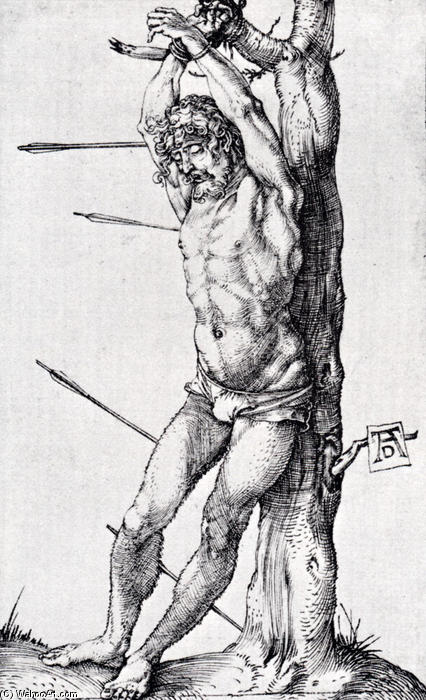
A Study in Suffering: Albrecht Dürer’s ‘St. Sebastian at the Tree’
Albrecht Dürer's “St. Sebastian at the Tree,” executed in 1501, is not merely a depiction of religious martyrdom; it’s a profoundly moving meditation on pain, faith, and the human condition. Created during a pivotal moment in the Northern Renaissance, this engraving embodies Dürer’s mastery of detail, his rigorous approach to observation, and his ability to infuse even the most harrowing subject matter with an almost unbearable sense of realism. The stark monochrome palette – a carefully orchestrated symphony of grays achieved through meticulous etching – immediately draws the viewer into the scene's desolate atmosphere. It is a world stripped bare of distraction, forcing us to confront the raw vulnerability of St. Sebastian himself.
Technical Brilliance: The Art of the Engraving
- The Burin’s Dance: Dürer's technique showcases the extraordinary skill required for engraving. Using a burin – a sharp tool resembling a small chisel – he painstakingly carved lines into a metal plate, typically copper or iron. These weren't casual scratches; each line was precisely controlled to create a vast range of tonal values, from the darkest shadows clinging to Sebastian’s body to the faintest highlights on the tree bark.
- Hatching and Cross-Hatching: The artist employed hatching – parallel lines drawn close together – and cross-hatching – intersecting lines – to build up depth and texture with astonishing accuracy. This technique is particularly evident in the rendering of Sebastian’s musculature, conveying a sense of strained strength and agonizing vulnerability.
- A Printmaker's Precision: The finished plate was then inked evenly across its surface and pressed onto paper using a printing press. This process replicated the image countless times, demonstrating Dürer’s mastery not just as an artist but also as a skilled printmaker.
Symbolism and Narrative: A Martyr's Plea
The subject matter itself is deeply rooted in Christian iconography. St. Sebastian, originally a Roman soldier, was martyred by Diocletian for his refusal to renounce Christianity. Traditionally depicted as being shot with arrows, the engraving powerfully conveys his suffering and unwavering faith. The tree, a recurring motif in Dürer’s work, acts as both a physical support and a symbol of confinement – mirroring Sebastian's imprisonment, not just of body but also of spirit. The positioning of the figure diagonally across the frame creates a dynamic tension, drawing the viewer’s eye to the central point of suffering while simultaneously emphasizing his isolation.
A Renaissance Masterpiece: Context and Influence
"St. Sebastian at the Tree" exemplifies Dürer's place as a leading figure in the Northern Renaissance. Executed around 1501, it reflects the period’s fascination with realism, human anatomy, and religious themes. Dürer’s meticulous attention to detail – evident in the rendering of textures like the rough bark of the tree and the smooth skin of Sebastian – was revolutionary for its time. His work profoundly influenced subsequent generations of artists, establishing a new standard for engraving technique and artistic expression. The flattened perspective, characteristic of engravings from this era, further contributes to the image's dramatic impact, focusing attention on the central figure and intensifying the emotional resonance of the scene.
Emotional Resonance: A Timeless Image
Beyond its technical brilliance and historical significance, “St. Sebastian at the Tree” possesses a profound emotional power. The engraving’s stark simplicity amplifies the sense of suffering, inviting contemplation on themes of sacrifice, faith, and mortality. It is a testament to Dürer's ability to transform a religious narrative into a universally relatable expression of human vulnerability – an image that continues to resonate with viewers centuries after its creation.