The Precision of Nature: Dürer’s Anatomical Mastery
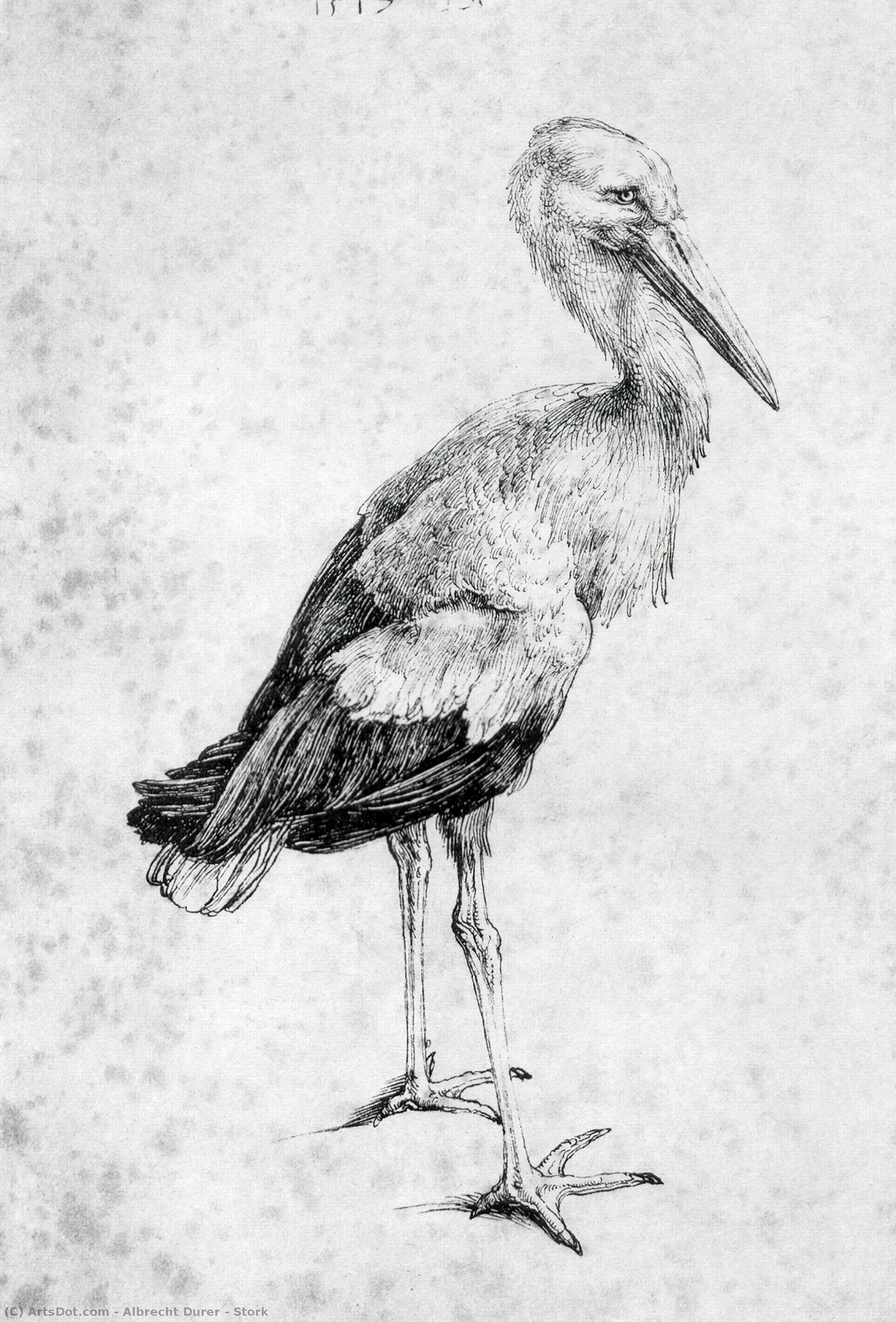
In the quiet, focused realm of the German Renaissance, few artists possessed the ability to bridge the gap between scientific observation and profound artistic expression as seamlessly as Albrecht Dürer. His engraving, Stork, stands as a breathtaking testament to this unique duality. At first glance, the viewer is met with an extraordinary level of detail that transcends mere illustration; it is a visceral encounter with the natural world. The composition centers on the crane, captured in a moment of poised stillness, its elongated neck and sharp beak commanding the frame with a regal, almost architectural presence. Every line etched into the metal plate serves a purpose, meticulously defining the delicate texture of feathers, the subtle musculature beneath the skin, and the structural integrity of the bird's anatomy. It is not merely a drawing of a bird, but an intimate study of life itself, rendered with a clarity that feels both timeless and immediate.
The technique employed here—the masterful art of engraving—is what allows such profound depth to emerge from a monochrome palette. Through the disciplined use of varying line weights, hatching, and cross-hatching, Dürer creates a sophisticated play of light and shadow. This interplay gives the stork a palpable three-dimensional volume, as if the creature might step off the paper and into the room. The lighting, appearing to descend from above, casts soft shadows that accentuate the bird's form, lending a sense of weight and reality to its single-legged stance. For the discerning collector or interior designer, this piece offers a sophisticated textural element; its fine, linear precision provides a rhythmic complexity that complements both minimalist modern spaces and more traditional, classical settings.
A Legacy of Humanism and Scientific Inquiry
To understand the Stork, one must look toward the intellectual currents of the late 15th and early 16th centuries. This was an era defined by Humanism, a movement that sought to reconcile the beauty of the natural world with the burgeoning scientific curiosity of the age. Dürer, working from the vibrant artisan hub of Nuremberg, was at the forefront of this revolution. His work reflects a shift away from the symbolic, often abstract representations of the Middle Ages toward a rigorous, empirical observation of reality. In this engraving, there is no hidden allegory or religious metaphor; instead, the "symbolism" lies in the perfection of the subject's form and the mathematical precision of its proportions. The stork becomes a vessel for exploring the wonders of biological design, embodying the Renaissance ideal that truth can be found through the careful study of nature.
For those seeking to incorporate fine art into their personal environments, this reproduction offers more than just aesthetic appeal; it provides a window into a pivotal moment in human history. The piece carries an emotional weight of quiet contemplation and intellectual rigor. It invites the viewer to slow down, to observe, and to appreciate the intricate complexities that often go unnoticed in the rush of modern life. Whether displayed as a focal point in a study or as part of a curated gallery wall, Dürer’s Stork serves as an enduring symbol of the harmony between art and science, making it a profound choice for any space dedicated to inspiration and thoughtful design.