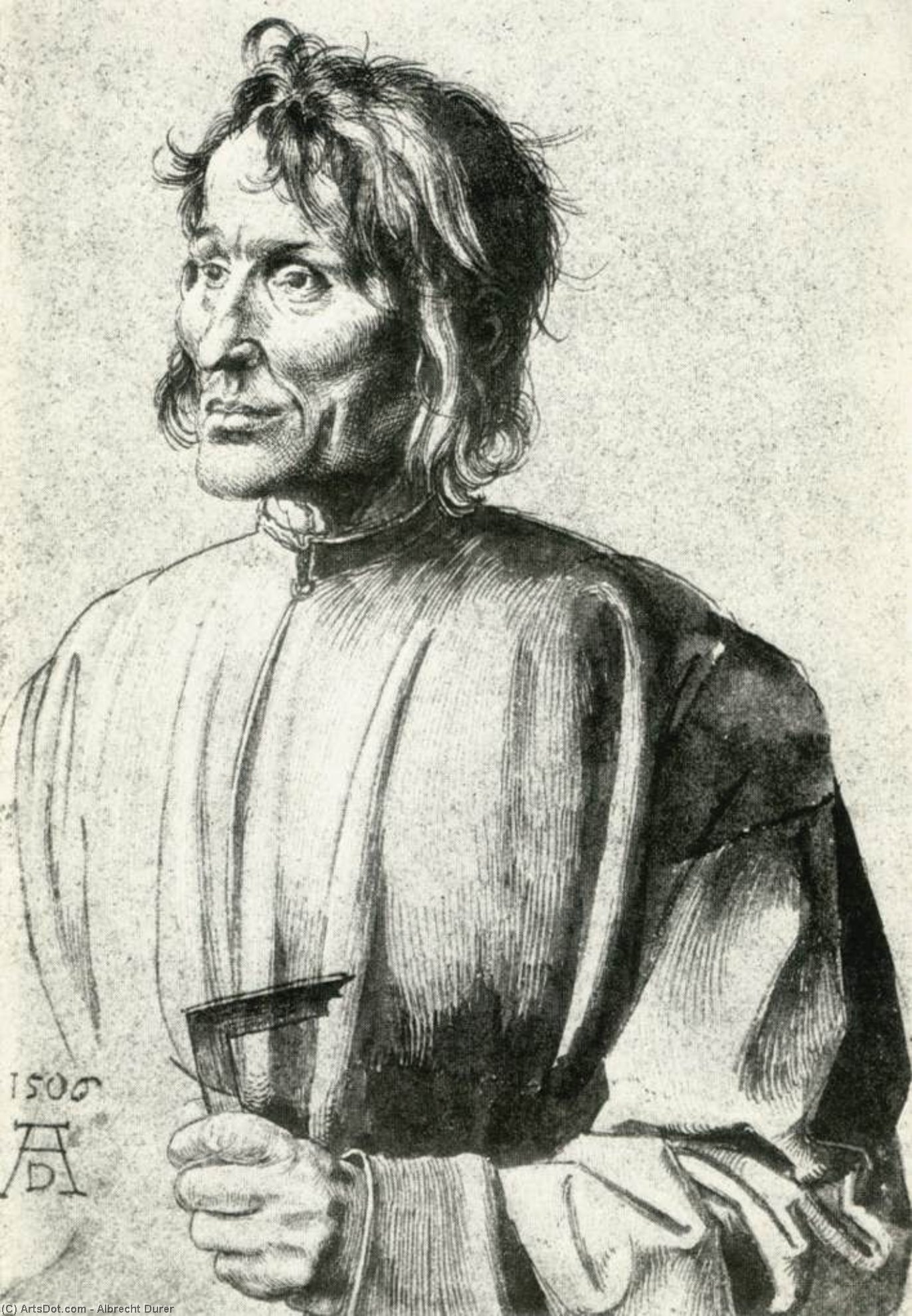
A Moment of Contemplation: Albrecht Dürer’s “Study of an Architect”
Albrecht Dürer's "Study of an Architect," created in 1506, isn’t merely a depiction of a man and a building; it’s a profound meditation on human intellect, the pursuit of knowledge, and the very nature of observation. This remarkably intimate portrait, measuring a substantial 386 x 262 cm, transcends its simple subject matter to become a cornerstone of Renaissance artistic thought. Dürer, already establishing himself as a pivotal figure in German art, employed his masterful technique to capture not just an external likeness but also the internal state of the architect before him – a man lost in considered thought.
The Man and His Task: Subject and Context
The central figure, identified as Hans Holbein the Younger (though this identification remains debated by scholars), is presented with an arresting stillness. He’s a man of considerable age, his face etched with lines that speak of experience and perhaps even weariness. His beard, meticulously rendered in Dürer's signature black chalk, adds to the impression of wisdom and contemplation. The architect stands before what appears to be a partially constructed building – a skeletal framework hinting at a grand design yet to fully materialize. The setting itself is deliberately ambiguous; it’s not a specific location but rather a representation of architectural possibility. Dürer was deeply interested in mathematics, perspective, and the principles governing harmonious proportion, all of which are subtly interwoven into this study. The year 1506 marks a crucial period for Dürer – he was increasingly focused on theoretical art, producing detailed treatises alongside his celebrated paintings and prints.
Technique and Material: A Study in Detail
Dürer’s choice of medium—black chalk—is profoundly significant. This painstaking technique allowed him to build up the image through countless layers of delicate lines, creating a remarkable sense of texture and depth. The level of detail is astonishing; you can almost feel the roughness of the stone, the precision of the measurements, and the weight of the architect’s gaze. The artist's use of hatching and cross-hatching creates subtle gradations of tone, lending volume to the figure and suggesting the play of light on the building. It’s a testament to Dürer’s unparalleled control over his materials and his ability to translate three-dimensional reality onto a two-dimensional surface. The scale of the work itself—a large format for its time—further emphasizes the importance he placed on capturing every nuance of the subject.
Symbolism and Emotional Resonance: Beyond Representation
“Study of an Architect” is more than a portrait; it’s a visual allegory. The architect, lost in his calculations and visions, embodies the intellectual pursuit of knowledge and the drive to create order from chaos. The cup he holds could represent both sustenance for the mind – the fuel required for creative thought – and a symbol of contemplation itself. The background figures, rendered with less detail, serve as a reminder that the architect exists within a broader context, reliant on others but ultimately driven by his own vision. Dürer’s work invites us to consider our own processes of observation, interpretation, and creation. The painting evokes a quiet sense of introspection—a feeling of being drawn into the architect's world, sharing in his focused attention and thoughtful deliberation. It is this ability to convey such profound emotion through seemingly simple imagery that secures Dürer’s place as one of the greatest artists of all time.
ArtsDot offers exquisite, hand-painted reproductions of Albrecht Dürer's "Study of an Architect," allowing you to bring this timeless masterpiece into your home or office. Each reproduction is created with meticulous attention to detail, faithfully capturing the artist’s unique style and emotional depth.