A Study in Raw Power: Dürer’s ‘Study Sheet with the Attacked Animals’
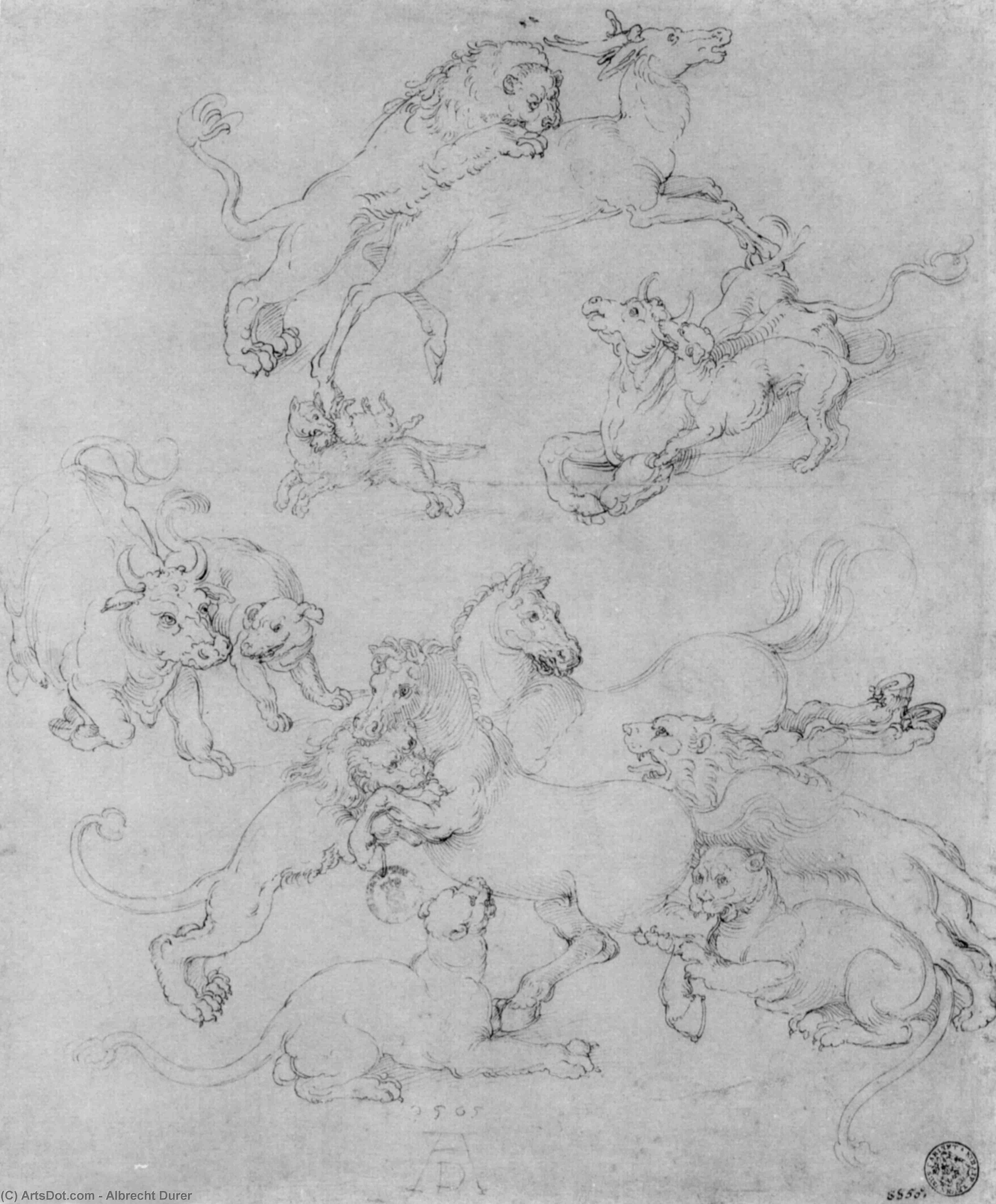
Albrecht Dürer's 'Study Sheet with the Attacked Animals,' created around 1507, is more than just a technical exercise; it’s a visceral exploration of primal forces rendered with breathtaking precision. This seemingly simple sheet of paper explodes with dynamic energy as Dürer meticulously captures the brutal ballet of attack and defense – a lion tearing into a bull, surrounded by hints of other struggling creatures. It's a window into the mind of one of the Renaissance’s greatest masters, revealing his relentless pursuit of anatomical accuracy and his profound fascination with the raw power inherent in the natural world.
Technical Mastery: Line as Sculpture
The artwork’s impact stems largely from Dürer's unparalleled command of line. Executed entirely in pen and ink on paper, ‘Study Sheet with the Attacked Animals’ is a testament to his draftsman’s skill. He doesn’t rely on color to define form; instead, he employs a sophisticated system of hatching and cross-hatching – layering lines to build up tonal values and create an illusion of three-dimensionality. The varying weights of the lines themselves contribute significantly to the dynamism of the composition, guiding the viewer's eye across the page as it follows the movements of the animals. Notice how the thickest lines delineate the powerful musculature of the charging lion, while finer strokes suggest the delicate textures of fur and skin. This technique elevates the drawing beyond a mere representation; it becomes a sculpted study in form and movement.
Renaissance Observation: Anatomy and Instinct
Dürer’s meticulous attention to detail reflects the Renaissance emphasis on observation and scientific inquiry. He wasn't simply sketching animals; he was dissecting them, understanding their anatomy, and capturing their instinctive behaviors with astonishing realism. The composition itself is deliberately chaotic, mirroring the frenzy of a real-life struggle. The overlapping figures create a sense of depth, though perspective plays a secondary role – Dürer prioritized conveying the *feeling* of movement and power over strict spatial accuracy. This approach aligns perfectly with the humanist ideals of the era, which sought to understand humanity through a rigorous study of nature.
Symbolic Resonance: The Fierce Heart of Nature
Beyond its technical brilliance, ‘Study Sheet with the Attacked Animals’ carries symbolic weight. The depiction of aggressive animals – lions and bulls traditionally representing strength and dominance – evokes primal themes of struggle, survival, and the inherent conflict within nature itself. These aren't idealized creatures; they are rendered with a brutal honesty that speaks to our own vulnerabilities and the constant battle for existence. The monochromatic palette further amplifies this sense of intensity, stripping away any distractions and focusing solely on the raw emotion conveyed through the animals’ postures and gestures.
A Legacy in Ink: Reproduction Possibilities
ArtsDot.com is proud to offer meticulously crafted hand-painted reproductions of Dürer's ‘Study Sheet with the Attacked Animals.’ Our skilled artisans employ techniques mirroring Dürer’s original process, ensuring that each reproduction captures the essence of this iconic work – its dynamism, precision, and profound emotional impact. Whether for a private collection or to enhance your interior design, a ArtsDot.com reproduction offers an unparalleled opportunity to experience the power and beauty of one of the Renaissance's greatest masters.