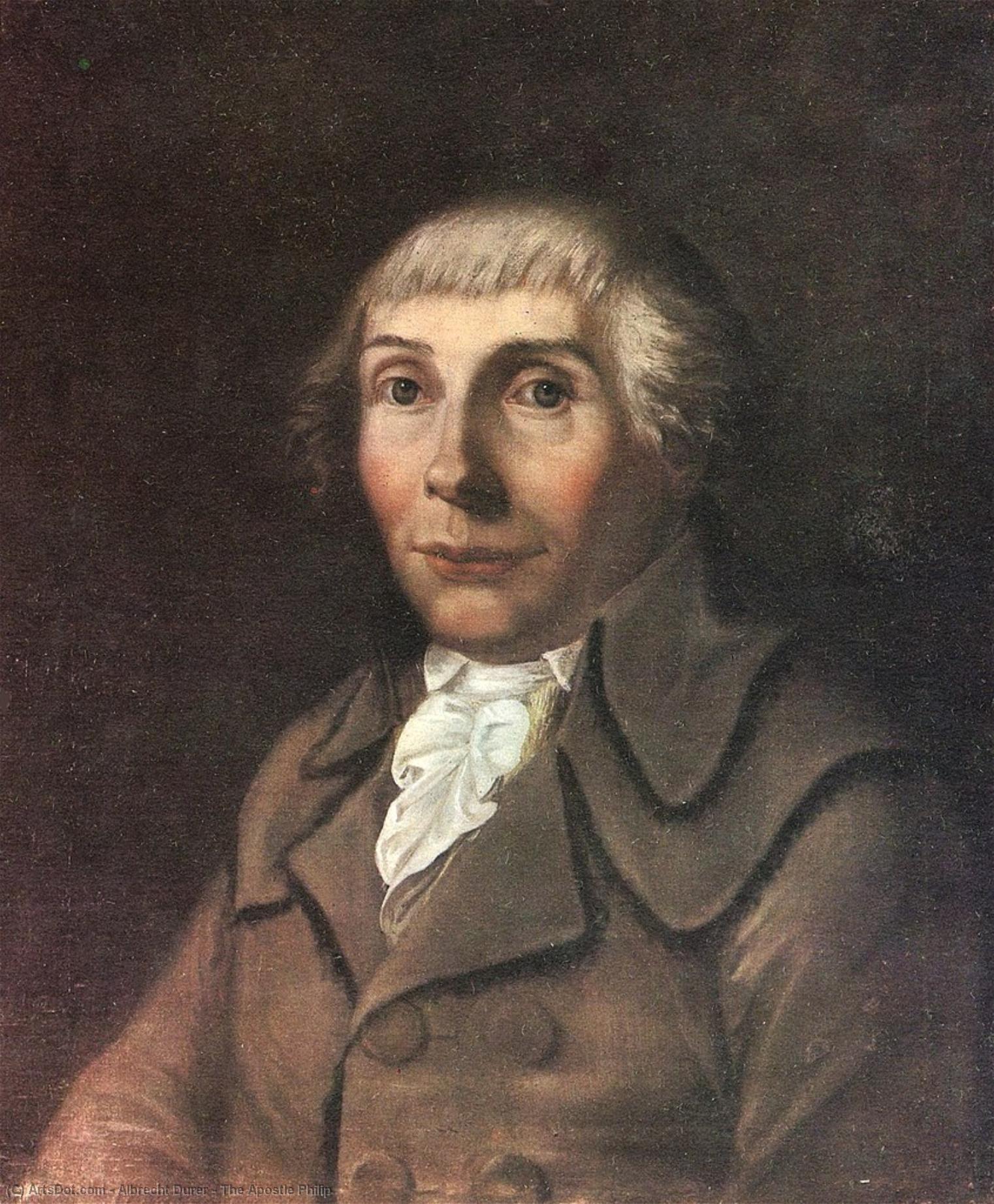
A Vision of Devotion: Encountering Dürer’s Apostle Philip
To stand before Albrecht Dürer’s The Apostle Philip is to enter a silent dialogue with the profound. Painted in 1516, this masterpiece serves as more than a mere religious portrait; it is a window into the soul of the Northern Renaissance. The painting captures Saint Philip not in a moment of divine ecstasy, but in a state of deep, human introspection. Seated against the rugged, textured backdrop of what appears to be an ancient stone wall, the Apostle’s gaze drifts slightly away from the viewer, lost in a contemplative reverie that invites us to share in his solemnity. There is an undeniable weight to his presence, a gravity born from a lifetime of faith and the heavy responsibility of his apostolic calling.
Dürer, a titan of the German Renaissance, utilizes this portrait to showcase his unparalleled ability to marry scientific precision with spiritual depth. The subject’s long, flowing hair and well-groomed beard are rendered with such meticulous care that one can almost sense the individual strands catching the light. His expression, marked by a serious and thoughtful countenance, avoids the flamboyant theatricality often found in later eras, opting instead for an emotional restraint that resonates with a timeless, quiet dignity. For the collector or the lover of fine art, this piece offers a rare opportunity to possess a fragment of history that speaks of both the earthly human form and the eternal divine spirit.
The Mastery of Northern Precision and Technique
The technical brilliance of The Apostle Philip lies in Dürer’s mastery of the oil on wood panel medium. Unlike the broader, more fluid brushstrokes characteristic of some Italian contemporaries, Dürer employs a technique defined by clarity and incredible detail. Through the sophisticated use of hatching and cross-hatching, he builds volume and form, creating a breathtaking illusion of three-dimensionality. This is most evident in the anatomical rendering of Philip’s torso; the artist’s dedication to scientific accuracy reflects the humanist fascination with the human body as a perfect vessel of divine proportion.
Every contour of the Saint's face and every fold of his heavy, textured robes is treated with a luminous quality. By layering thin glazes of oil paint, Dürer achieves a subtle tonal variation that allows light to seem as though it is emanating from within the subject himself. This luminosity creates a tactile richness, making the textures of skin, hair, and stone feel palpably real. For interior designers seeking to introduce a sense of historical weight and intellectual sophistication into a space, a high-quality reproduction of this work provides an anchor of classical elegance and unparalleled craftsmanship.
A Legacy of Humanism and Faith
Contextually, this work is a profound emblem of the intellectual ferment of the early 16th century. Created during a period when the humanist movement was reshaping European thought, the painting reflects a shift toward valuing individual experience and empirical observation. Dürer does not merely present a symbol of a saint; he presents a man. This intersection of religious iconography and humanistic realism is what gives the portrait its enduring emotional impact. The Saint is stripped of unnecessary ornamentation, leaving only the raw, honest essence of his character.
The subtle symbolism within the composition—the weathered wall representing the enduring strength of the Church, and the introspective gaze representing the inward journey of the believer—makes the piece a rich subject for study and admiration. It is an artwork that does not demand attention through spectacle, but earns it through depth. Whether displayed in a private study, a grand library, or a curated gallery space, The Apostle Philip serves as a constant reminder of the beauty found in stillness, the power of focused thought, and the timeless allure of the Renaissance spirit.