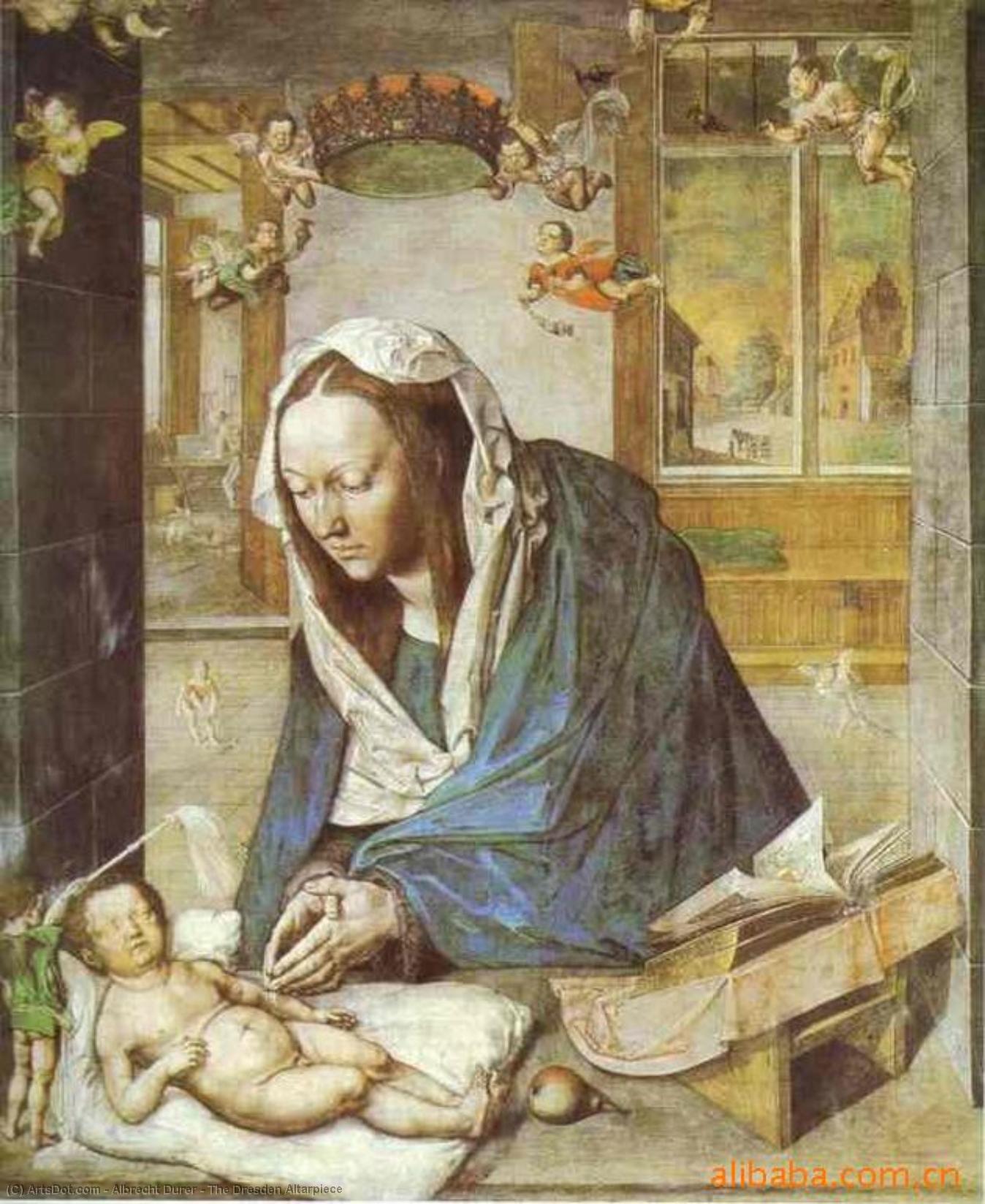
Albrecht Dürer’s "The Dresden Altarpiece" presents a poignant portrait of the Virgin Mary cradling baby Jesus, surrounded by angels and symbolic books – a masterpiece of the Northern Renaissance showcasing meticulous detail and religious devotion. Discover this iconic artwork and bring its timeless beauty into your space.
A Timeless Reverie: Albrecht Dürer's "The Dresden Altarpiece"
Albrecht Dürer’s “The Dresden Altarpiece,” a poignant depiction of the Virgin Mary cradling the infant Jesus, transcends mere portraiture; it is a profound meditation on faith, humility, and the sacred bond between mother and child. Executed by one of the most influential artists of the Northern Renaissance, this work embodies Dürer’s meticulous attention to detail, his mastery of perspective, and his deep understanding of symbolism – qualities that cemented his legacy as a true innovator.
- Subject Matter: The central focus is undeniably Mary, presented with an almost ethereal grace. Her posture conveys both tenderness and unwavering devotion, while the infant Jesus, lying peacefully at her feet, embodies innocence and vulnerability.
- Composition: Dürer employs a carefully constructed pyramidal composition, drawing the viewer’s eye directly to Mary and Christ. The flanking angels, positioned on either side, reinforce this central focus and contribute to the overall sense of harmony.
A Symphony of Technique – Dürer's Masterful Approach
Dürer’s technical prowess is immediately apparent in every aspect of “The Dresden Altarpiece.” He was a pioneer in printmaking, and his skill with woodcuts and engravings informed his painting. The use of oil paint allows for incredibly rich colors and subtle gradations – particularly noticeable in Mary's robes and the delicate rendering of Christ’s garments. His meticulous attention to detail is evident in the textures of the fabrics, the folds of Mary’s drapery, and the individual strands of hair on Christ’s head. The use of sfumato, a technique popularized by Leonardo da Vinci, adds an atmospheric haze, softening the edges and creating a sense of depth.
- Color Palette: Dürer favored a restrained yet luminous palette dominated by blues, reds, and golds – colors traditionally associated with royalty, divinity, and spiritual significance.
- Perspective & Detail: The precise rendering of perspective, combined with an almost obsessive attention to detail, creates a remarkably realistic portrayal of the figures and their surroundings.
Symbolism Woven into the Fabric of Faith
Beyond its aesthetic beauty, “The Dresden Altarpiece” is rich in symbolic meaning. The presence of books scattered around the scene alludes to Mary’s role as a scholar and her connection to biblical knowledge. The bowl at the base of Christ suggests nourishment – both physical and spiritual – while the angels represent divine messengers and protectors. Dürer's inclusion of these elements elevates the work beyond a simple depiction of the Madonna and Child, transforming it into a complex theological statement about faith, redemption, and the mysteries of the Christian narrative.
- The Book Motif: Represents Mary’s role as a learned figure and her connection to scripture.
- The Bowl: Symbolizes nourishment – both physical (for the infant) and spiritual.
A Legacy of Artistic Innovation
“The Dresden Altarpiece” stands as a testament to Albrecht Dürer’s genius and his pivotal role in shaping the course of Northern Renaissance art. Its influence can be seen in countless subsequent works, and its enduring appeal continues to captivate viewers centuries later. A hand-painted reproduction offers an unparalleled opportunity to experience the beauty and profound symbolism of this iconic masterpiece within your own space – a timeless reminder of faith, devotion, and the power of artistic vision.