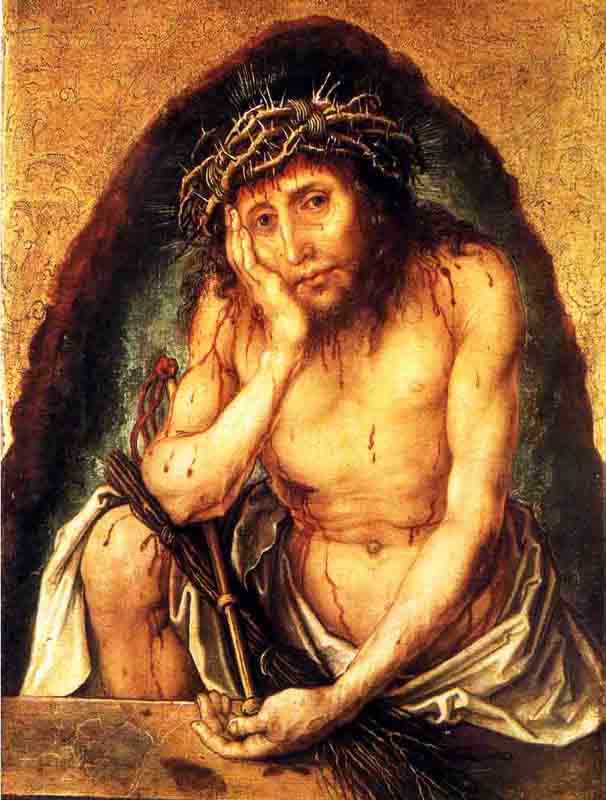
Experience Albrecht Dürer’s poignant ‘The Man of Sorrows,’ a Northern Renaissance masterpiece depicting Christ with a crown of thorns and bloodied forehead in a dramatic, dark setting – perfect for art lovers to discover or own.
The Man of Sorrows: A Profound Meditation on Suffering
Albrecht Dürer’s “The Man of Sorrows,” painted in Karlsruhe around 1500, is not merely a depiction of Christ; it's an intensely personal and profoundly moving exploration of human suffering. This arresting image, often interpreted as a self-portrait reflecting the artist’s own anxieties and spiritual struggles, immediately draws the viewer into a world of palpable grief and introspection. The composition itself – Jesus Christ with his head bowed, hands clasped to his face – is a direct echo of traditional depictions of the Pietà, yet Dürer imbues it with an unprecedented level of psychological depth. The dark, almost claustrophobic background amplifies the figure’s isolation, forcing us to confront the raw emotion radiating from him.
- Subject Matter: The central subject is undoubtedly Christ as the “Man of Sorrows,” a title derived from the Gospels describing his suffering during the Passion.
- Symbolism: The crown of thorns, blood dripping from the forehead, and the overall posture are laden with symbolic weight, representing sacrifice, pain, and redemption.
- Emotional Impact: Dürer masterfully evokes a sense of profound sorrow and empathy, inviting viewers to contemplate themes of mortality, guilt, and spiritual anguish.
Northern Renaissance Technique and Detail
Dürer’s mastery is immediately evident in the meticulous detail and technical brilliance of “The Man of Sorrows.” Executed during the height of the Northern Renaissance, this work showcases Dürer's innovative approach to printmaking and painting. The use of oil paints allows for a remarkable level of realism – the texture of the hair, the wrinkles on his brow, the sheen of the robe – all rendered with astonishing precision. Dürer’s meticulous attention to detail was revolutionary at the time, influenced by his extensive study of anatomy and his experimentation with woodcut techniques. The subtle gradations of tone achieved through layering and glazing demonstrate a sophisticated understanding of color theory and light, creating a sense of three-dimensionality that was uncommon for paintings of this period.
- Oil Paint Technique: Dürer’s use of oil paints allowed for nuanced shading and detail unattainable with tempera.
- Anatomical Accuracy: The figure's anatomy reflects Dürer's deep understanding of human form, achieved through careful observation and dissection.
- Woodcut Influence: Subtle elements suggest the influence of Dürer’s woodcut prints, particularly in the graphic quality of certain details.
Historical Context and Artistic Significance
"The Man of Sorrows" was created during a period of intense religious and intellectual upheaval in Europe. The late 15th and early 16th centuries witnessed a renewed interest in classical antiquity, alongside a fervent devotion to Christian faith. Dürer’s work reflects this complex interplay of influences, blending humanist ideals with deeply rooted religious symbolism. As one of the most influential artists of his time, Dürer's exploration of human emotion and spiritual themes paved the way for future generations of Renaissance painters. This particular version, painted in Karlsruhe, offers a unique perspective on Dürer’s artistic trajectory, showcasing his evolving style and deepening engagement with profound philosophical questions.
- Late Medieval/Early Renaissance: The painting exemplifies the transition between late medieval religious art and the burgeoning Renaissance.
- Humanist Influence: Dürer's focus on human emotion reflects the humanist emphasis on individual experience and moral responsibility.
- Dürer’s Innovation: This work demonstrates Dürer’s pioneering techniques in oil painting, printmaking, and his profound understanding of artistic principles.
A Timeless Masterpiece – Recreated for Today
ArtsDot offers a stunning hand-painted reproduction of “The Man of Sorrows,” capturing the essence of Dürer’s masterpiece with unparalleled fidelity. Each reproduction is created by skilled artisans, meticulously recreating every detail and nuance of the original painting. Whether you are an art collector seeking to expand your collection, an interior designer looking for a statement piece, or simply someone captivated by this iconic image, our hand-painted reproduction provides a beautiful and authentic representation of this timeless work of art. Experience the profound emotional impact of Dürer’s “The Man of Sorrows” in your own home.