A Celestial Symphony in Ink
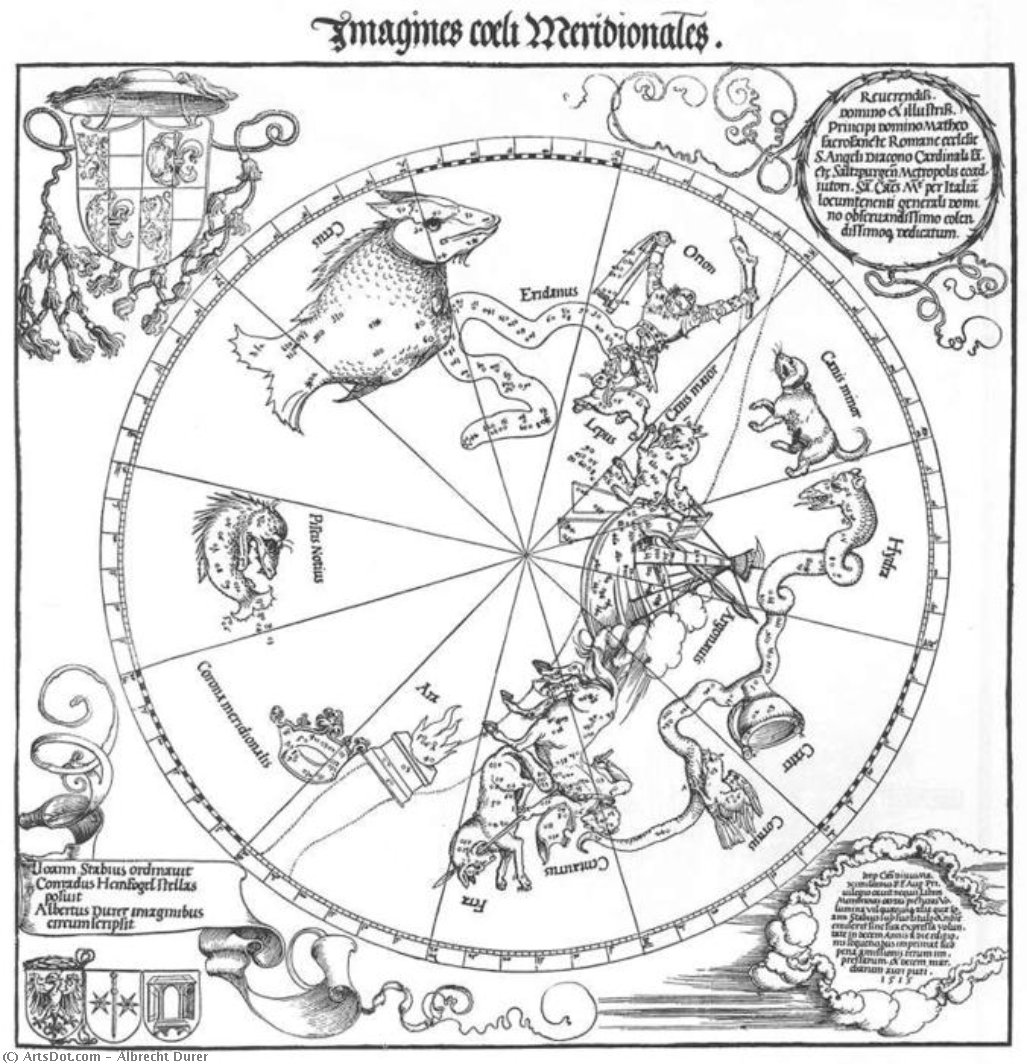
In the quiet intersection of scientific inquiry and artistic mastery, Albrecht Dürer’s “The Southern Hemisphere of the Celestial Globe” emerges as a breathtaking window into the Renaissance mind. Created in 1515, this exquisite work is far more than a mere astronomical chart; it is a profound meditation on the harmony of the cosmos. At first glance, the viewer is swept into a swirling dance of constellations, where the boundaries between the physical heavens and mythological legend dissolve. Dürer captures a moment in history when the world was expanding—not just geographically through maritime exploration, but intellectually through the burgeoning humanist movement. The piece serves as a silent witness to an era that sought to map the unknown, blending the rigorous observations of astronomers with the timeless beauty of classical myth.
The technical brilliance of this work lies in Dürer’s unparalleled command of the burin engraving technique. Every millimeter of the composition is alive with a rhythmic vitality born from meticulous hatching and cross-hatching. Through these fine, deliberate lines, the artist achieves a sculptural depth that defies the flat surface of the paper. There is a tactile quality to the way the light seems to catch the edges of the celestial figures; the density of the ink creates shadows that give weight to the animals and gods inhabiting the southern sky. For the discerning collector or interior designer, this monochrome mastery offers a sophisticated textural element, providing a sense of historical gravity and intellectual depth that can anchor any curated space.
The Architecture of the Heavens
Structurally, the composition is a marvel of radial symmetry and geometric precision. Dürer utilizes lines emanating from a central axis to divide the celestial sphere into distinct, navigable segments, much like the spokes of a cosmic wheel. This organized structure guides the eye in a continuous loop, mirroring the cyclical nature of planetary motion. Within these demarcated zones, we encounter a captivating cast of characters—Hercules, Perseus, and Andromeda—interwoven with various animal forms that represent the constellations. This deliberate juxtaposition of human anatomy and celestial beasts creates a visual narrative of interconnectedness, suggesting that the same laws governing the stars also govern the mortal realm.
Beyond its aesthetic allure, the artwork carries an emotional resonance of wonder and discovery. To gaze upon this globe is to experience the same sense of awe felt by the navigators and scholars of the 16th century. It evokes a period of profound curiosity, where every new star charted was a step toward understanding humanity's place in the grand design. For those looking to adorn their homes with art that inspires contemplation, this reproduction offers more than decoration; it provides a portal to an age of enlightenment. It is a piece that invites conversation, serving as both a scholarly reference to the Northern Renaissance and a timeless emblem of the human spirit’s eternal quest to map the infinite.