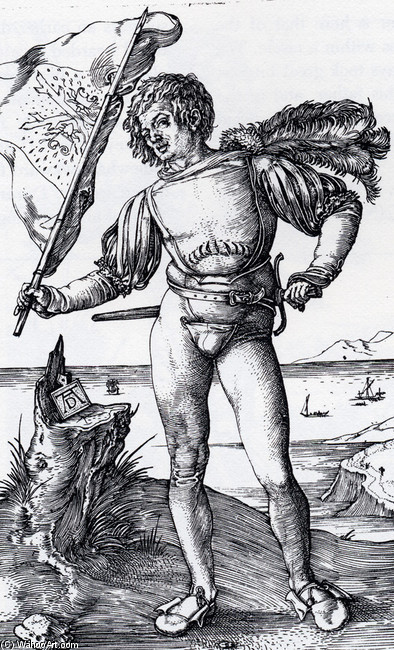
Experience Albrecht Dürer’s masterful ‘The Standard Bearer,’ a meticulously detailed black and white engraving showcasing the strength and authority of a Northern Renaissance military figure. This iconic portrait, rendered with precise linework and anatomical accuracy, offers a timeless glimpse into a pivotal moment in art history – discover or own this exceptional reproduction.
A Study in Resolve: Albrecht Dürer's 'The Standard Bearer'
Albrecht Dürer’s ‘The Standard Bearer,’ executed around 1524, is more than just a portrait; it’s a meticulously crafted meditation on power, duty, and the very essence of Renaissance humanism. This arresting engraving, rendered in stark monochrome with Dürer's signature precision, immediately commands attention with its dynamic composition and the unwavering gaze of its subject. The work exemplifies the Northern Renaissance style at its peak – a period defined by an almost obsessive dedication to realism, anatomical accuracy, and a profound understanding of perspective and light. Dürer’s mastery is evident in every carefully incised line, a testament to his relentless pursuit of technical perfection.
- Subject Matter: The central figure embodies the archetype of the military standard bearer, a role signifying leadership, loyalty, and the embodiment of an army's or noble house’s identity. The flag he holds, emblazoned with what appears to be a heraldic coat of arms, reinforces this symbolic weight.
- Technique: Executed as an engraving – a process demanding immense skill – ‘The Standard Bearer’ showcases Dürer's unparalleled control over the burin. The artist meticulously cut lines into a copper or steel plate, creating a matrix that was then inked and pressed onto paper to produce the final image. This technique allowed for incredibly fine detail and tonal variations achieved through varying line weights and densities.
Decoding the Lines: Technique and Composition
Dürer’s compositional choices are equally deliberate. The engraving is vertically oriented, emphasizing the figure's imposing stature and creating a sense of upward movement – a visual metaphor for aspiration and authority. The dynamic pose, with the flag held aloft, immediately draws the viewer into the scene. The landscape receding into the distance, rendered with linear perspective, adds depth and reinforces the feeling of vastness and perhaps even the weight of responsibility borne by the standard bearer. Note the subtle atmospheric perspective – details soften as they recede, further enhancing the illusion of three-dimensionality.
- Line Weight: Dürer masterfully employs a range of line weights to create depth and texture. Thick lines outline the figure’s musculature and the major elements of the flag, while finer lines depict details like the folds of his clothing and the intricate patterns on the banner.
- Cross-Hatching & Hatching: The extensive use of cross-hatching and hatching creates a remarkable illusion of shadow and volume, giving the figure a tangible presence despite its two-dimensional nature. This technique is crucial to understanding Dürer’s ability to simulate texture – from the roughness of stone to the softness of fabric.
Symbolism and Emotional Resonance
'The Standard Bearer' transcends a simple portrait; it’s laden with symbolic meaning. The figure’s confident stance, direct gaze, and unwavering grip on the flag project an image of strength, resolve, and unwavering loyalty. The inscription carved into the rocky outcrop – its precise meaning lost to time – likely held further significance within Dürer's original context, perhaps referencing a specific battle or historical event. The entire composition speaks to themes of duty, honor, and the burden of leadership—concepts deeply resonant with the Renaissance ideal of the virtuous citizen.
- Light & Shadow: The directional lighting, originating from the upper right, dramatically shapes the figure’s form, casting strong shadows that emphasize his musculature and contribute to a sense of realism.
- Historical Context: Dürer created this engraving during a period of significant political and military upheaval in Europe. The work reflects the anxieties and aspirations of the time, embodying the values of courage, discipline, and service – qualities highly valued by both rulers and soldiers.