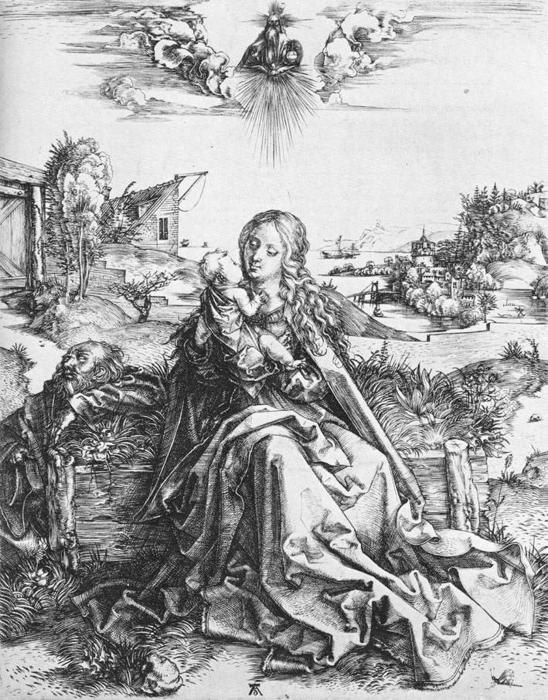
A Masterpiece of Line and Light
In the quiet, meticulous world of the Northern Renaissance, few works capture the delicate intersection of divine grace and earthly detail as profoundly as Albrecht Dürer’s “The Virgin with the Dragonfly.” Created around 1495, this exquisite engraving serves as a breathtaking testament to the technical brilliance of a young master finding his voice. At first glance, the viewer is drawn into a serene, monochromatic landscape where the sacred and the natural coalesce. The composition is anchored by a powerful pyramidal arrangement, with the Virgin Mary and the Christ Child positioned at the apex, radiating a sense of maternal tenderness and spiritual stability. This structural choice does more than provide balance; it directs the soul upward, mirroring the very ascent of prayer itself.
The artwork is a triumph of linear precision. Through the masterful use of hatching and cross-hatching, Dürer breathes life into a medium that lacks color. Every stroke of the burin needle serves a purpose, creating a rich tapestry of textures that range from the soft, heavy folds of Mary’s drapery to the rugged, organic complexity of the surrounding foliage. There is a palpable sense of touch within the print; one can almost feel the coolness of the stone structures and the lightness of the breeze moving through the distant trees. This incredible command over light and shadow—achieved solely through varying the density of black lines against the paper—creates a luminous atmosphere that feels both grounded in reality and elevated by divinity.
Symbolism and the Renaissance Spirit
Beyond its technical virtuosity, “The Virgin with the Dragonfly” is a dense thicket of theological meaning. In the tradition of the Northern Renaissance, every element of the natural world was often viewed as a mirror reflecting the divine. The landscape, teeming with life and architectural depth, suggests a universe that is ordered, purposeful, and watched over by a higher power. The presence of additional figures, perhaps saints or attendants, adds a layer of communal piety, suggesting that the grace of the Holy Family extends to all of humanity. Even the title itself hints at the ephemeral nature of life; the dragonfly, often associated with transformation and spiritual awakening, serves as a subtle metaphor for the soul's journey through the earthly realm toward eternal light.
For the discerning collector or interior designer, this piece offers much more than mere decoration. It provides a window into an era of profound intellectual and spiritual transition. The artwork’s ability to evoke tranquility and contemplation makes it a sophisticated addition to any curated space. Whether placed in a quiet study to inspire deep thought or as a focal point in a grand gallery, the print commands attention through its subtle complexity. Owning a high-quality reproduction of such a seminal work allows one to bring the disciplined beauty and historical weight of Dürer’s genius into the modern home, fostering an environment of timeless elegance and enduring peace.