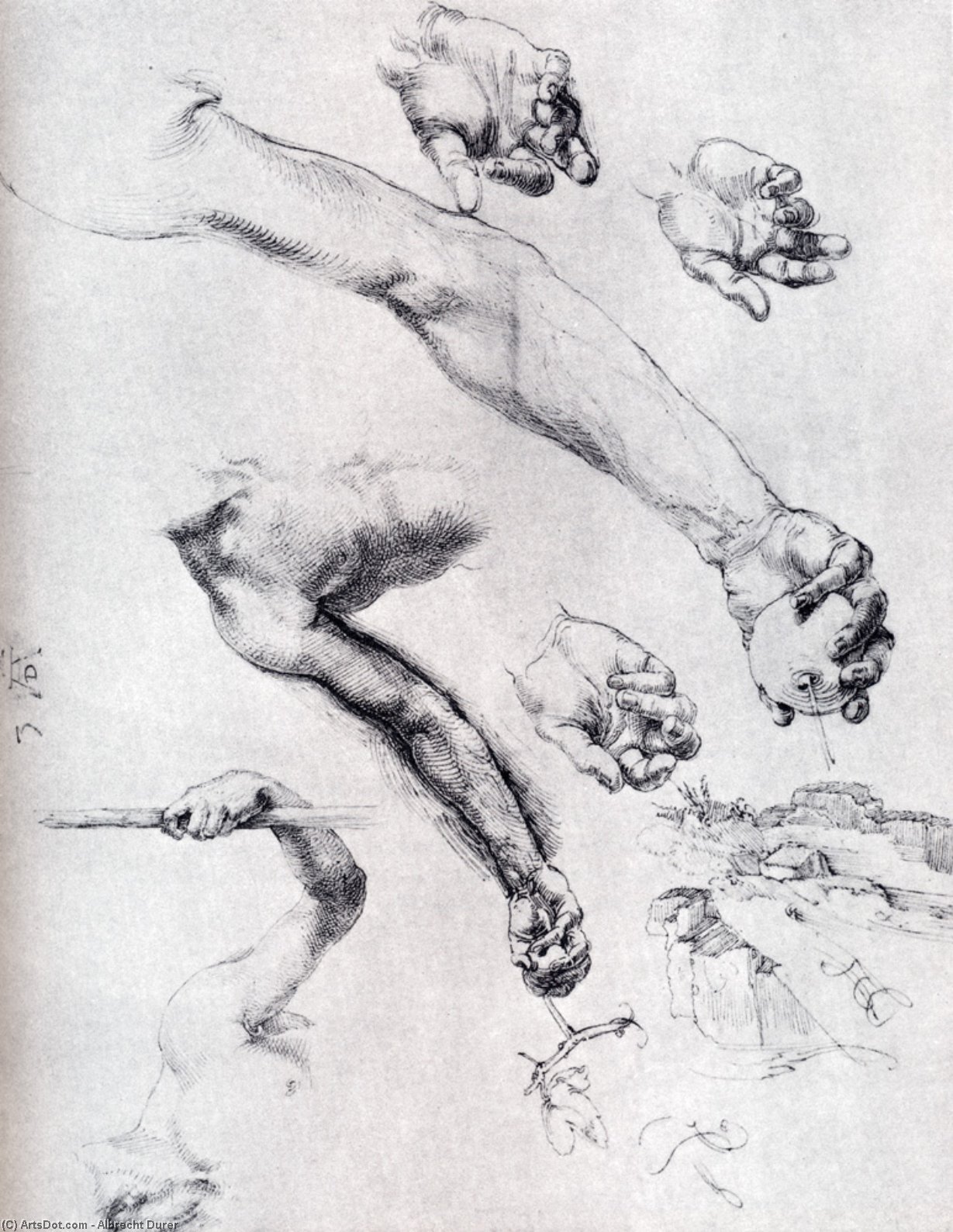
Albrecht Dürer’s intricate black and white engraving, ‘Three Studies From Nature For Adam’s Arms,’ showcases meticulous anatomical studies of human arms and birds in a Renaissance style. Explore this detailed masterpiece and bring its timeless beauty into your space.
A Study in Precision: Albrecht Dürer’s “Three Studies From Nature For Adam’s Arms”
Albrecht Dürer's "Three Studies From Nature For Adam’s Arms," created in 1504, is more than just a depiction of human anatomy; it’s a profound meditation on form, movement, and the very essence of observation. Executed as a masterful copperplate engraving, this work embodies the meticulous spirit of the Northern Renaissance, revealing Dürer's unparalleled skill and his relentless pursuit of artistic perfection. The image immediately captivates with its intricate detail – a dense tapestry of lines that build volume and texture, drawing the viewer into a world of precise observation. Three distinct studies of arms and hands dominate the composition, interspersed with delicate birds, each rendered with an astonishing level of realism.
Technique and Process: The Art of Copperplate Engraving
Dürer’s technique is central to understanding the impact of this artwork. Copperplate engraving demanded immense patience and control. He began by meticulously drawing the initial design onto a prepared copper plate using a sharp needle, creating thousands of tiny lines that would ultimately form the image. This process, known as *matrixing*, was incredibly laborious, requiring hours of painstaking work. The resulting plate was then inked – typically with oil-based inks – and carefully pressed onto paper to transfer the image. The density and spacing of these lines were crucial; closely spaced lines created areas of shadow and texture, while bolder strokes defined outlines and contours. This masterful manipulation of line weight and direction is what gives the engraving its remarkable sense of depth and dynamism. The inclusion of birds adds another layer of complexity, demonstrating Dürer’s ability to integrate natural elements into his meticulously planned compositions.
Historical Context and Symbolism
Created during a pivotal moment in Renaissance art, “Three Studies From Nature For Adam’s Arms” reflects the humanist ideals that were beginning to shape European thought. Dürer's intense interest in anatomical accuracy aligns with the broader trend of studying the human form through direct observation – a departure from purely allegorical or religious representations. The inclusion of birds is particularly intriguing, potentially symbolizing freedom, nature, or even spiritual concepts, reflecting the complex symbolism prevalent within Renaissance art. Dürer’s work was intended as studies for a larger project, “Adam and Eve,” further emphasizing its preparatory function and highlighting his dedication to achieving unparalleled realism in his depictions of the human figure.
Emotional Impact and Legacy
Beyond its technical brilliance, "Three Studies From Nature For Adam’s Arms" possesses a quiet emotional power. The sheer concentration required to produce this engraving – the hours spent meticulously crafting each line – imbues it with a sense of reverence for the subject matter. The work's enduring appeal lies in its ability to transport us back to a time when artistic skill was valued above all else, and when the pursuit of knowledge and beauty was considered a noble endeavor. Today, reproductions of this iconic engraving offer an opportunity to experience firsthand the genius of Albrecht Dürer and appreciate the profound impact of his work on the history of art.