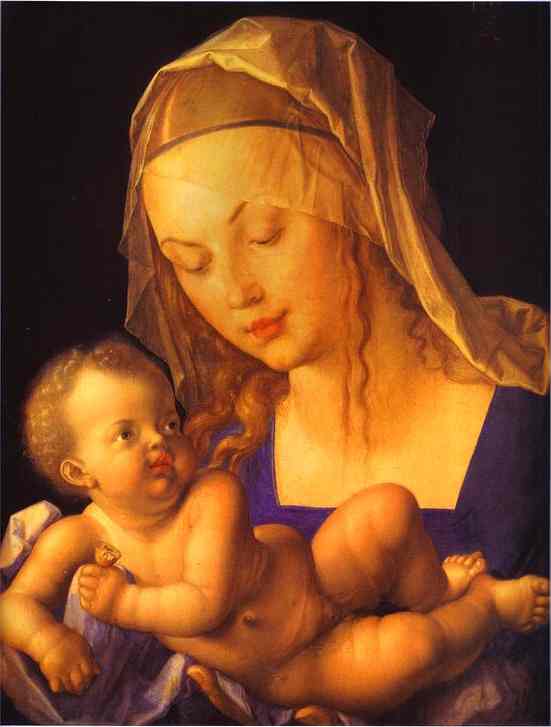
Albrecht Dürer’s "Virgin and Child with Half a Pear" captures the iconic Renaissance style with a serene depiction of Mary and Christ. This masterful work, dating from the 16th century, showcases Dürer's meticulous detail and profound artistic vision – discover this timeless masterpiece.
A Tender Reverie: Dürer's 'Virgin and Child with Half a Pear'
Albrecht Dürer’s ‘Virgin and Child with Half a Pear’ is not merely a depiction of the Madonna and Child; it’s an exquisitely rendered meditation on innocence, vulnerability, and the quiet beauty of the everyday. Painted during his intensely productive period in the late 15th century, this work exemplifies Dürer's mastery of detail, his profound understanding of human emotion, and his innovative approach to printmaking – a skill he honed relentlessly throughout his career. The painting’s unassuming subject matter—a young Mary cradling her infant son against a backdrop of simple domesticity—is elevated through Dürer’s meticulous observation and masterful execution.
Technical Brilliance and Printmaking Innovation
- Woodcut Technique: Executed as a woodcut, the image reveals Dürer's extraordinary control over this demanding medium. Woodcuts were known for their crisp lines and tonal range, but Dürer pushed these boundaries to an unprecedented degree. He employed intricate cross-hatching and burnishing techniques – carefully manipulating the pressure and direction of the cutting tools – to achieve a remarkable level of shading and depth, far exceeding what was typically expected from woodcut prints.
- Compositional Precision: The composition itself is deceptively simple yet remarkably balanced. Dürer’s use of perspective, though subtly applied, creates a sense of spatial realism, drawing the viewer into the intimate scene. The positioning of Mary, Christ, and even the pear – strategically placed to catch the light – demonstrates his keen eye for visual harmony.
- Detailed Rendering: Notice the incredible detail in the rendering of fabrics, hair, and facial features. Dürer’s meticulous attention to texture and form is a hallmark of his style, reflecting his dedication to capturing the essence of his subjects with unparalleled accuracy.
Symbolism and Narrative Depth
The inclusion of the pear itself is laden with symbolic meaning. Often interpreted as an allegory for the Virgin Mary’s purity and innocence, it represents a symbol of fertility and new life. The half-pear, in particular, adds a layer of poignant vulnerability to the scene – a reminder of mortality and the transient nature of beauty. The presence of the two additional figures, likely representing Joseph or other members of the family, expands the narrative beyond a purely devotional one, suggesting a domestic setting and highlighting the importance of familial bonds within Christian iconography.
Historical Context and Dürer’s Legacy
‘Virgin and Child with Half a Pear’ was created during a period of immense artistic and intellectual ferment in Europe. Dürer, working primarily in Nuremberg, was at the forefront of the German Renaissance, influenced by both Italian humanism and Northern European traditions. His work reflects this synthesis – blending classical ideals with a distinctly personal style. This piece is a testament to his ambition to elevate printmaking from a mere illustration technique to a fine art form, solidifying his place as one of the most influential artists of the 15th and 16th centuries. The painting’s enduring appeal lies in its ability to evoke a sense of timeless serenity and profound human connection.