A Glimpse of Triumph: Alexandre Cabanel’s ‘Esquisse pour Le Triomphe de Flore’
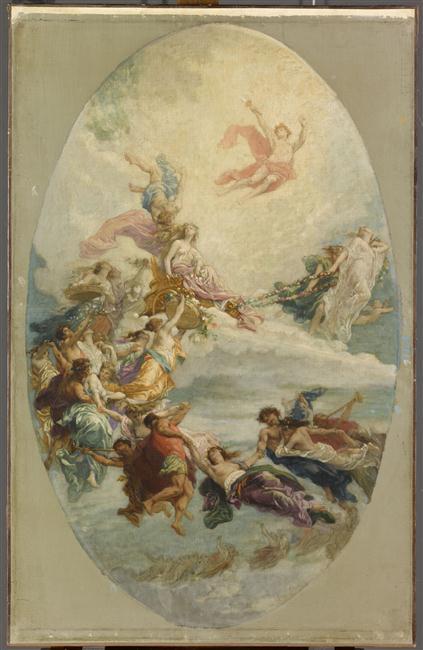
Alexandre Cabanel's 'Esquisse pour Le Triomphe de Flore,' a preparatory sketch for his monumental 1873 painting, offers a captivating window into the creative process behind one of the Musée du Louvre’s most celebrated works. More than just a preliminary study, this piece embodies the meticulous academic style that defined Cabanel's career – a style rooted in classical ideals and imbued with a profound sense of theatrical grandeur. The sketch itself is not merely unfinished; it’s brimming with potential, revealing the artist’s initial thoughts on composition, color, and the dynamic interplay between figures and atmosphere.
Cabanel's work belongs firmly within the context of 19th-century France, a period marked by a renewed interest in classical antiquity. Following the Romantic era, artists sought to restore order and harmony through a return to the principles of Greek and Roman art. Cabanel was a key figure in this movement, producing works that celebrated mythological subjects with an almost photographic realism – a hallmark of the academic tradition. His patrons, including Napoleon III, favored his ability to render idealized beauty and create scenes of immense scale and emotional impact. This sketch provides tangible evidence of how he approached these ambitious projects, starting with a carefully considered outline before embarking on the full-scale painting.
A Symphony of Pastel Hues and Fluid Lines
The immediate impression of ‘Esquisse pour Le Triomphe de Flore’ is one of ethereal beauty. The color palette is dominated by soft, muted tones – pale blues, delicate pinks, creamy whites, and subtle yellows – creating a dreamlike atmosphere reminiscent of a twilight sky. These pastel hues are not simply decorative; they contribute to the overall sense of serenity and grace that permeates the scene. Cabanel’s use of charcoal or pastel on paper is evident in the visible texture of the surface, with delicate layering and blending suggesting a deliberate effort to capture subtle gradations of light and shadow.
The lines are remarkably fluid and graceful, contributing significantly to the dynamic movement within the composition. Cabanel masterfully employs curved lines – particularly when depicting flowing drapery, swirling clouds, and the poses of his figures – to create a sense of continuous motion. These lines aren’t rigid or defined; instead, they possess an organic quality, mirroring the natural forms that populate the scene. The sketch reveals how he initially explored different arrangements of these curves before committing to the final design.
Deconstructing the Myth: Symbolism and Composition
At its core, ‘Esquisse pour Le Triomphe de Flore’ depicts a pivotal moment in Roman mythology – the triumphant return of Flora, the goddess of flowers and spring. The composition follows an oval format, emphasizing the circular motion inherent in the scene as Flora ascends on her chariot-like structure. Surrounding her are figures representing angels, allegorical representations of nature, and other celebrants, all contributing to a sense of joyous celebration. The lower portion of the sketch features additional figures, adding depth and complexity to the narrative.
Symbolically, the scene is rich with meaning. Flora herself represents spring, fertility, and beauty – qualities highly valued in 19th-century France. The angels likely symbolize divine favor or assistance, underscoring Flora’s elevated status. The overall composition conveys themes of triumph, ascension, and renewal—a potent message reflecting the era's aspirations for progress and prosperity.
A Study in Preparation: Technique and Materials
This sketch is a testament to Cabanel’s meticulous approach to artmaking. The loose sketching technique reveals a deliberate layering and blending of materials – likely charcoal or pastel sticks, perhaps subtly blended with a soft cloth or brush. The visible texture of the surface speaks to the artist's hands-on engagement with the medium, showcasing his process of building up form and value through multiple layers.
It’s important to note that this is not a finished artwork; rather, it’s a crucial step in Cabanel’s creative journey. The unfinished quality of the sketch—the exposed underdrawing, the areas where he experimented with different compositions—offers a rare glimpse into the artist's thought process and reveals the immense effort involved in realizing his grand vision for ‘Le Triomphe de Flore.’ A high-quality reproduction captures not only the beauty of the final painting but also the spirit of artistic exploration that fueled its creation.