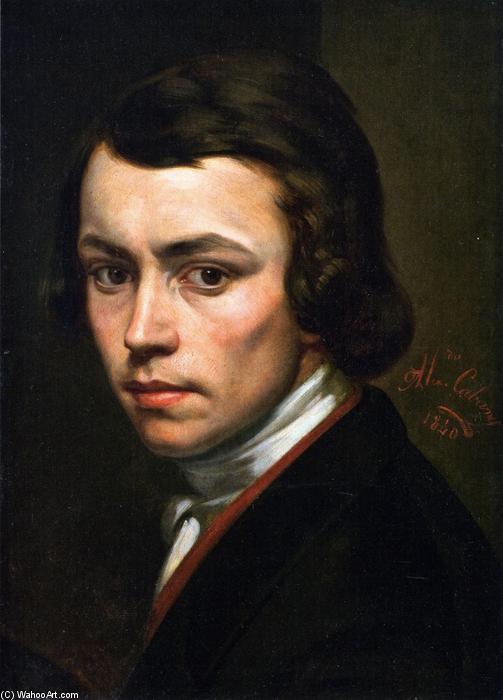
A Young Man’s Gaze: Alexandre Cabanel's ‘Self Portrait (aged 17)’
Alexandre Cabanel’s “Self Portrait (aged 17),” painted in 1840, is more than a simple depiction of a young man; it’s a carefully constructed meditation on youth, confidence, and the burgeoning artistic sensibilities of its creator. This intimate portrait, housed within the Musée Fabre in Montpellier, France, offers a rare glimpse into the formative years of an artist destined to become one of the most celebrated figures of 19th-century academic painting. The work immediately commands attention through its masterful use of chiaroscuro – the dramatic interplay of light and shadow – which sculpts Cabanel’s face with remarkable precision, drawing the viewer's eye directly into his intense gaze.
Cabanel, a native of Montpellier, began his artistic journey not within a traditional family of artists but as the son of a carpenter. This grounding in craftsmanship undoubtedly instilled a deep appreciation for material and form, qualities that would profoundly influence his approach to painting. The portrait itself is executed in oil on canvas, utilizing a restrained palette dominated by earthy tones – browns, ochres, and subtle hints of pink – which serve to heighten the impact of the light and shadow. The brushwork is deliberate and controlled, reflecting Cabanel’s commitment to academic training and his desire to achieve a sense of photographic realism, a hallmark of the Salon style prevalent at the time.
Decoding Symbolism and Technique
Beyond its technical brilliance, “Self Portrait (aged 17)” is rich in symbolic meaning. The young man’s direct gaze – unwavering and slightly challenging – suggests an emerging self-awareness and a nascent confidence. He isn't simply presenting himself; he’s engaging with the viewer, inviting contemplation. The carefully arranged folds of his white shirt and black vest contribute to a sense of formality and dignity, while the subtle details—the slight furrow in his brow, the hint of a smile—reveal a complex inner life. The inclusion of two figures in the background – seemingly observing him – adds another layer of intrigue, perhaps representing the influence of family or mentors on his artistic development.
Cabanel’s technique is particularly noteworthy for its meticulous attention to detail and its ability to capture the nuances of human expression. He employs a layering technique, building up thin glazes of paint to create subtle variations in tone and texture. This creates a remarkable sense of depth and realism, while also allowing him to manipulate light and shadow with extraordinary skill. The impasto – the raised application of paint – is particularly evident in areas such as his forehead and cheekbones, adding a tactile quality to the portrait and further emphasizing its three-dimensionality.
Historical Context: Academic Painting at its Zenith
“Self Portrait (aged 17)” was created during a period when academic painting reigned supreme in France. The Salon, the official art exhibition of the Académie des Beaux-Arts, served as the primary venue for showcasing artistic talent and determining trends. Cabanel’s work exemplifies the ideals of this era – its emphasis on classical principles, meticulous technique, and idealized representations of beauty and virtue. The portrait reflects a desire to capture not just a likeness but also an essence, a sense of character that resonated with contemporary audiences.
Interestingly, this self-portrait was painted at a pivotal moment in Cabanel’s career. He had already begun to establish himself as a promising artist, and the work can be seen as a demonstration of his skills and a statement of intent. It's a testament to his early ambition and foreshadows the monumental success he would achieve with works like “The Birth of Venus” and “Sacrifice of Iphigenia.”
A Timeless Portrait: Reproduction and Inspiration
Today, “Self Portrait (aged 17)” stands as a powerful example of academic painting at its finest. Its enduring appeal lies not only in its technical mastery but also in its ability to evoke a sense of empathy and connection with the viewer. ArtsDot offers high-quality reproductions that faithfully capture the nuances of Cabanel’s original work, allowing art lovers and collectors alike to appreciate this remarkable portrait for generations to come. Consider incorporating elements of its composition – the dramatic lighting, the direct gaze, the carefully rendered details – into your own interior design projects to create a space that is both elegant and evocative.