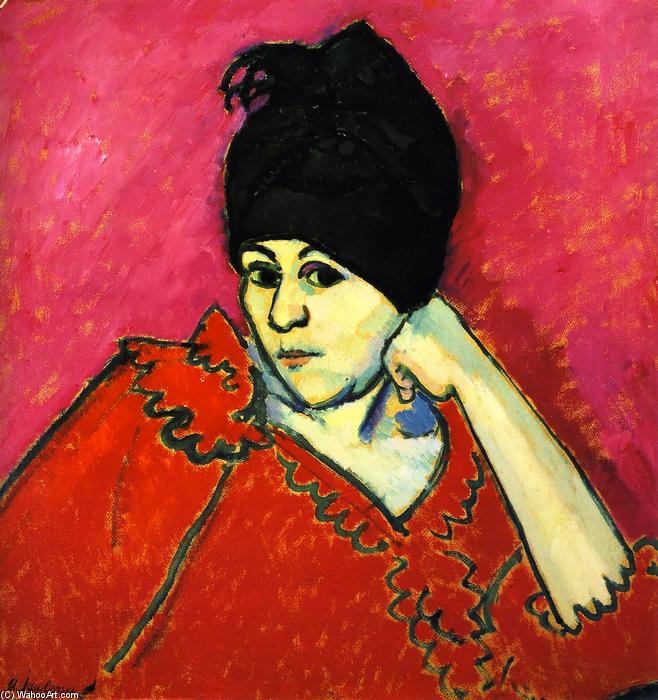
Dark Blue Turban (also known as Helene with Dark Blue Turban) – A Symphony of Emotion in Expressionism
Alexej Georgewitsch von Jawlensky’s “Dark Blue Turban,” painted in 1910, stands as a cornerstone of German Expressionist art. More accurately titled “Helene with Dark Blue Turban,” this oil on cardboard masterpiece transcends mere visual representation; it embodies the turbulent spirit of its era and delves into profound psychological depths.
- Subject Matter: The painting depicts Helene Schimmelmann, a German noblewoman known for her patronage of avant-garde artists. Her gaze is averted, conveying introspection and solitude – themes central to Expressionist exploration of the human condition.
- Style & Technique: Jawlensky’s distinctive style—characterized by bold color palettes and simplified forms—is evident throughout “Dark Blue Turban.” He employs loose brushstrokes and a flattened perspective, rejecting academic realism in favor of conveying emotion directly through visual elements. The dominant hue is a deep indigo, punctuated by subtle shades of grey and ochre, creating an atmosphere of melancholy and contemplation.
- Historical Context: Created during the formative years of Expressionism, “Dark Blue Turban” reflects the anxieties surrounding World War I and the burgeoning disillusionment with bourgeois values. The Blaue Reiter group—of which Jawlensky was a prominent member—challenged conventional artistic norms and sought to express inner turmoil through symbolic imagery.
- Symbolism: The dark blue turban itself serves as a potent symbol of mystery, spirituality, and perhaps even mourning. It draws inspiration from Orthodox iconography, reflecting Jawlensky’s personal faith and highlighting the movement's preoccupation with religious themes.
- Emotional Impact: Viewing “Dark Blue Turban” evokes feelings of quiet sadness, introspection, and profound contemplation. Its masterful use of color and brushwork captures the essence of psychological complexity—a hallmark of Expressionist art that continues to resonate with audiences today.
Provenance & Artistic Legacy
“Helene with Dark Blue Turban” resides in a private collection, demonstrating its enduring appeal beyond the confines of museum halls. Its influence extends across subsequent artistic movements, particularly Abstract Expressionism, where artists embraced similar techniques for conveying emotion and exploring psychological landscapes.
Reproductions & Artistic Appreciation
A high-quality reproduction of “Dark Blue Turban” can transform any interior space into a sanctuary of artistic contemplation. ArtsDot offers exceptional reproductions crafted by skilled artisans using archival pigments—preserving the original artwork’s vibrancy and nuance for generations to come.
Exploring Jawlensky's Oeuvre
To fully appreciate Alexej von Jawlensky’s artistic vision, delve deeper into his extensive body of work. Visit ArtsDot to discover reproductions of iconic pieces such as “Violet Turban,” “The Gardener (also known as Old Blue Beard),” and “Spanish Woman.”
Resources for Further Study
For scholarly insights into Expressionism and Jawlensky’s contribution, consult resources like Wikipedia: Alexej von Jawlensky – a Russian expressionist painter active in Germany. He was a key member of the Neue Künstlervereinigung München, Der Blaue Reiter group, and later Die Blaue Vier (“The Blue Four”).