A Portrait of Quietude: Alexej von Jawlensky’s “Lady in a Yellow Straw Hat”
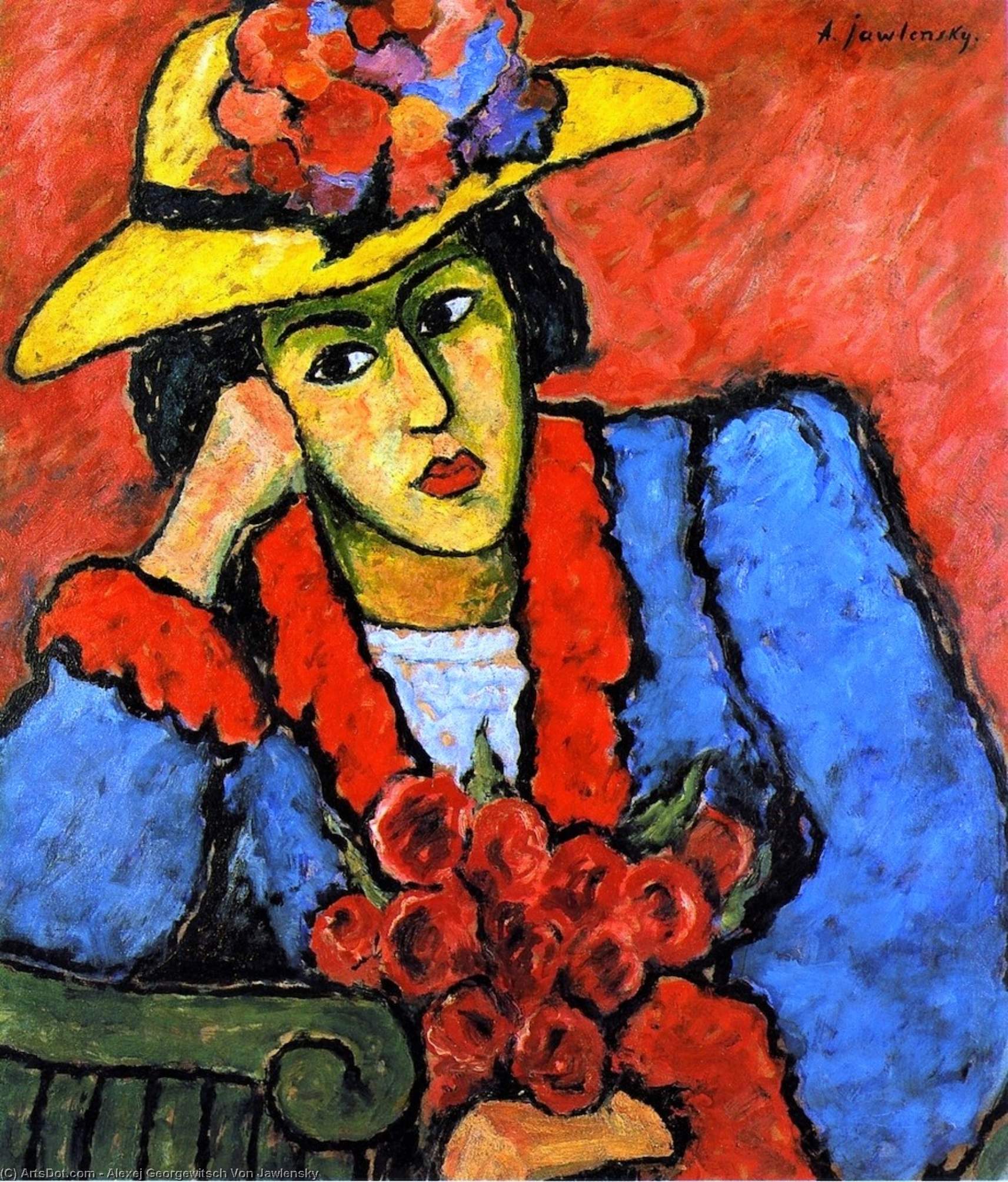
Alexej von Jawlensky's "Lady in a Yellow Straw Hat" (1910) isn't merely a painting; it’s an immersion into the heart of early Expressionism, a raw and intensely personal exploration of emotion rendered with a boldness that continues to resonate today. This oil on panel work captures a woman – identified only as “Lady” – in a moment of profound contemplation, her gaze fixed directly upon the viewer, inviting us into her private world. The painting’s power lies not in idealized beauty but in its unflinching portrayal of human vulnerability and the quiet intensity of inner experience.
Jawlensky's artistic journey was deeply rooted in his spiritual beliefs and a rejection of academic conventions. He sought to depict not what he *saw*, but what he *felt*, prioritizing emotional truth over photographic realism. This is immediately evident in the painting’s technique – thick, impasto brushstrokes build up layers of color, creating a tactile surface that vibrates with energy. The colors themselves are deliberately jarring, a deliberate departure from naturalism; the vibrant yellow of the hat and roses clashes dramatically with the cool blues and browns of her coat, amplifying the emotional tension within the scene.
The Echoes of Munich’s Artistic Circle
To fully appreciate “Lady in a Yellow Straw Hat,” it's crucial to understand its context. Jawlensky was a central figure in the artistic circles of Munich at the turn of the 20th century, particularly within the New Munich Artist’s Association (Neue Künstlervereinigung München) and the influential Der Blaue Reiter (The Blue Rider) group. This group challenged established artistic norms, embracing abstraction and exploring themes of spirituality, mythology, and psychological intensity. The Blue Rider's fascination with symbolism – evident in their use of color and imagery – profoundly influenced Jawlensky’s work, as seen here in the deliberate choice of the yellow straw hat, a motif frequently employed by the group to represent enlightenment and spiritual awakening.
His friendships with artists like Wassily Kandinsky and Gabriele Münter provided a fertile ground for experimentation. Jawlensky's style evolved rapidly during this period, moving from more traditional portraiture towards a highly expressive, almost primitive aesthetic. The painting’s simplified forms and intense color palette reflect the group’s desire to strip away superficial details and reveal the core essence of human emotion.
Symbolism Woven into the Fabric
Beyond its immediate emotional impact, “Lady in a Yellow Straw Hat” is rich with symbolic potential. The yellow straw hat itself has multiple layers of meaning – representing both protection from the sun (a symbol of enlightenment) and perhaps a fragile vulnerability. Her gaze, unwavering and direct, suggests a confrontation with truth or a profound understanding. The bouquet of red roses, traditionally associated with love and passion, introduces an element of yearning or desire into the scene. The two chairs in the background could represent isolation or contemplation, while the vase adds to the overall sense of domesticity and quietness.
Jawlensky’s deliberate use of these symbols invites viewers to engage actively with the painting, projecting their own interpretations onto the subject's face and posture. It is a portrait that demands attention, prompting reflection on themes of identity, emotion, and the human condition.
A Legacy of Emotional Intensity
"Lady in a Yellow Straw Hat" stands as a testament to Alexej von Jawlensky’s artistic vision – a bold, uncompromising exploration of emotional truth. Its enduring appeal lies not just in its technical brilliance but in its ability to evoke a powerful sense of empathy and understanding. Reproductions of this iconic work capture only a fraction of the original's impact, yet it remains a cornerstone of Expressionist art, continuing to inspire artists and captivate audiences with its raw intensity and profound psychological depth.