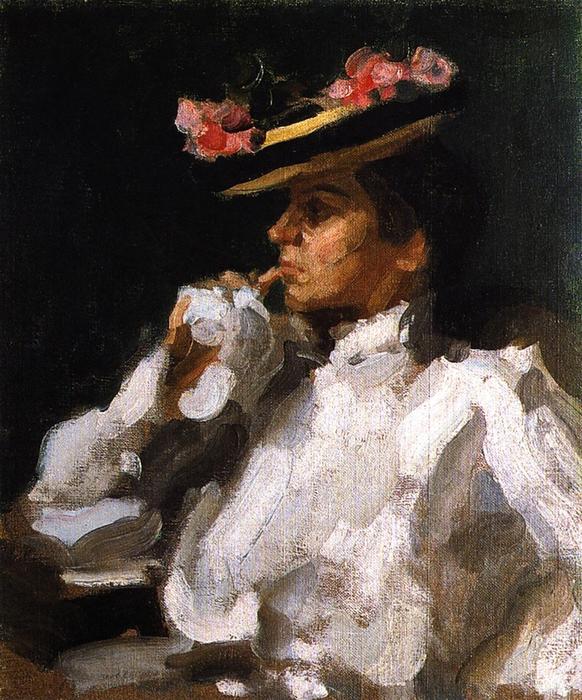
Experience Alexej von Jawlensky’s ‘Maria II,’ a raw Expressionist portrait of quiet intensity featuring a woman in ochre and red, capturing profound introspection through sharp lines and symbolic details – discover this iconic artwork.
Maria II – A Portrait of Quiet Intensity
Alexej von Jawlensky’s “Maria II” is not merely a depiction of a woman; it's an immersion into a carefully constructed emotional landscape. Painted in 1901, during a period of intense artistic experimentation and the burgeoning Expressionist movement, this portrait captures a moment of profound introspection. The subject, seated with a cigarette held delicately between her fingers, exudes a sense of contained melancholy – a feeling amplified by the simple yet powerful composition.
Jawlensky’s distinctive style is immediately apparent. He eschews traditional representational techniques in favor of bold, flattened forms and intensely saturated colors. The palette here leans heavily into ochres, browns, and muted reds, creating a sense of depth and shadow that draws the viewer's eye inward. Notice how he avoids softening edges; every line is deliberately sharp, contributing to the painting’s raw and unvarnished quality. This technique, rooted in his belief that art should directly confront the viewer with emotion, aligns perfectly with the core tenets of Expressionism.
The Language of Symbolism
Beyond its formal qualities, “Maria II” is rich in symbolic meaning. The woman’s posture – seated and contemplative – suggests a private moment of reflection. The hat adorned with flowers isn't simply an accessory; it subtly hints at themes of fragility, beauty, and perhaps even mortality. The scattered books are equally significant. They represent knowledge, experience, and the weight of thought—elements that contribute to the overall sense of quiet sadness. Jawlensky was deeply interested in exploring the psychological states of his subjects, and this painting is a testament to his ability to convey complex emotions through seemingly simple details.
Historical Context & The New Munich Circle
To understand “Maria II,” it’s crucial to consider its place within the artistic landscape of early 20th-century Germany. Jawlensky was a key member of the New Munich Artist's Association (Neue Künstlervereinigung München), a group that challenged the prevailing academic styles and sought to create art that was deeply personal and emotionally charged. This association, alongside his involvement with “Der Blaue Reiter” (“The Blue Rider”), positioned him at the forefront of artistic innovation. The influence of artists like Kandinsky and Munch is evident in Jawlensky’s use of color and form, reflecting a broader movement towards abstraction and subjective expression.
A Legacy of Emotional Intensity
“Maria II” remains a powerful example of Alexej von Jawlensky's artistic vision. It’s a painting that invites contemplation, prompting viewers to consider the complexities of human emotion and the enduring power of art to capture those moments of quiet intensity. This hand-painted reproduction offers an unparalleled opportunity to experience the raw beauty and emotional depth of this iconic work – a timeless portrait that continues to resonate with audiences today.