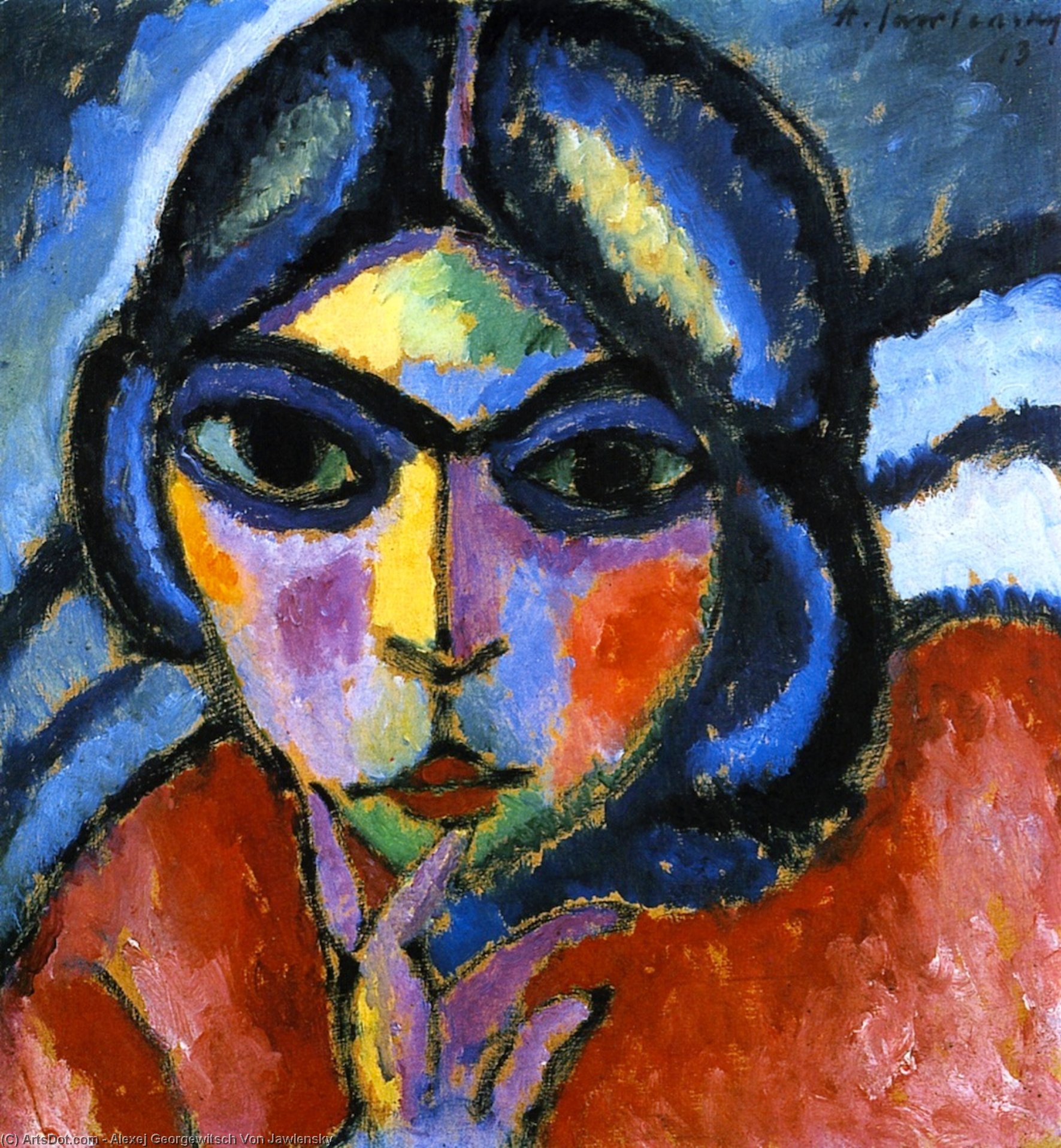
A Window into the Soul: The Expressive Power of Meditative Woman
In the realm of early twentieth-century modernism, few works capture the profound intersection of psychological depth and chromatic intensity quite like Alexej von Jawlensky’s 1913 masterpiece, Meditative Woman. This oil on panel work is far more than a mere portrait; it is an arresting emblem of the Expressionist movement, a period where artists sought to strip away the superficial layers of reality to reveal the raw, emotional truth beneath. As one gazes upon the subject, there is an immediate sense of being drawn into a private moment of introspection. The woman, with her long, flowing hair and a gaze that drifts toward an unseen horizon, embodies a quiet strength and a deep, internal dialogue. For the discerning collector or interior designer, this piece offers a captivating focal point that commands attention through its spiritual gravity rather than mere decorative flair.
The technical brilliance of Jawlensky lies in his ability to use color as a language of emotion. Moving away from the academic precision of his Russian training, Jawlensky embraced a vibrant, almost rhythmic palette dominated by crimson, ochre, and violet. These are not merely colors chosen for their beauty; they are carefully selected pigments intended to vibrate against one another, creating a sense of movement and life within the stillness of the subject's pose. The artist employs a masterful technique of thick impasto, where layers of paint are applied with such confidence that the canvas takes on a palpable, physical texture. This tactile quality adds a layer of complexity to the work, allowing light to catch the ridges of the brushstrokes and lending a sense of urgency and vitality to the woman's contemplative expression.
Historical Resonance and Symbolic Depth
To understand Meditative Woman, one must consider the turbulent era of its creation. Painted in 1913, on the precipice of profound global upheaval, the painting reflects a world in transition. Jawlensky, a pivotal figure in groups such as Der Blaue Reiter, utilized the distorted forms and heightened colors characteristic of Expressionism to mirror the existential anxieties of the age. The elongated features of the face and the simplified, bold outlines serve to de-emphasette the physical likeness in favor of a psychological portrait. In this way, the subject becomes an archetype for the human condition—a symbol of solitude, spirituality, and the search for meaning amidst chaos.
For those looking to integrate such a profound work into a curated space, Meditative Woman provides an unparalleled opportunity to introduce narrative depth. Whether placed in a contemporary gallery setting or as a soulful centerpiece in a sophisticated residential study, the painting acts as a catalyst for conversation and reflection. It does not simply occupy space; it transforms it, inviting anyone who encounters it to pause, breathe, and engage in their own moment of meditation. Owning a high-quality reproduction of this Jawlensky treasure allows the enduring legacy of Expressionist emotion to reside within your personal collection, offering a timeless connection to one of art history's most evocative eras.