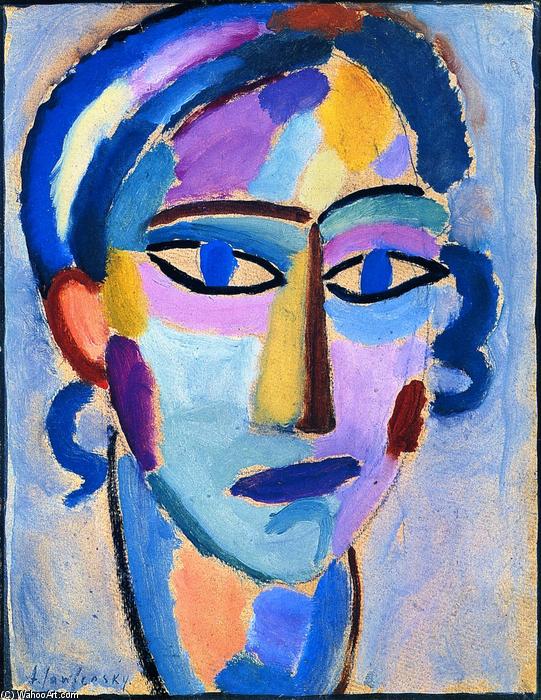
Alexej von Jawlensky’s ‘Mystical Head: Opal’ – A Window into the Soul
Alexej von Jawlensky's “Mystical Head: Opal,” painted in 1917, is not merely a portrait; it’s an intensely personal and profoundly moving exploration of the human spirit. This striking work, dominated by blues, purples, and pinks, exemplifies the artist’s signature style – a raw, emotionally charged expressionism that sought to bypass representational accuracy in favor of conveying inner experience. The subject, a woman with piercing blue eyes, a delicate purple mouth, and a softly pink nose, appears lost in contemplation, her gaze directed towards an unseen point beyond the canvas, inviting the viewer into her private world.
The Expressionist Vision
Created during a pivotal moment in art history – the burgeoning of early 20th-century Expressionism – “Mystical Head: Opal” reflects the movement’s core tenets. Jawlensky, deeply influenced by Russian icon painting and his own spiritual convictions, rejected academic conventions, prioritizing direct emotional impact over meticulous detail. The bold brushstrokes, the vibrant yet somewhat discordant colors, and the simplified forms all contribute to a sense of urgency and unrestrained feeling. This wasn't about capturing a likeness; it was about distilling the essence of a soul – a characteristic deeply rooted in Jawlensky’s artistic practice.
A Biographical Context: The Artist’s Journey
Born Alexej Georgewitsch von Jawlensky in 1864 in Torzhok, Russia, Jawlensky's life was one of constant movement and transformation. Initially trained as a military man, he abandoned this path after encountering the vibrant artistic scene at the 1880 Moscow World Exposition. His subsequent studies in St. Petersburg, under the tutelage of Ilya Repin, provided a foundation before he fully embraced his own unique vision. A key element of his story is his relationship with Marianne von Werefkin, who became not just a mentor but a lifelong companion and collaborator. Their shared artistic journey, culminating in their relocation to Munich in 1894, fueled the development of Jawlensky’s intensely personal style. The period surrounding “Mystical Head: Opal” – marked by his involvement with groups like Die Blaue Vier – represents a peak of this expressive intensity.
Symbolism and Emotional Resonance
The title itself, "Mystical Head: Opal," hints at the work’s deeper symbolic layers. The opal, known for its shifting colors and ethereal beauty, suggests transformation, illusion, and hidden depths—qualities that resonate powerfully within the portrait. The woman's gaze, so intently focused beyond the frame, evokes a sense of longing, perhaps even spiritual seeking. Jawlensky masterfully uses color to amplify these emotions; the blues and purples convey melancholy and introspection, while the pink adds a touch of vulnerability and tenderness. The overall effect is one of profound emotional intensity, inviting viewers to contemplate themes of identity, faith, and the human condition.