Alexej von Jawlensky’s ‘Portrait’: A Raw Expression of the Soul
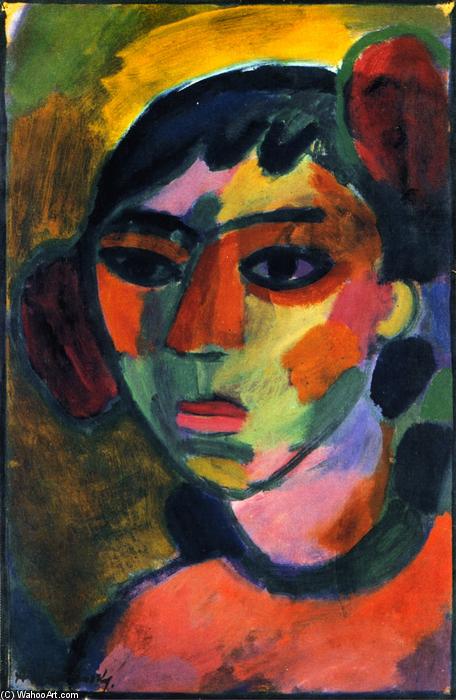
This arresting portrait by Alexej von Jawlensky, painted in 1916, is not merely a representation of a woman; it's a visceral encounter with raw emotion and an intensely personal vision. Executed during a pivotal moment in his career – a period marked by profound shifts in artistic focus – the painting embodies Jawlensky’s signature style: a brutal honesty rendered through simplified forms, bold color, and a deliberate avoidance of illusionistic depth. The subject, identified as Galka (Emmy Scheyer), becomes less an individual and more a conduit for the artist's deeply felt responses to the world around him.
Jawlensky’s work in this era was profoundly influenced by his experiences within various artistic circles – the New Munich Artist’s Association, Der Blaue Reiter, and later Die Blaue Vier. These groups championed a rejection of academic conventions, advocating for art that prioritized direct emotional expression over representational accuracy. His time with Wassily Kandinsky and Gabriele Münter in the Bavarian Alps further solidified this approach, fostering experimentation with color and form as tools to evoke spiritual and psychological states. The yellowish hue dominating the background isn’t simply a decorative element; it contributes to a sense of unease and introspection, mirroring the emotional intensity of the figure.
The Language of Expressionism
The painting firmly establishes itself within the burgeoning movement of Expressionism, a reaction against the perceived superficiality of Impressionism. Jawlensky’s technique is characterized by thick impasto – layers of paint applied with vigorous brushstrokes – creating a textured surface that vibrates with energy. The simplification of form, particularly in the face, directs the viewer's attention to the eyes, which are rendered with an almost unnerving directness. This focus on the gaze is crucial; it’s not a polite or welcoming look but one of unwavering intensity, suggesting a profound awareness and perhaps even a guarded vulnerability. The red dress, a bold and unconventional choice, further amplifies this dramatic effect, acting as a focal point that draws the eye and adds to the overall sense of urgency.
Symbolism and Spiritual Resonance
Beyond its purely formal qualities, the portrait resonates with deeper symbolic meanings rooted in Jawlensky’s spiritual beliefs. Born in Torzhok, Russia, he carried within him a strong connection to Orthodox traditions, evident in the subtle nods to iconographic conventions – particularly the direct gaze and the simplified representation of the face. This isn't a secular portrait; it’s an attempt to capture something beyond the physical appearance of Galka, hinting at a deeper spiritual essence. The painting can be interpreted as a meditation on faith, doubt, and the search for meaning in a turbulent world – themes that were central to Jawlensky’s artistic concerns throughout his life.
A Window into a Master's Vision
This reproduction offers an unparalleled opportunity to experience the power and emotional depth of Alexej von Jawlensky’s work. Hand-painted with meticulous attention to detail, it captures not just the likeness of the subject but also the very spirit of the artist’s vision. Whether displayed in a private collection or incorporated into a thoughtfully curated interior design scheme, this portrait will undoubtedly serve as a powerful and enduring statement – a testament to Jawlensky's legacy as one of the most significant figures in early 20th-century art.