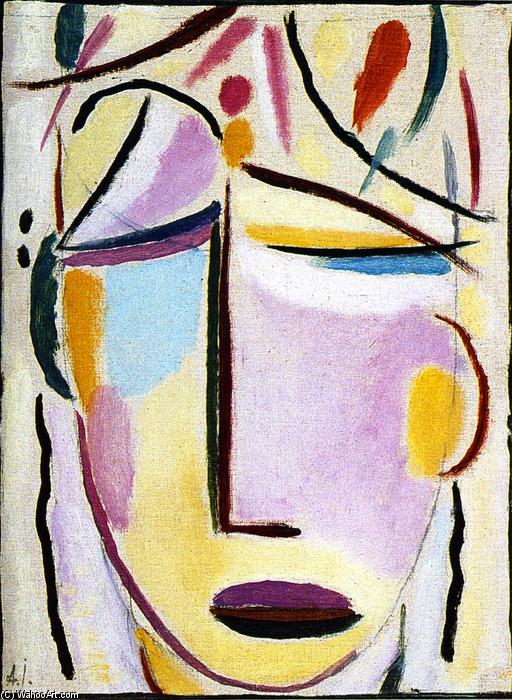
This enigmatic painting by Alexej von Jawlensky, titled "Savior’s Face," showcases a distorted visage against a purple backdrop. Featuring prominent eyes and nose, it captures an unsettling expression—a testament to Jawlensky's Expressionist style and his exploration of psychological depth.
Delve into Alexej von Jawlensky's haunting "Savior’s Face," a striking Expressionist portrait embodying pro
A Portrait of Sorrow: Exploring Alexej von Jawlensky’s “Savior’s Face”
Alexej von Jawlensky's "Savior's Face," completed in 1921, stands as a cornerstone of Expressionist art—a testament to the artist’s profound engagement with emotion and spirituality. More than just a depiction of human visage, it embodies a complex tapestry of psychological exploration interwoven with stylistic innovation, offering viewers an enduring invitation to contemplate themes of suffering and transcendence.
The painting immediately captivates with its arresting palette – predominantly shades of purple and ochre—a deliberate choice that eschews conventional realism in favor of conveying inner turmoil. Jawlensky’s signature technique involves layering thick impasto strokes onto the canvas, creating a textured surface that pulsates with palpable energy. This physicality isn't merely decorative; it serves as an integral component of communicating the artist’s emotional state—a deliberate rejection of academic precision for a visceral representation of feeling. The geometric abstraction employed contributes to this effect, fracturing the face into angular planes that heighten its sense of distortion and vulnerability.
Historically situated within the burgeoning Expressionist movement of the early 1920s, “Savior's Face” reflects the anxieties and spiritual uncertainties prevalent during the period following World War I. Artists like Jawlensky sought to bypass rational thought and access primal emotions—a reaction against the perceived sterility of bourgeois culture and a yearning for connection with something beyond the material world. The influence of Buddhist iconography is evident in the stylized depiction of the face, specifically the gaze – unnervingly serene yet hinting at profound sorrow. This deliberate allusion speaks to the artist’s preoccupation with confronting mortality and accepting inevitable suffering as an unavoidable aspect of existence.
The painting's emotional impact remains powerfully resonant today. It compels contemplation on themes of resilience and acceptance—a reminder that beauty can emerge from darkness, and that confronting difficult truths is essential for achieving inner peace. Collectors appreciate “Savior’s Face” not only for its artistic merit but also for its ability to evoke a deeply felt response in the viewer. Interior designers recognize its potential to infuse spaces with an atmosphere of contemplative solemnity—a visual statement that transcends mere decoration and engages the soul.
- Artist: Alexej von Jawlensky
- Year Created: 1921
- Medium: Oil on Canvas
- Style: Expressionism
Symbolic Resonance
The purple hue dominating the background is often interpreted as representing spiritual contemplation and mourning—a visual embodiment of the artist’s internal struggles. The angular planes of the face symbolize fragmentation and vulnerability, mirroring the psychological complexities inherent in confronting existential questions.
Technique & Texture
Jawlensky's masterful impasto technique – applying paint thickly onto the canvas – creates a surface that invites tactile engagement and amplifies the painting’s emotional intensity. This deliberate disregard for conventional artistic conventions underscores Expressionism’s commitment to conveying feeling above all else.