The Profound Echoes of Torzhok: Alexej von Jawlensky’s “Savior’s Face”
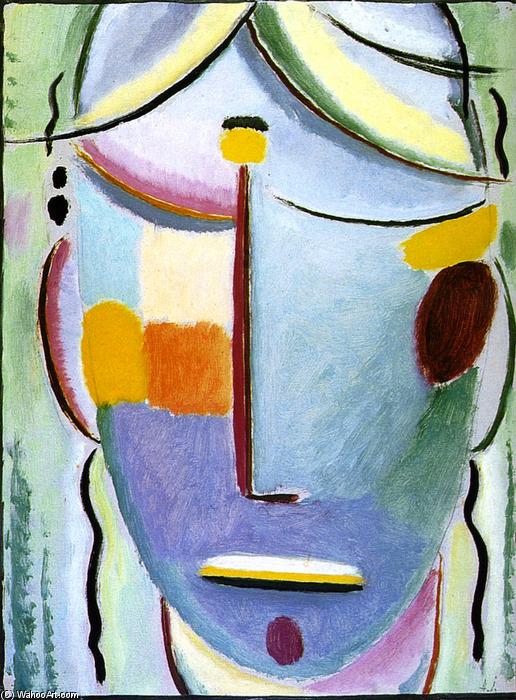
Alexej von Jawlensky's "Savior’s Face," painted in 1920, is not merely a depiction of a human visage; it’s a raw, intensely felt distillation of the artist’s lifelong struggle with faith, doubt, and the very essence of human emotion. Born in Torzhok, Russia – a name that itself carries a weight of history and spiritual significance – Jawlensky's artistic journey was profoundly shaped by his origins. This painting, with its stark blue background and deliberately fractured features, embodies the core tenets of his Expressionist style: an unflinching commitment to conveying inner experience rather than objective reality. The work’s power resides in its ambiguity; is it a portrait of a savior figure, a meditation on suffering, or perhaps a self-portrait stripped bare? Jawlensky intentionally avoids offering easy answers, inviting the viewer into a deeply personal and unsettling contemplation.
The technical execution of “Savior’s Face” is as crucial to its impact as its subject matter. Jawlensky employed a technique characterized by thick impasto – layers of paint applied with vigorous brushstrokes – creating a tactile surface that vibrates with energy. The blue background, far from being merely decorative, acts as a visual void, amplifying the intensity of the face and isolating it within a realm of profound solitude. His use of color is similarly deliberate; the blues evoke a sense of melancholy and spirituality, while the simplified forms – the two prominent eyes, the nose, and the mouth – are rendered with an almost brutal directness, devoid of sentimentality or idealized beauty. This approach aligns perfectly with his rejection of academic conventions and his desire to tap into primal emotions.
A Figure Rooted in Russian Iconography
Jawlensky’s artistic development was deeply influenced by the religious art of his childhood in Russia. Like many Orthodox Christians, he would have been familiar with the iconic tradition – images of Christ, Mary, and other saints – which served as a powerful means of spiritual connection. “Savior’s Face” can be seen as a direct response to this visual language, albeit one radically transformed through the lens of Expressionism. The simplified features, reminiscent of traditional icons, are not intended to represent a specific individual but rather to evoke a universal sense of humanity's need for salvation and redemption. The deliberate distortion adds another layer of meaning, suggesting that true faith cannot be captured by conventional representations; it must be experienced directly.
Contextualizing the Artist: The New Munich Group
Understanding Jawlensky’s work requires acknowledging his involvement with key artistic movements of the early 20th century. A member of the New Munich Artist's Association (Neue Künstlervereinigung München) and later, the “Blue Rider” group (Der Blaue Reiter), he was part of a vibrant circle of artists experimenting with abstraction and exploring new ways to express emotion through color and form. The Blue Rider’s emphasis on spirituality and their rejection of representational art aligned perfectly with Jawlensky's own artistic goals. His time within this influential group exposed him to the ideas of Wassily Kandinsky, Franz Marc, and others, further enriching his already complex artistic vocabulary. This context highlights “Savior’s Face” not just as a solitary work but as part of a broader movement challenging established norms in European art.
Emotional Resonance & Reproduction
"Savior's Face" continues to resonate with viewers today because it speaks to fundamental human concerns – faith, suffering, and the search for meaning. ArtsDot offers meticulously crafted hand-painted reproductions that capture not only the visual details of this powerful artwork but also its emotional intensity. Each reproduction is created by skilled artisans who employ similar techniques to those used by Jawlensky himself, ensuring an authentic representation of his vision. Whether displayed in a private collection or incorporated into interior design, this reproduction offers a tangible connection to one of the most significant figures of early 20th-century art – a testament to Alexej von Jawlensky’s enduring legacy.