Alexej von Jawlensky: A Vision of Spiritual Depth
Alexej Georgewitsch von Jawlensky (1864 – 1941) stands as one of the most distinctive voices within early twentieth-century Expressionism, a movement characterized by its fervent rejection of academic conventions and its unwavering commitment to conveying raw emotion. Born in Torzhok, Russia, Jawlensky’s formative years were marked by constant relocation—a journey that instilled within him an awareness of displacement and arguably fueled his artistic preoccupation with themes of solitude and inner turmoil.
His artistic trajectory began with a military commission, but it swiftly pivoted toward painting after encountering the vibrant atmosphere of the 1880 Moscow World Exposition. This pivotal encounter ignited a passion for visual expression that would dominate his subsequent life’s work, propelling him into the vanguard of avant-garde art circles.
Jawlensky's artistic style is instantly recognizable: characterized by bold simplification and an almost obsessive focus on geometric forms—particularly circles and squares—he eschewed illusionistic representation in favor of conveying spiritual essence. His palette leaned heavily toward muted blues and reds, colors he believed possessed inherent symbolic power, reflecting his profound interest in mysticism and religious iconography.
Savior’s Face: Starlight – A Meditation on Faith
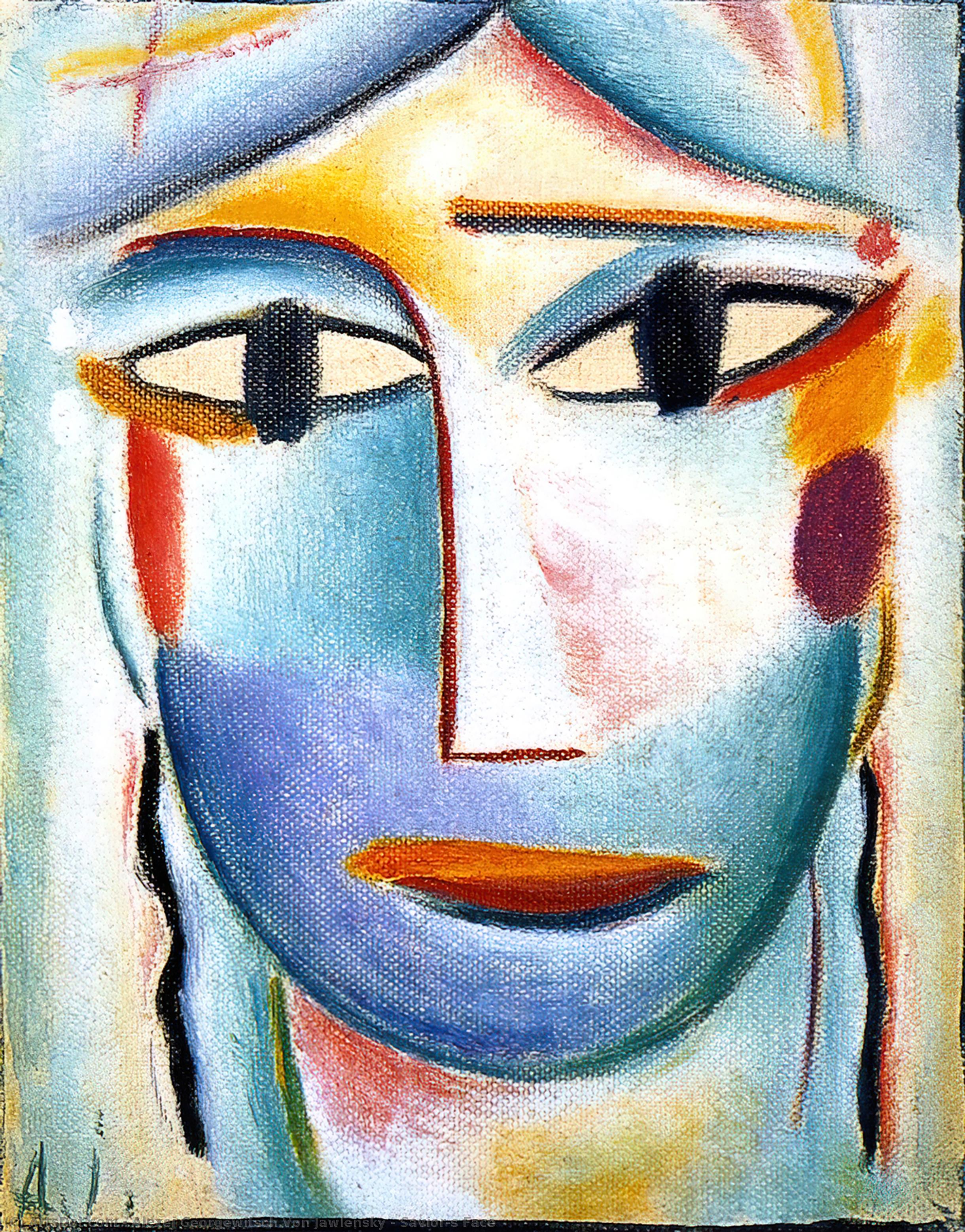
"Savior's Face," painted circa 1922, exemplifies Jawlensky’s signature approach. This striking lithographic crayon piece captures a head of Christ rendered with meticulous detail—yet devoid of conventional realism. The artist employs a masterful technique of layering crayon onto wove paper, creating textured surfaces that amplify the emotional resonance of the image.
The dominant hues are deep blues and reds, mirroring the biblical symbolism of divine compassion and sacrifice. Jawlensky’s deliberate distortion—a hallmark of Expressionism—serves not to deceive but rather to heighten the viewer's sensitivity to the spiritual core of the subject matter. The composition is strikingly austere, emphasizing the solemnity of contemplation.
The Influence of Der Blaue Reiter
Jawlensky’s involvement with “Der Blaue Reiter” (The Blue Rider), a German Expressionist group founded by Wassily Kandinsky and Franz Marc, profoundly shaped his artistic vision. This collective championed abstraction as a means of accessing spiritual truths beyond the confines of observable reality—a stance that resonated deeply with Jawlensky’s own philosophical convictions.
“Der Blaue Reiter” encouraged artists to explore unconventional materials and techniques, fostering experimentation and challenging established aesthetic norms. Jawlensky embraced this spirit of innovation, consistently pushing boundaries in his pursuit of artistic expression. His work continues to inspire admiration for its uncompromising honesty and its ability to convey profound emotional depth.
A Legacy of Emotional Intensity
Alexej von Jawlensky’s oeuvre remains a testament to the transformative power of art—a realm where emotion reigns supreme, and visual language transcends mere representation. “Savior's Face,” like many of his other paintings, embodies this legacy, inviting viewers into a contemplative dialogue with themes of faith, solitude, and spiritual yearning.
Reproductions of Jawlensky’s masterpieces offer an opportunity to experience firsthand the artist’s distinctive aesthetic—a captivating blend of geometric precision and emotive color that speaks directly to the soul. Explore the beauty and complexity of Expressionism through a stunning rendition of this iconic artwork.