Alexej von Jawlensky’s ‘Savior’s Face: Black Buddha’ – A Descent into Raw Emotion
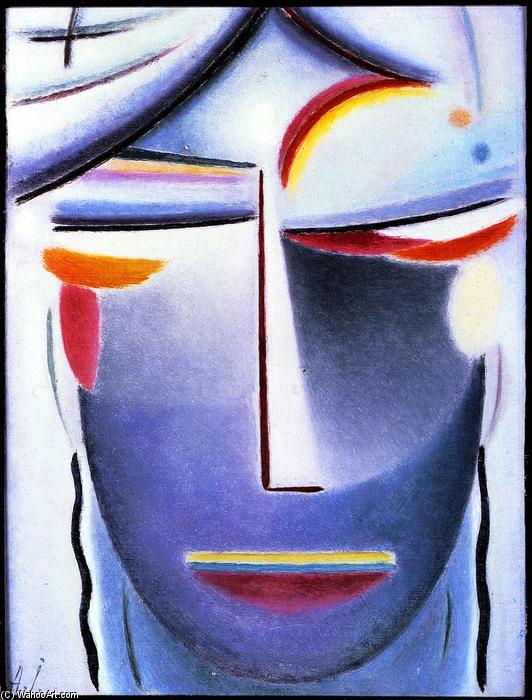
The painting “Savior’s Face: Black Buddha,” created around 1921 by the intensely private and profoundly influential Alexej von Jawlensky, is not a portrait in the conventional sense. It's an excavation of the soul, a concentrated distillation of emotion rendered with a brutal honesty that defines Jawlensky’s entire oeuvre. This work, dominated by a stark blue background and a deliberately distorted face, invites viewers into a realm where recognizable form yields to primal feeling – a characteristic hallmark of the Expressionist movement.
Jawlensky, born in Torzhok, Russia, arrived in Germany during a period of immense artistic upheaval. Initially trained as a military doctor, he abandoned that path after an encounter with art at the 1880 Moscow World Exposition. His subsequent career was marked by a relentless pursuit of authentic expression, rejecting academic conventions and embracing a deeply personal visual language. He became a key figure within the New Munich Artist’s Association (Neue Künstlervereinigung München), the Der Blaue Reiter (“The Blue Rider”) group, and later Die Blaue Vier (“The Blue Four”), movements all dedicated to exploring the expressive potential of color and form.
A Face of Unyielding Intensity
The subject of “Savior’s Face: Black Buddha” is a powerfully rendered head – or perhaps more accurately, a mask – of profound sorrow and contemplation. The features are deliberately fragmented; a prominent nose, a simplified mouth, and two strikingly placed eyes convey an unsettling sense of vulnerability and inner turmoil. Jawlensky's technique here is characterized by thick, impasto brushstrokes applied with a forceful energy. The oil paint is built up in layers, creating a tactile surface that seems to vibrate with emotion. This deliberate roughness – a rejection of smooth, polished surfaces – reflects the artist’s desire to capture not just the appearance of the face, but its very essence.
Symbolism and Spiritual Resonance
The title itself, “Savior’s Face,” immediately introduces a layer of religious symbolism. While Jawlensky resisted explicit theological interpretations, many scholars believe this work alludes to Buddhist concepts of enlightenment and compassion. The "Black Buddha" figure is often interpreted as representing the potential for spiritual awakening through confronting one's own suffering – a central theme in both Eastern philosophy and Jawlensky’s artistic practice. The blue background isn’t merely decorative; it evokes a sense of the infinite, of transcendence, and perhaps even hints at the artist’s own search for meaning amidst personal hardship.
Emotional Impact and Artistic Legacy
"Savior's Face: Black Buddha" is a profoundly moving work that continues to resonate with viewers today. It exemplifies Jawlensky’s ability to translate intense emotional experience into a powerfully visual form. This painting, like much of his output, demands engagement; it doesn’t offer easy answers or comforting illusions. Instead, it forces us to confront the darker aspects of human existence – sorrow, doubt, and the yearning for something beyond ourselves. A hand-painted reproduction offers an unparalleled opportunity to experience the raw power and enduring beauty of this seminal work by one of Expressionism's most compelling figures.