Savior’s Face: Nemesis II – A Vision of Spiritual Struggle
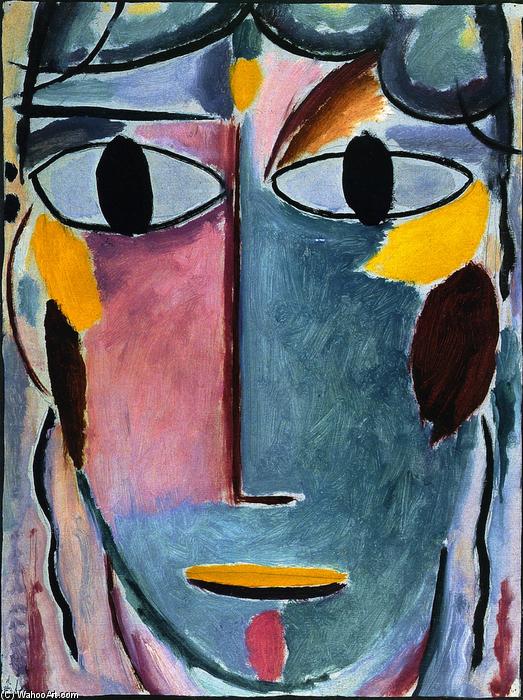
Alexej von Jawlensky's "Savior’s Face: Nemesis II" is not merely a depiction of a face; it’s a raw, visceral embodiment of spiritual struggle and the agonizing search for redemption. Painted in 1919 during a period of intense artistic experimentation, this work exemplifies Jawlensky’s signature style – a potent blend of Expressionism and Byzantine influences that sought to bypass rational thought and tap directly into primal emotion. The fragmented features, the jarring color palette dominated by blues, reds, yellows, and greens, and the unsettling gaze all contribute to an atmosphere of profound unease and psychological intensity.
The painting’s composition is deliberately disorienting. The two eyes, positioned at opposite ends of the face, create a sense of imbalance and disorientation, mirroring the internal turmoil of the subject. The rough, almost brutal application of paint – achieved through thick impasto techniques – adds to the feeling of urgency and desperation. Jawlensky eschewed traditional modeling and smooth surfaces, favoring instead a textured surface that seems to pulse with an inner energy. This technique, combined with his bold color choices, creates a dynamic visual experience that demands attention and invites contemplation.
The Roots of Expressionism & Byzantine Echoes
Jawlensky’s artistic journey was deeply rooted in the intellectual currents of early 20th-century Europe. He was profoundly influenced by the burgeoning Expressionist movement, which sought to represent subjective experience rather than objective reality. However, unlike some of his contemporaries who embraced abstraction entirely, Jawlensky remained committed to figurative representation, using it as a vehicle for exploring profound psychological and spiritual themes. His work also reveals a subtle but significant debt to Byzantine iconography – particularly the use of flattened forms, symbolic color palettes (often associated with religious devotion), and the emphasis on conveying inner meaning over realistic detail.
The painting’s stark simplicity—a single face stripped bare of extraneous adornment—echoes the iconographic tradition of Eastern Orthodox Christianity. This deliberate reduction to essential form suggests a yearning for spiritual purity, a desire to confront fundamental questions about faith, suffering, and salvation. The use of blue, often associated with divinity and transcendence in religious art, further reinforces this connection.
Symbolism & Emotional Resonance
"Savior’s Face: Nemesis II" is laden with symbolic weight. The “Nemesis” within the title suggests a confrontation – not just with an external force, but with one's own inner demons and the inherent contradictions of human existence. The face itself can be interpreted as representing humanity itself—vulnerable, flawed, yet capable of profound spiritual yearning. The intense gaze is particularly arresting; it feels both accusatory and pleading, inviting the viewer to engage in a dialogue about morality, guilt, and redemption.
Jawlensky’s work transcends mere representation; it evokes a powerful emotional response. The painting's unsettling quality forces us to confront uncomfortable truths about ourselves and our place in the world. It is a testament to Jawlensky’s ability to translate profound psychological and spiritual experiences into a visual language that remains powerfully relevant today. This reproduction captures not just an image, but the very essence of Jawlensky’s artistic vision – a timeless exploration of the human condition.