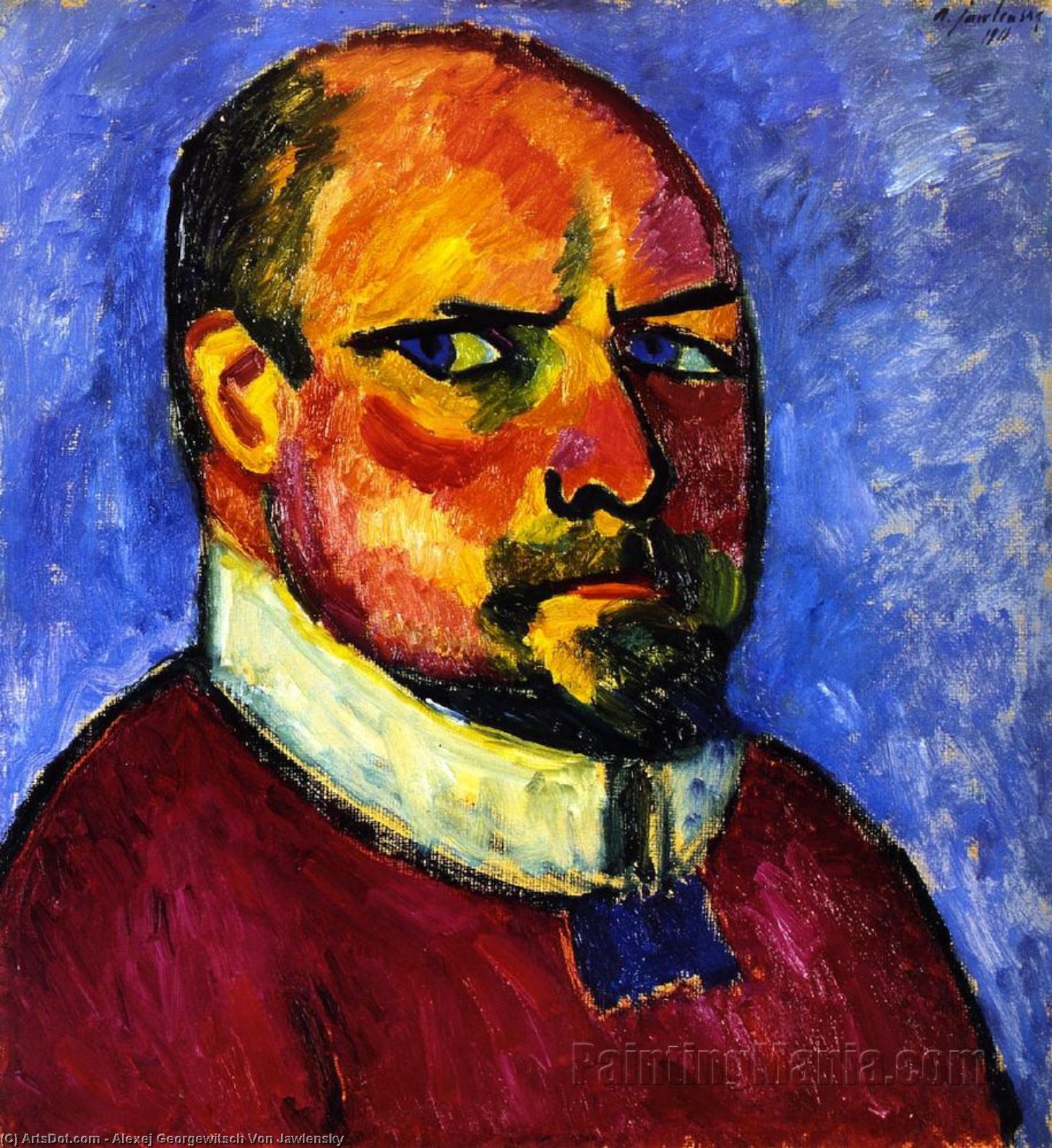
Experience the raw emotion of Alexej von Jawlensky's 'Self-Portrait' (1911). This Expressionist masterpiece, rendered in oil on panel, captures a stern gaze and bold colors – a powerful statement of inner turmoil. Own a hand-painted reproduction today!
A Raw Portrait of Emotion: Alexej von Jawlensky's Self-Portrait
Alexej von Jawlensky’s 1911 “Self-Portrait” isn’t merely a depiction of an artist; it’s a visceral plunge into the turbulent heart of Expressionism. Painted during a period of intense artistic and social upheaval, this work embodies the movement's core tenets – a fervent commitment to subjective experience, raw emotion, and a deliberate rejection of academic realism. Measuring 55 x 51 cm, the painting immediately commands attention with its bold color palette and the artist’s unflinching gaze. It’s a portrait stripped bare, revealing not just physical features but the very soul of a man wrestling with his place in the world.
Expressionist Techniques: A Symphony of Color and Texture
- Oil on Panel: Executed in oil paint on a panel, the texture is deliberately rough and uneven, contributing to the painting’s sense of urgency and immediacy. Jawlensky eschewed smooth blending, favoring visible brushstrokes that amplify the emotional intensity.
- Color as Emotion: The striking juxtaposition of vibrant red and deep blue isn't accidental. Red symbolizes passion, anger, or perhaps a desperate plea, while the blue evokes melancholy, introspection, or spiritual yearning. This deliberate chromatic discord reflects the psychological turmoil at the heart of Expressionism.
- Distorted Features: Jawlensky’s face is rendered with an almost brutal honesty. The features are slightly distorted, emphasizing his stern expression and conveying a sense of inner conflict. It's a far cry from the idealized portraits of previous eras; this is a portrait that confronts you directly.
Historical Context: The Rise of Expressionism in Early 20th Century Russia
Created in 1911, “Self-Portrait” emerged from the fertile ground of early 20th-century Russian art. Jawlensky was deeply influenced by the social and political climate of his time – a period marked by rapid industrialization, growing unrest, and a sense of alienation. Expressionism, as a movement, arose in response to these anxieties, offering artists a means to articulate the profound emotional impact of modern life. His work aligns with the broader Expressionist trend of prioritizing inner experience over objective representation, reflecting a desire to capture not just what was seen but how it *felt*.
Symbolism and Emotional Impact: A Window into the Artist's Soul
The subject’s gaze is particularly arresting. It’s direct, unwavering, and almost challenging – as if he’s inviting you to confront your own emotions. The blue collar, a simple yet significant detail, could represent labor, perhaps a sense of obligation, or even a subtle critique of social hierarchies. Ultimately, “Self-Portrait” is a powerful meditation on the human condition—a testament to the artist's ability to translate personal struggle into a universally resonant work of art. It’s a painting that lingers in the mind long after you’ve first encountered it.
Size:** 55 x 51 cm
**Date:** 1911
**Artist:** Alexej von Jawlensky