Alexej von Jawlensky
Torzhok
Russia
1864
1912
1941
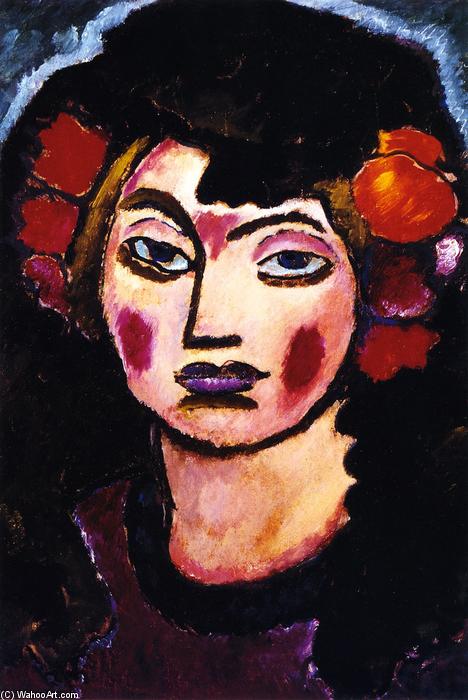
A captivating Expressionist portrait of a woman with striking red flowers in her hair. Jawlensky’s masterful use of color and intense gaze creates a powerfully emotive image, reflecting the artist's focus on raw emotion and spiritual depth.
70 x 51 cm
Expressionism
Spanish Girl
Experience Alexej von Jawlensky’s ‘Spanish Girl’ – a hauntin
Alexej von Jawlensky’s ‘Spanish Girl’: A Portrait of Raw Emotion
This arresting portrait, titled ‘Spanish Girl,’ painted in 1912 by the profoundly influential Alexej von Jawlensky, is a masterclass in Expressionist intensity. Measuring 70 x 51 cm, the work immediately commands attention with its stark contrasts – the fiery reds of the flowers interwoven into the subject’s hair against a predominantly black and grey palette. It's a painting that doesn’t merely depict a woman; it excavates and reveals a wellspring of raw emotion, a hallmark of Jawlensky’s artistic vision.
Expressionist Technique and Materiality
Executed in oil on panel, ‘Spanish Girl’ exemplifies Jawlensky's distinctive technique. He employed thick, impasto brushstrokes – deliberately applied to build up texture and create a palpable sense of physicality. The paint isn’t blended smoothly; instead, it’s layered and scraped, revealing the artist’s hand and contributing significantly to the work’s agitated surface. This tactile quality is crucial to understanding Expressionism's core aim: to convey inner experience rather than objective reality. The use of black pigment, a frequent element in Jawlensky’s oeuvre, adds to the painting’s somber mood and emphasizes the contours of the subject’s face, drawing the viewer’s eye directly to her intense gaze.
Symbolism and the Portrait as Vessel
The woman herself – identified simply as ‘Spanish Girl’ – is rendered with a deliberate ambiguity. Her pouting expression, wide-open eyes, and slightly parted lips suggest vulnerability and perhaps even a hint of defiance. The inclusion of red flowers in her hair isn't merely decorative; it’s a potent symbol, often associated with passion, sacrifice, and remembrance. In Jawlensky’s work, the portrait frequently functions as a vessel for profound psychological states. This painting seems to capture a moment of intense contemplation or perhaps suppressed sorrow – a feeling intensified by the artist’s masterful manipulation of color and form.
Historical Context: A Pivotal Moment in Art
'Spanish Girl' was created during a period of immense artistic upheaval, marking a crucial transition within Expressionism. Jawlensky, along with artists like Ernst Ludwig Kirchner and Karl Schmidt-Rottluff, were at the forefront of this movement, rejecting academic conventions in favor of intensely personal and emotionally charged imagery. The painting’s creation aligns with Jawlensky's increasing focus on portraiture as a means of exploring the human condition – a theme that would dominate his work for decades to come. This piece represents a significant moment in the artist’s development, solidifying his reputation as one of the most compelling and uncompromising voices of early 20th-century art.