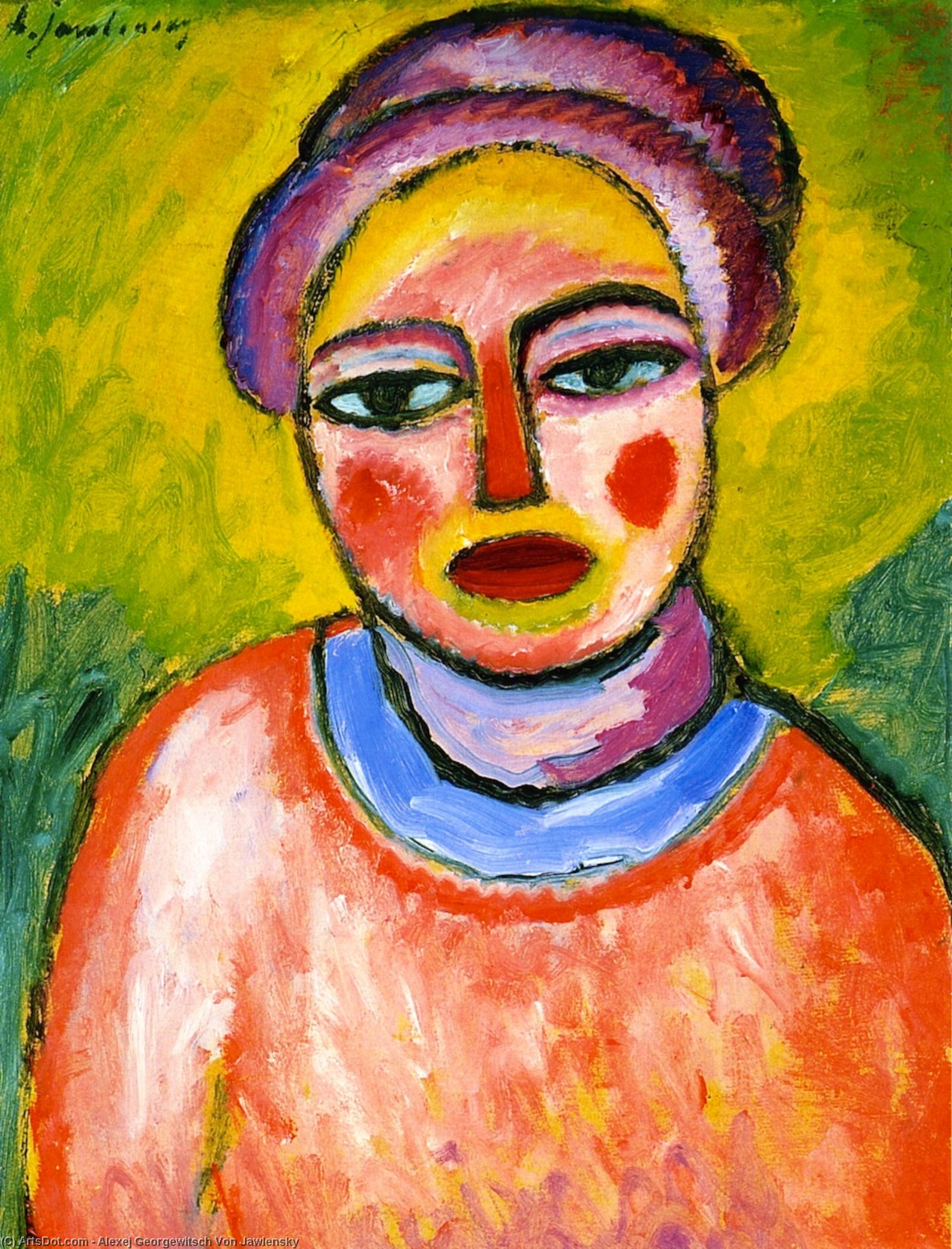
Experience the emotive power of Alexej von Jawlensky's 'Spring,' a vibrant Expressionist masterpiece capturing profound emotion and beauty through bold colors and distorted forms.
Explore the Expressionist world of Alexej von Jawlensky (1864-1941). Discover his iconic 'Mystical Heads,' bold colors, and key role in movements like Der Blaue Reiter. A Russian artist who profoundly impacted modern art.
A Portrait of Emotion: Exploring Spring by Alexej von Jawlensky
The world of art holds moments that transcend mere visual perception—pieces like “Spring” by Alexej Georgewitsch Von Jawlensky possess the ability to resonate deeply within us, prompting contemplation and stirring feelings long after we’ve turned away from their canvas. Painted in 1912 during the fervent crucible of Expressionism, this artwork isn't simply a depiction of nature; it’s an audacious attempt to distill the very essence of human experience into pigment and brushstroke—a courageous endeavor that cemented Jawlensky’s place as one of the movement’s foremost innovators.
The Expressionist Vision: Beyond Representation
Expressionism emerged from the anxieties and uncertainties of early twentieth-century Europe, rejecting the conventions of Impressionism's serene observation in favor of confronting raw emotion. Artists like Hilma Af Klint and Ernst Ludwig Kirchner sought to bypass rational thought altogether, channeling inner turmoil directly onto the canvas. Jawlensky’s approach mirrored this ethos perfectly—he eschewed meticulous realism, prioritizing instead a subjective interpretation of reality. The distorted forms and jarring color palette characteristic of Expressionism served as conduits for conveying feelings of unease, longing, and spiritual yearning—qualities that permeate every inch of “Spring.”
A Woman Illuminated: Symbolism Within the Frame
At the heart of the painting resides a woman with striking red hair, her gaze fixed intently upon the viewer. This figure isn’t merely presented as an individual; she embodies a broader symbolic language familiar to Expressionist artists. The crimson hue of her hair—a color often associated with passion, vitality, and even danger—immediately draws attention and establishes a palpable tension. Her facial expression is deliberately ambiguous, hinting at profound inner conflict yet simultaneously radiating a quiet resilience. The scarf draped around her neck adds another layer of complexity, concealing her face while simultaneously emphasizing the vulnerability inherent in human emotion.
Technique and Texture: Jawlensky's Distinctive Style
Jawlensky’s mastery lay not only in his conceptual vision but also in his meticulous execution. He employed oil on panel—a medium that allowed for exceptional textural richness—creating a surface imbued with palpable depth and luminosity. Thick impasto strokes dominate the background, conveying a sense of turbulent energy and mirroring the emotional landscape depicted within. The artist’s deliberate layering of colors—primarily shades of pink, yellow, and red—further amplifies this visual dynamism. This technique wasn't merely aesthetically pleasing; it served as an integral component of Expressionism’s expressive impulse, translating inner feelings into tangible form.
A Legacy Enduring: Spring in the Museum Collection
“Spring” currently resides within the St. Louis Art Museum’s collection—a testament to its enduring appeal and recognition by art historians worldwide. Its presence underscores the significance of Jawlensky's contribution to Expressionism and confirms his ability to capture the complexities of human psychology with unparalleled sensitivity. For those seeking a connection to this seminal artwork, high-quality reproductions are available at ArtsDot.com—offering an opportunity to experience the transformative power of art history firsthand. Let “Spring” inspire you to contemplate beauty alongside vulnerability, emotion alongside intellect—a timeless reminder that true artistic achievement lies in conveying not just what we see but what we feel.