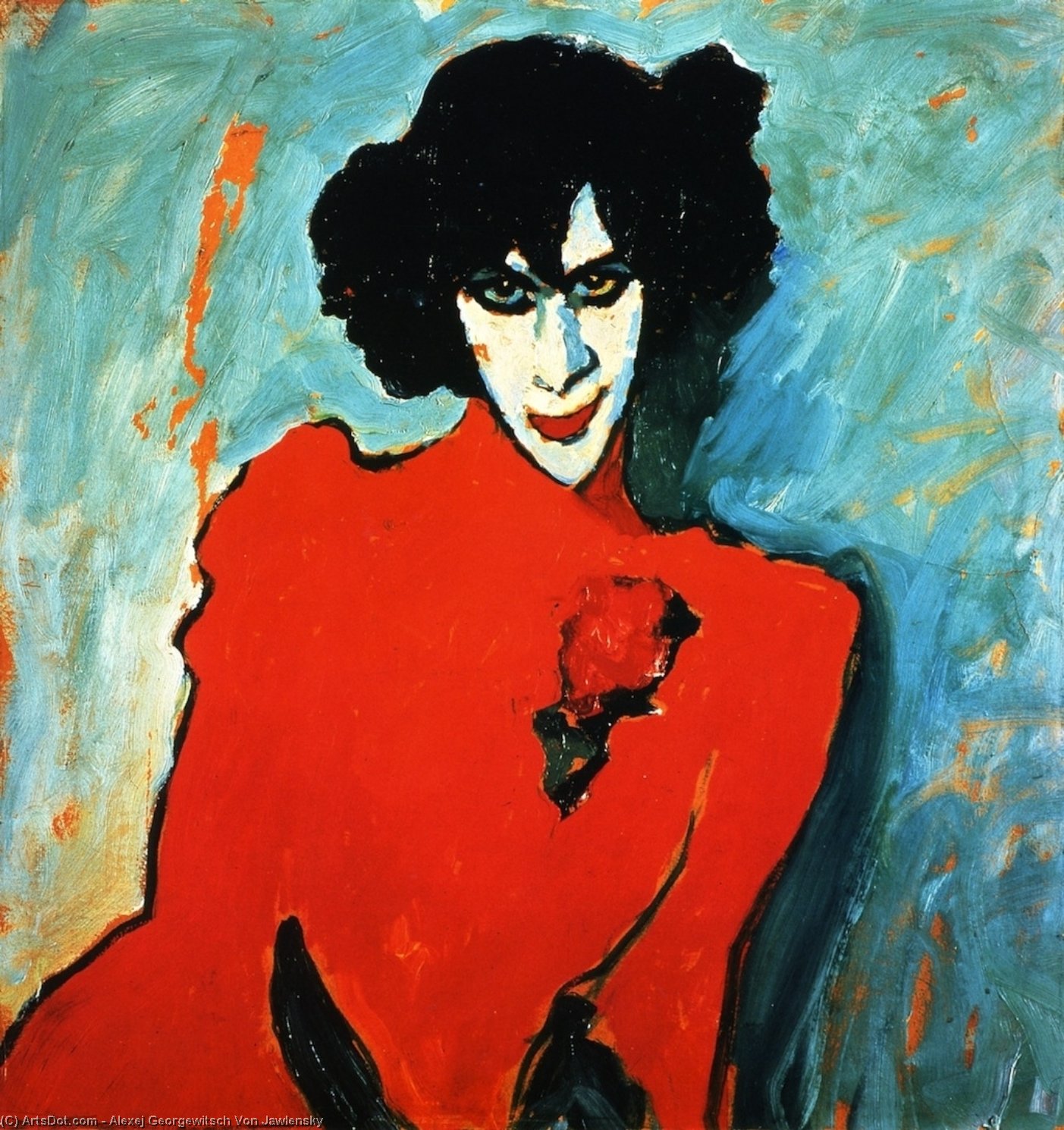
Experience the raw emotional intensity of Alexej von Jawlensky’s The Dancer Sacharoff, a 1909 Expressionist masterpiece featuring bold crimson hues and profound psychological depth, available for your private collection.
The Dancer Sacharoff: A Portrait of Expressionist Intensity
Alexej von Jawlensky’s “The Dancer Sacharoff,” completed in 1909, stands as a cornerstone of early Expressionism—a movement that sought to transcend mere representation and delve directly into the realm of emotion. More than just a portrait of Alexander Sacharoff, a daring Russian dancer who championed unconventional performance styles, this painting embodies Jawlensky’s profound engagement with Orthodox iconography and his burgeoning fascination for the avant-garde currents reshaping European art.
Style & Technique: Jawlensky eschewed academic conventions entirely, prioritizing bold color palettes and fractured forms to convey psychological states. The painting utilizes a technique reminiscent of iconographic tradition—a deliberate flattening of perspective and simplification of contours—creating an unsettling yet captivating visual experience. Dominant hues of crimson and azure clash dramatically against the dancer’s scarlet dress, amplifying the sense of agitation and highlighting Sacharoff's central position within the composition.
Historical Context: Produced during Munich’s artistic ferment—a crucible where artists like Kandinsky wrestled with abstraction—"The Dancer Sacharoff" reflects the broader anxieties surrounding modernity. Jawlensky’s exploration of psychological depth aligns perfectly with Expressionist concerns about confronting inner turmoil and expressing subjective experience in defiance of societal norms.
Symbolism & Emotion: The dancer's gaze, directed outwards towards the viewer, is imbued with a palpable sadness—a subtle yet insistent acknowledgment of vulnerability. Jawlensky’s masterful manipulation of color and line communicates not merely physical movement but also emotional resonance. The blue background serves as a counterpoint to the dress, symbolizing both serenity and perhaps, an unattainable ideal.
Concluding Impression: “The Dancer Sacharoff” transcends its subject matter to become a powerful meditation on human emotion and artistic innovation. It remains a testament to Jawlensky’s unwavering commitment to conveying psychological truth through visual language—a captivating artwork that continues to inspire contemplation and admiration for its expressive power.