Alexej von Jawlensky’s ‘Variation (17)’ – A Raw Expression of Inner Turmoil
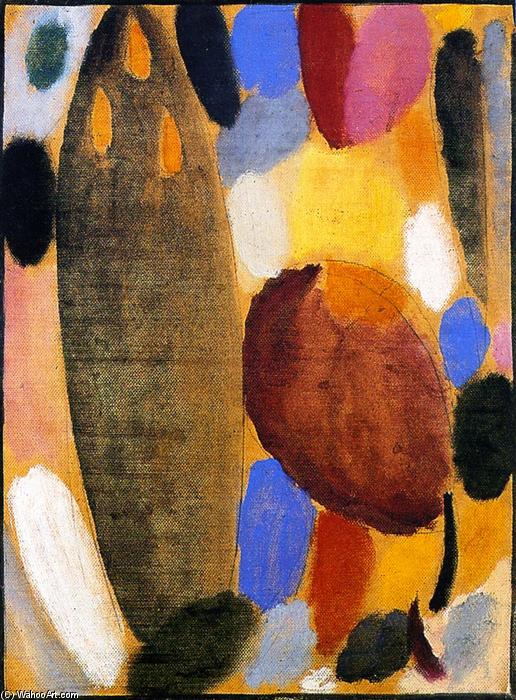
“Variation (17)” by Alexej von Jawlensky, painted in 1917, is not merely a colorful abstraction; it's a visceral outpouring of emotion rendered with a brutal honesty that defines the artist’s oeuvre. This piece, currently measuring 13 1/2 x 10 inches and executed on oil on canvas mounted on cardboard, offers a rare glimpse into the intensely personal world of one of Expressionism’s most compelling figures. The painting's immediate impact lies in its vibrant chaos – a deliberate rejection of academic precision in favor of an unfiltered representation of feeling.
At first glance, the composition appears almost childlike: a dominant orange circle pulsates at the center, surrounded by smaller circles in hues of blue, yellow, and red. These shapes aren’t neatly arranged; they jostle for space, creating a sense of dynamic tension. However, to reduce this work to simple color blocks would be a profound misunderstanding. Jawlensky wasn't interested in decorative beauty; he sought to capture the raw energy of experience, the tremors beneath the surface of consciousness.
The Language of the Brushstroke – A Technique Rooted in Emotion
Jawlensky’s technique is immediately recognizable. He employed a thick impasto application of paint, building up layers of color with bold, decisive brushstrokes. These aren't delicate gestures; they are forceful marks, imbued with an almost violent energy. The surface of the canvas itself becomes a record of his struggle – visible ridges and textures speak to the physical exertion involved in creating this work. Notice how the edges of the circles are often ragged and unfinished, further emphasizing the painting’s emotional urgency rather than striving for polished perfection. This technique aligns perfectly with the tenets of Expressionism, prioritizing subjective experience over objective representation.
Historical Context & The ‘Blue Rider’ Movement
Created in 1917, “Variation (17)” sits squarely within a period of immense social and political upheaval – the years leading up to World War I. Jawlensky was deeply affected by these events, as evidenced by the intensity of his work during this time. He was a key member of Der Blaue Reiter (“The Blue Rider”), a group of artists associated with Wassily Kandinsky and Franz Marc who sought to break free from traditional artistic conventions. The ‘Blue Rider’ movement aimed to explore spiritual themes through color and form, often employing symbolism to convey profound emotional states. This painting reflects the group's interest in exploring the subconscious and expressing inner turmoil through non-naturalistic imagery.
Symbolism & Emotional Resonance
While Jawlensky resisted overt symbolic interpretation, art historians suggest that the circle itself may represent wholeness or a contained, yet turbulent, spirit. The scattered blue dots could symbolize fleeting thoughts or moments of clarity amidst the chaos. Ultimately, “Variation (17)” is less about deciphering specific symbols and more about experiencing the raw emotion conveyed through its powerful visual language. It’s a testament to Jawlensky's ability to translate personal anguish into a universally resonant work of art – a reminder that true beauty can be found in confronting the darkest aspects of human experience.