A Moment Frozen in Emotion: The Raw Power of Jawlensky’s ‘Variation’
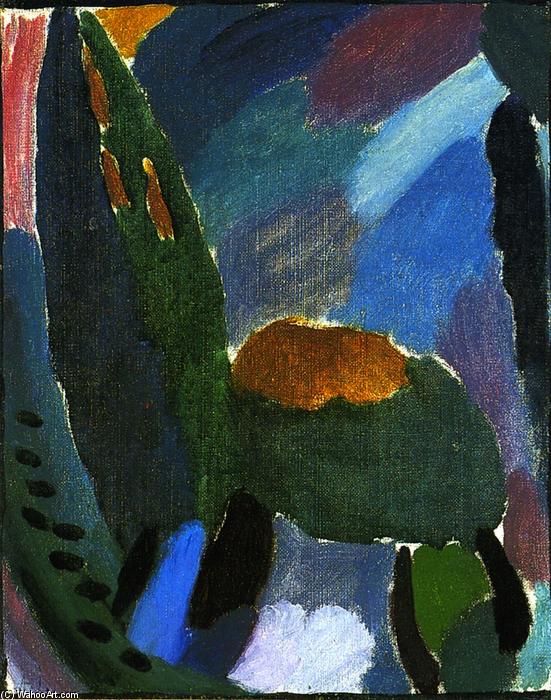
Alexej von Jawlensky's “Variation: Before the Thunderstorm” isn’t merely a depiction of a landscape; it’s a visceral outpouring of feeling, a testament to the artist’s profound engagement with the world around him. Created in 1916 amidst the turmoil of the First World War, this painting embodies the core tenets of Expressionism – prioritizing subjective experience and emotional intensity over objective representation. The scene unfolds with stark simplicity: a solitary tree dominates the canvas, its gnarled trunk and reaching branches rendered with a deliberate, almost brutal honesty. The sky, bruised with impending storm, is not a serene backdrop but a force to be reckoned with, captured in bold strokes of blue and grey that hint at an imminent deluge. It’s a scene pregnant with anxiety, a premonition of chaos – a feeling Jawlensky masterfully translates onto the canvas.

(Image: File:Alexej von Jawlensky Variation c1916.jpg – Wikimedia Commons)
The Language of Color and Texture: A Masterclass in Expressionist Technique
Jawlensky’s technique is immediately arresting. He eschews the smooth, blended brushwork favored by many contemporary artists, opting instead for a deliberately rough, almost violent application of paint. Thick impasto layers build up a tactile surface, inviting the viewer to physically engage with the image. The colors are not mixed in a palette; they’re applied directly from the tube, resulting in jarring juxtapositions and an intense luminosity. The greens of the leaves aren't delicate or harmonious; they possess a raw, almost sickly vibrancy, reflecting perhaps a heightened state of emotional awareness. The yellow flowers, strategically placed, offer fleeting moments of warmth against the dominant gloom, yet even their brightness feels strained, hinting at a precarious balance.
A Life Shaped by Emotion: Contextualizing Jawlensky’s Vision
Born in Torzhok, Russia, in 1864, Alexej von Jawlensky's artistic journey was marked by constant relocation and a deep-seated sense of displacement. His early military training instilled discipline, but it was his encounter with art at the 1880 Moscow World Exposition that truly ignited his passion. He became a key figure in the New Munich Artist’s Association (Neue Künstlervereinigung München), Der Blaue Reiter (“The Blue Rider”) group, and later Die Blaue Vier (“The Blue Four”). During this period, Jawlensky was deeply influenced by the ideas of Wassily Kandinsky and other pioneers of abstraction. His work reflects a desire to strip away superficial appearances and reveal the underlying spiritual essence of things – a theme particularly resonant in the context of the war-torn years that saw him exiled from Germany. The recurring motifs of his paintings—trees, faces, and simple objects—were not merely subjects but vehicles for expressing profound emotional truths.
Symbolism and the Power of Suggestion
The tree itself is a potent symbol – representing resilience, strength, and perhaps even mortality. Its imposing presence against the turbulent sky suggests a confrontation with forces beyond human control. The impending storm isn’t just a meteorological event; it's a metaphor for inner turmoil, anxiety, and the fragility of existence. Jawlensky doesn’t offer easy answers or comforting resolutions. Instead, he presents us with a raw, unfiltered emotional experience – a reminder that beauty can be found even in the face of chaos and despair. “Variation: Before the Thunderstorm” remains a powerfully evocative work, demonstrating Jawlensky's mastery of expressionist technique and his ability to translate profound emotion onto canvas.