Alexej von Jawlensky’s ‘Variation: Grey Day’ – A Study in Emotional Resonance
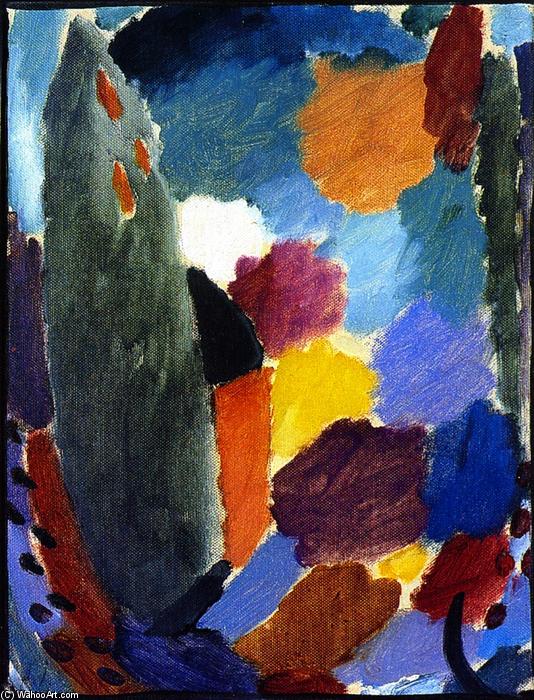
Alexej von Jawlensky's ‘Variation: Grey Day,’ painted in 1916, stands as a powerfully evocative example of early Expressionism. This seemingly simple depiction—a solitary tree rendered with bold strokes and intensely saturated colors—transcends mere representation to become a profound exploration of mood, memory, and the human condition. The painting’s impact lies not in its photographic accuracy but in Jawlensky's masterful manipulation of color and form to convey an overwhelming sense of melancholy and quiet contemplation.
The composition itself is deliberately unbalanced, drawing the viewer’s eye immediately to the vibrant red trunk and branches – a stark contrast against the muted grey backdrop. This deliberate discordance mirrors the emotional turbulence often associated with memory and reflection. The blue sky, though present, feels distant and almost dreamlike, further isolating the tree and amplifying its sense of loneliness. The yellow flowers, strategically placed, offer fleeting moments of warmth and perhaps, a fragile hope within this otherwise somber scene.
Expressionist Techniques & Color Theory
Jawlensky’s technique is characterized by thick impasto – layers of paint applied with energetic brushstrokes that create a palpable sense of texture. This physicality isn't merely decorative; it actively contributes to the painting’s emotional intensity. The use of color is particularly significant. Jawlensky eschewed traditional academic color theory, opting instead for a highly subjective approach. He employed colors not to represent reality but to express feeling – the deep reds and yellows conveying passion and vitality, while the grey dominates, representing loss, uncertainty, or perhaps simply the fading light of a day.
The bold simplification of forms—the tree reduced to its essential elements—is a hallmark of Expressionism. This reduction allows Jawlensky to focus entirely on the emotional impact of his subject matter, stripping away any superfluous detail and intensifying the viewer’s engagement with the core feeling conveyed. It's a technique that anticipates the later developments of abstract art, prioritizing inner experience over external representation.
Historical Context & The ‘Blue Rider’ Movement
'Variation: Grey Day' was created during a period of immense social and artistic upheaval – the years leading up to World War I. Jawlensky was deeply involved with the avant-garde movements of his time, notably the ‘Der Blaue Reiter’ (The Blue Rider) group, which sought to break free from traditional academic constraints and explore new forms of expression. This group, centered in Munich, embraced a radical approach to art, prioritizing emotional intensity and subjective experience over objective representation.
Jawlensky's work aligns closely with the core tenets of Expressionism: an intense focus on personal emotion, distortion of form to convey feeling, and a rejection of traditional artistic conventions. His association with figures like Wassily Kandinsky and Franz Marc within ‘Der Blaue Reiter’ further cemented his place as a pivotal figure in the development of modern art.
Symbolic Interpretation & Emotional Impact
The tree itself is open to multiple interpretations, acting as a potent symbol of resilience, endurance, or perhaps even isolation. Its stark silhouette against the grey sky suggests vulnerability and solitude. The painting’s enduring power lies in its ability to evoke a deeply personal response from the viewer – prompting reflection on themes of loss, memory, and the transient nature of beauty. ‘Variation: Grey Day’ is not simply a depiction of a tree; it's a distilled emotional experience, a testament to Jawlensky’s profound understanding of the human psyche.