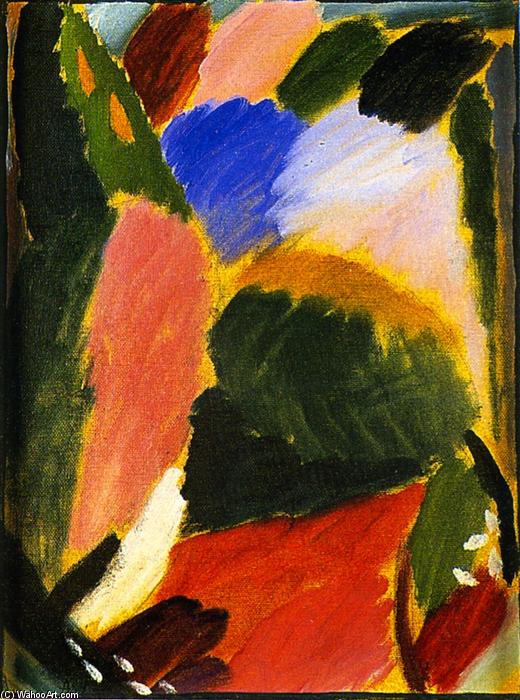
Variation: Melancholy - Alexej von Jawlensky
The year 1916 marked a pivotal moment in Alexej von Jawlensky’s artistic trajectory, encapsulating the profound emotional currents that would define his oeuvre. This painting, titled “Variation: Melancholy,” exemplifies the core tenets of Expressionism—a movement born from disillusionment with rational thought and fueled by an urgent desire to convey subjective experience.
Style & Technique Jawlensky’s approach eschewed academic conventions, prioritizing directness and immediacy. He employed a bold palette dominated by muted blues and greens interwoven with splashes of crimson—a deliberate choice designed to evoke feelings of sorrow and introspection. The painting utilizes thick impasto layering, creating palpable textural surfaces that capture the artist's tactile engagement with the medium. Geometric forms – primarily squares and rectangles – are subtly integrated into the composition, providing a structural counterpoint to the amorphous shapes that dominate the canvas.
Historical Context Jawlensky’s work emerged during the tumultuous period of World War I, mirroring the anxieties and uncertainties prevalent across Europe. The Expressionist movement responded to the horrors of the conflict with visceral depictions of suffering and psychological turmoil—a reaction rooted in a deep skepticism towards societal narratives.
Symbolism The melancholic hue palette is laden with symbolic significance. Blue traditionally represents sorrow, contemplation, and spiritual yearning – themes central to Jawlensky’s artistic vision. Crimson, representing passion and vitality, serves as an unsettling juxtaposition against the dominant blues, highlighting the inescapable presence of pain within beauty.
Emotional Impact “Variation: Melancholy” transcends mere visual representation; it strives to elicit a profound emotional response from the viewer. The painting’s subdued colors and textured surface invite contemplation on themes of loss, vulnerability, and the human condition—a testament to Jawlensky's ability to translate inner feelings into compelling artistic expression.
Size & Reproduction Unknown
Provenance: 1916
About Alexej von Jawlensky
Alexej Georgewitsch von Jawlensky (Russian: Алексе́й Гео́ргиевич Явле́нский; March 13, 1864 – March 15, 1941) was a Russian Expressionist painter active in Germany. He was a key member of the Neue Künstlervereinigung München and Der Blaue Reiter group, and later Die Blaue Vier.
Born in Torzhok, Russia, Jawlensky’s early life was marked by frequent relocations—experiences that instilled within him a sense of displacement and perhaps, a yearning for deeper connection. Initially drawn to military service, he discovered painting during the 1880 Moscow World Exposition, transforming his artistic pursuits into a lifelong vocation.
His formative years at St. Petersburg Academy of Art saw him mentored by Ilya Repin, fostering connections with fellow artists and establishing a foundation for his future endeavors. Notably, he formed a lasting partnership with Marianne von Werefkin, whose influence extended beyond their romantic relationship to encompass shared artistic sensibilities.
Moving to Munich in 1894, Jawlensky studied under Anton Ažbe, immersing himself in the burgeoning avant-garde scene and forging friendships with influential figures like Wassily Kandinsky and Gabriele Münter. These collaborations fueled his experimentation with color theory and stylistic innovation—elements that would become hallmarks of his distinctive artistic style.
Expelled from Germany during World War I, Jawlensky sought refuge in Switzerland, where he continued to refine his technique and explore new creative avenues. He established a studio alongside Emmy Scheyer, fostering a collaborative environment that nurtured his artistic vision.