Alexej von Jawlensky’s “Variation on a Landscape Theme”: A Symphony of Emotion
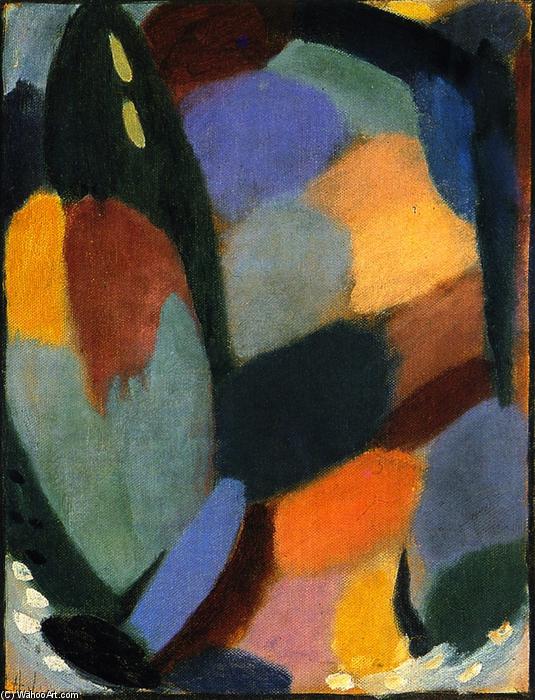
Alexej von Jawlensky's "Variation on a Landscape Theme," painted in 1916, is not merely a depiction of a vista; it’s a raw and intensely personal expression distilled onto canvas. This work, born from the turbulent currents of early Expressionism, reveals a profound engagement with color, form, and the very essence of human emotion. Jawlensky, deeply influenced by his experiences in Russia and Germany, sought to bypass representational accuracy entirely, aiming instead to capture an inner landscape – a feeling, a memory, or perhaps even a spiritual truth – through a rigorously controlled vocabulary of shapes and hues.
The painting’s immediate impact is one of vibrant dynamism. The dominant blue background acts as a grounding force, providing the necessary contrast for the assertive presence of the yellow circle at its center. This circle isn't simply an element within the composition; it feels like a contained explosion of energy, radiating outwards and influencing the placement of the other circles scattered throughout the scene. These secondary shapes, rendered in varying shades of yellow and ochre, create a sense of movement and depth, drawing the viewer’s eye across the canvas in a continuous, almost hypnotic rhythm.
The Language of Color: Jawlensky's Expressionist Technique
Jawlensky’s technique is characterized by its deliberate simplicity and emotional intensity. He employed thick, impasto brushstrokes – particularly evident in the treatment of the circles – to build up layers of color and texture. This tactile quality imbues the painting with a palpable sense of physicality, as if the forms are emerging directly from his hand. The use of unmixed pigments is crucial; Jawlensky avoided blending colors, instead layering them to create startling juxtapositions that heighten their emotional impact. The lack of detail forces the viewer to focus solely on the color relationships and the expressive qualities of the shapes themselves.
His approach aligns with the broader Expressionist movement’s rejection of academic realism in favor of subjective experience. Influenced by artists like Ferdinand Hodler, Jawlensky sought to convey not what he *saw*, but what he *felt*. This is particularly evident in the bold, almost aggressive application of color – a deliberate departure from the more subtle and nuanced palettes favored by many contemporary painters.
Symbolism and Spiritual Resonance
While seemingly abstract, “Variation on a Landscape Theme” resonates with symbolic depth. The circle itself has long been associated with wholeness, unity, and the divine—a recurring motif in Jawlensky’s work. The scattered circles can be interpreted as fragments of memory, echoes of emotion, or perhaps even representations of spiritual forces at play. Considering Jawlensky's background within groups like Der Blaue Reiter and Die Blaue Vier, it is reasonable to assume that the painting carries a strong spiritual dimension, reflecting his interest in exploring the relationship between art and faith.
The date of 1916 – a period marked by immense social and political upheaval – adds another layer of significance. The painting can be seen as a reflection of the anxieties and uncertainties of the time, expressed through Jawlensky’s intensely personal artistic language. It's a testament to his ability to transform profound emotional experience into a powerfully evocative work of art.
Bringing “Variation on a Landscape Theme” Home
ArtsDot offers meticulously hand-painted reproductions of Alexej von Jawlensky’s "Variation on a Landscape Theme," allowing you to bring this iconic artwork into your own space. Our skilled artisans recreate the painting's original texture and color palette with exceptional fidelity, ensuring that your reproduction captures the full emotional power of Jawlensky’s vision. Choose from a range of sizes to perfectly suit your décor – from intimate study pieces to grand statement wall coverings. Invest in a piece of art history and experience the enduring legacy of one of Expressionism's most compelling figures.