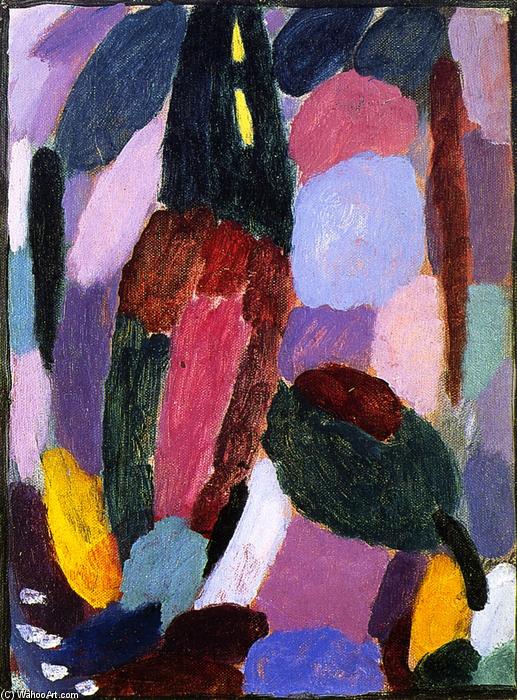
Alexej von Jawlensky's "Variation: Twilight" (1916) explodes with vibrant color and dynamic abstraction. A road, trees, and bold lines converge in a captivating expressionist masterpiece – a study of form, color, and wartime material constraints.
Variation: Twilight – A Descent into Emotional Color by Alexej von Jawlensky
Alexej von Jawlensky’s “Variation: Twilight” (1916) isn't merely a painting; it’s an immersion. Created during a turbulent period of artistic experimentation, this work embodies the core tenets of early Expressionism – a deliberate rejection of objective representation in favor of conveying raw emotion and subjective experience. The canvas pulsates with a restrained energy, dominated by blocks of color that seem to vibrate with unspoken feeling. The central focus, a road rendered in stark yellow, isn’t a literal depiction but rather a symbolic channel, perhaps representing the journey through life's uncertainties or the fleeting nature of time itself – hence the title.
- Composition and Technique: Jawlensky employs a technique characterized by thick, impasto brushstrokes layered upon one another. The paint isn’t blended smoothly; instead, it retains a tactile quality, suggesting a deliberate act of creation—a physical struggle to capture an elusive emotion. The use of tessellating shapes – the road, the implied trees – creates a dynamic tension, drawing the eye across the surface while simultaneously maintaining a sense of contained chaos.
- Color as Emotion: The palette is deliberately muted yet intensely expressive. Deep blues and purples dominate, evoking feelings of melancholy, introspection, and perhaps even a touch of foreboding. The flashes of pink within the trees introduce an element of fragile beauty, hinting at hope or memory amidst the prevailing darkness.
A Window into the Zeitgeist: Expressionism in 1916
To fully appreciate “Variation: Twilight,” it’s crucial to understand its historical context. 1916 was a year of immense upheaval – the height of World War I, casting a long shadow over Europe and profoundly impacting artistic sensibilities. Jawlensky, like many artists of his time, responded to this atmosphere of anxiety and disillusionment with an intensely personal and often unsettling style. The New Munich Artist’s Association, to which he belonged, was at the forefront of this movement, challenging traditional notions of beauty and embracing a more honest, emotionally charged approach to art.
The influence of figures like Kandinsky and other pioneers of abstraction is palpable here, though Jawlensky retains a distinctly figurative element – the road, the trees – grounding the work in recognizable forms while simultaneously distorting them through his expressive technique. This tension between representation and abstraction was a key characteristic of Expressionism.
Symbolic Resonance: Roads, Trees, and the Human Condition
The elements within “Variation: Twilight” are laden with symbolic weight. The road itself is a potent motif – representing life’s journey, choices, and destinations. Its yellow hue could signify hope or warning, depending on the viewer's interpretation. The trees, depicted in shades of pink, might symbolize memory, loss, or perhaps even the resilience of nature amidst human suffering.
Jawlensky was deeply interested in exploring the inner lives of his subjects, and this is evident in the raw emotional intensity conveyed through his brushwork and color choices. He wasn’t concerned with creating a pretty picture; he sought to capture something far more profound – the fundamental anxieties and yearnings of the human condition.
A Legacy of Emotional Intensity: Owning a Reproduction
"Variation: Twilight" stands as a testament to Alexej von Jawlensky's artistic vision and his ability to translate complex emotions onto canvas. A hand-painted reproduction offers an unparalleled opportunity to bring this powerful work into your home or office, allowing you to experience its emotional depth and visual dynamism firsthand. This isn’t simply acquiring a print; it’s investing in a piece of art history – a tangible connection to one of the most significant figures in early 20th-century Expressionism. The meticulous detail and vibrant colors of our reproduction faithfully capture the essence of Jawlensky's original, ensuring that this evocative artwork will continue to inspire and captivate for generations to come.