A Vision of Elegance: The World of ‘Carriage Dealers’
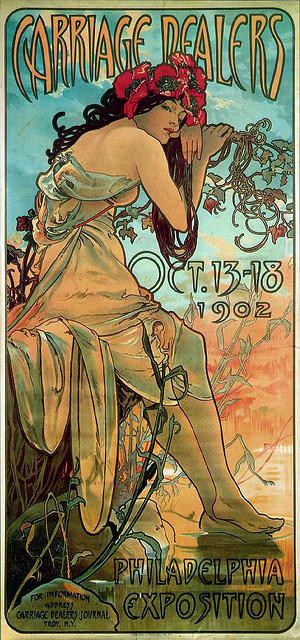
Alphonse Mucha's “Carriage Dealers,” a vibrant poster advertising the 1902 Philadelphia exposition, is more than just an advertisement; it’s a distillation of Art Nouveau’s most captivating ideals. Created around 1902, this piece exemplifies Mucha’s signature style – a harmonious blend of organic forms, flowing lines, and idealized beauty that immediately transports the viewer to a world of refined luxury and subtle enchantment. The composition itself is carefully orchestrated: a seated woman, rendered with exquisite detail, becomes the focal point, drawing the eye through a meticulously constructed background brimming with decorative motifs.

(Image: Alphonse Mucha in his studio, circa 1899 – a visual representation of the artist’s creative environment.)
The Art Nouveau Aesthetic: Line, Form, and Symbol
Mucha was a pivotal figure in the rise of Art Nouveau, a movement that rejected academic traditions in favor of embracing natural forms and decorative ornamentation. “Carriage Dealers” is saturated with this aesthetic; observe the sinuous curves defining the woman’s garments, the swirling patterns of the background – reminiscent of foliage and water – and the overall sense of graceful movement. The use of rounded figures, a hallmark of Art Nouveau, softens the composition while simultaneously conveying an impression of timeless elegance. The color palette—rich ochres, golds, and deep teal accented with vibrant reds—further enhances this luxurious feel, reflecting the opulent atmosphere Mucha sought to evoke.
Beyond mere decoration, Mucha’s work is deeply symbolic. The seated woman represents not just a model but an embodiment of feminine beauty and prosperity – themes frequently explored in Art Nouveau imagery. The inclusion of floral motifs—lilies, roses, and other blossoms—reinforces this connection to nature and adds layers of meaning associated with fertility, renewal, and the celebration of life’s pleasures.
Craftsmanship and Technique: A Lithograph Masterpiece
“Carriage Dealers” was almost certainly produced using lithographic techniques – a process favored by Mucha for its ability to achieve incredibly detailed images and rich colors. The smooth, decorative textures visible in the artwork are a direct result of this printing method. The flattened perspective, typical of posters designed for immediate visual impact, directs attention to the central figure while subtly layering elements—the woman in front of the intricate background patterns—to create depth. The artist’s meticulous attention to detail – from the delicate folds of fabric to the individual petals of flowers – speaks volumes about Mucha's skill and dedication.
Materials likely included high-quality paper, carefully selected inks, and a skilled printer who understood how to translate Mucha’s artistic vision into a tangible form. The longevity of this piece is a testament to the quality of these materials and the precision of the printing process.
A Legacy of Beauty: Mucha's Enduring Influence
Alphonse Mucha’s “Carriage Dealers” stands as a powerful example of Art Nouveau’s enduring appeal. His work continues to inspire artists, designers, and collectors alike, demonstrating the timeless beauty of elegant design and the power of visual storytelling. Reproductions like those offered by ArtsDot.com allow us to experience this masterpiece firsthand, bringing Mucha's vision to life in a way that celebrates both his artistic genius and the rich cultural heritage he represents. It’s a piece that speaks to our innate appreciation for beauty, craftsmanship, and the evocative power of art.