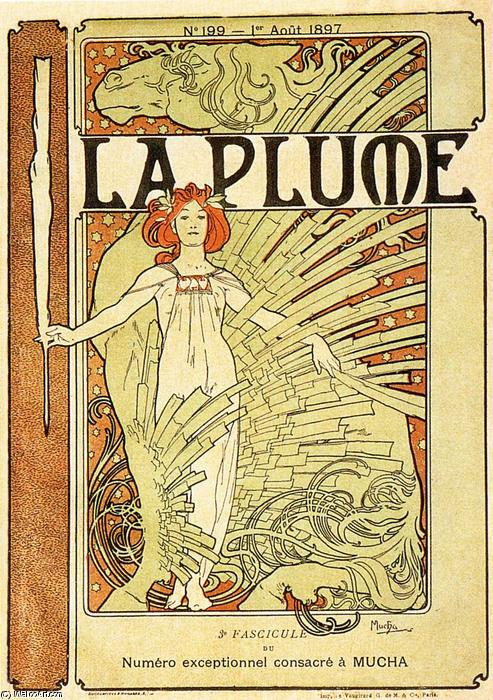
Zodiaque ("La Plume") by Alphonse Marie Mucha – A captivating Art Nouveau lithograph depicting a woman holding a bird on a beach, embodying the elegance and fluidity of the era.
Discover Alphonse Mucha (1860-1939), the Art Nouveau master! Explore his iconic posters, beautiful women & the monumental 'Slav Epic'. A Czech artistic legend.
A Vision of Femininity and Renewal: Exploring Alphonse Mucha’s “La Plume”
Alphonse Maria Mucha's "La Plume" – translating to "The Feather" – stands as a quintessential emblem of Art Nouveau, capturing the movement’s fascination with organic forms, flowing lines, and idealized femininity. Created in 1896-97 during his Parisian heyday, this stunning lithograph offers more than just a beautiful image; it delves into profound symbolism rooted in Czech folklore and reflects Mucha's artistic rebellion against academic conventions.
The Art Nouveau Aesthetic: Fluidity and Ornamentation
Muchas style is instantly recognizable by its characteristic curvilinear elegance. Influenced by artists like Pierre-Auguste Renoir and Gustave Moreau, he eschewed rigid geometric shapes for graceful curves that mimic natural patterns – specifically the delicate unfolding of petals and the undulating surface of water. The composition itself embodies this aesthetic principle; a woman stands serenely on a beach, her flowing robe mirroring the movement of the sand beneath her feet. This deliberate avoidance of straight lines underscores Art Nouveau’s desire to express dynamism and vitality, rejecting the static formalism prevalent in earlier artistic periods.
Symbolism: Birds, Fertility, and Bohemian Spirit
The titular feather is laden with symbolic significance. In Czech folklore, feathers represent rebirth, renewal, and spiritual ascension – themes central to Mucha's broader artistic vision. The woman’s posture exudes confidence and grace, mirroring the idealized female figure so prevalent in Art Nouveau art. Her gaze directs upwards towards a bird perched delicately in her hand, reinforcing this connection to celestial realms and hinting at aspirations for transcendence. Furthermore, the beach setting itself evokes Bohemia – Mucha's homeland – symbolizing freedom from societal constraints and embracing natural beauty.
Lithography: Precision and Color Reproduction
“La Plume” exemplifies the meticulous craftsmanship of lithography, a printing technique favored by Art Nouveau artists. Multiple stones were painstakingly prepared to transfer tonal variations onto tan wove paper, resulting in a remarkably detailed color reproduction that captures the subtle nuances of Mucha’s original painting. The process demanded considerable skill and patience, highlighting the importance of technical mastery alongside artistic vision within the movement. This careful attention to detail ensures that reproductions faithfully convey the artwork's ethereal luminescence and textural richness.
Historical Context: Challenging Tradition
Mucha’s embrace of Art Nouveau wasn’t merely stylistic preference; it represented a deliberate rejection of academic art’s rigid rules and conventions. He sought inspiration from diverse sources, including Celtic mythology and Slavic folklore, forging a unique artistic identity that celebrated Bohemian spirit and questioned established hierarchies. “La Plume” stands as testament to this courageous stance—a beautiful artwork born from an artist determined to forge his own path and express the transformative power of imagination. Its enduring appeal lies in its ability to transport viewers back to a moment of artistic innovation, reminding us that true beauty resides not just in form but also in spirit.