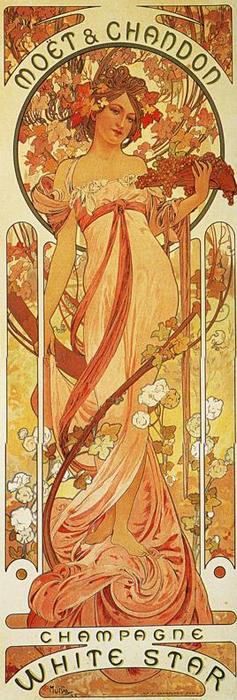
Moet & Chandon White Star: A Symphony of Art Nouveau Luxury
Alphonse Mucha’s “Moët & Chandon White Star” is more than just an advertising poster; it's a crystallized moment of the Art Nouveau movement, a testament to elegance, and a captivating exploration of feminine beauty. Created in approximately 1896-1897, this iconic piece perfectly encapsulates Mucha’s signature style – a world of flowing lines, organic forms, and an almost dreamlike quality that continues to enchant viewers today. The poster's enduring appeal lies not just in its subject matter—the promise of exquisite champagne—but in the masterful execution of Mucha’s artistic vision.
Composition & Style: A Central Figure in a Decorative World
The composition immediately draws the eye to the central female figure, a quintessential Mucha muse. She stands with a graceful turn of the head and body, enveloped in a flowing gown that seems to ripple with movement. This deliberate asymmetry, combined with the symmetrical arrangement of the floral motifs above and below, creates a dynamic balance – a hallmark of Art Nouveau design. The poster’s vertical orientation further emphasizes this sense of upward flow, mirroring the aspiration for luxury and refinement associated with Moët & Chandon. Mucha's use of curvilinear lines is utterly dominant; they dictate every element, from the delicate folds of the woman’s dress to the intricate patterns of the surrounding foliage. This deliberate rejection of hard angles in favor of organic shapes was a radical departure from prevailing artistic trends and firmly established Mucha as a leading figure of the Art Nouveau movement.
Color & Technique: Warmth and Delicate Detail
The color palette is deliberately rich and inviting, dominated by warm tones – creams, golds, peaches, and soft browns – that evoke feelings of comfort and indulgence. Strategic accents of red and green within the floral arrangements add pops of vibrancy, preventing the overall effect from becoming overly muted. Mucha’s meticulous attention to detail is evident in the shading used to create a sense of volume and depth, particularly in the fabric of the gown and the petals of the flowers. It's highly likely this poster was produced using lithography, a technique favored for its ability to reproduce intricate details and vibrant colors with precision. The artist would have meticulously crafted stone or metal plates, transferring the image onto paper through multiple impressions – a process that demanded both artistic skill and technical expertise.
Symbolism & Legacy: More Than Just Champagne
Beyond its promotional purpose, “Moët & Chandon White Star” is laden with symbolic meaning. The idealized female figure represents not just beauty but also grace, sophistication, and the allure of luxury. The abundant floral motifs – lilies, roses, and other blossoms – symbolize abundance, natural elegance, and the celebratory spirit associated with champagne. Mucha’s work frequently featured women in flowing robes, a deliberate choice that reinforced the association between femininity and opulence. The poster's impact extends far beyond its initial purpose; it became one of Mucha’s most recognizable works, solidifying his reputation as a master of Art Nouveau and influencing generations of artists and designers. Today, reproductions like those offered by ArtsDot.com allow us to appreciate the enduring beauty and artistic brilliance of this remarkable piece.