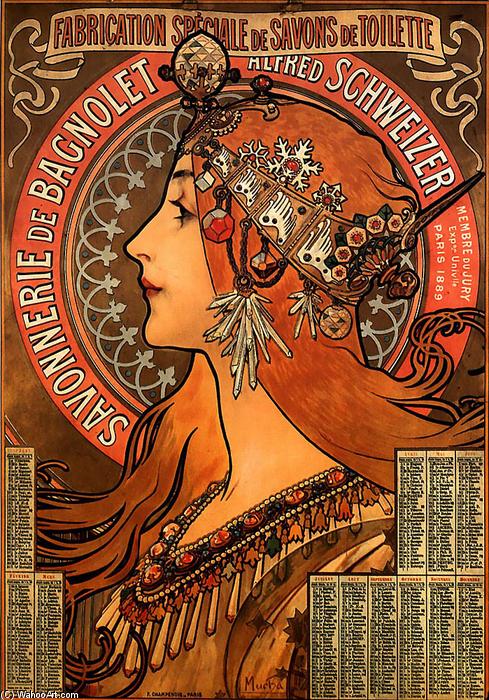
The painting's use of floral patterns and flowing lines is characteristic of Mucha’s work. The inclusion of text suggests a commercial purpose – likely an advertisement for the 'Savonnerie de Bagnolet' soap company. Further research into the artist's signature would be beneficial to definitively identify the creator.
Born in Brno, Mucha initially studied at the Academy of Fine Arts in Prague but
A Window into the Art Nouveau World: Savonnerie de Bagnolet
Alphonse Mucha’s “Savonnerie de Bagnolet” is more than just a decorative image; it's a meticulously crafted portal to the opulent and imaginative world of Art Nouveau. Executed with a masterful understanding of pattern, line, and color, this piece captures the essence of a bygone era – a time when beauty was deliberately sought in everyday objects and grand designs alike. The scene depicts a soap factory, but through Mucha’s artistic lens, it transforms into a fantastical tableau brimming with symbolic richness and an undeniable sense of movement.
The Language of Art Nouveau: Form and Decoration
Mucha's signature style is immediately apparent. The elongated forms of the figures, particularly the central woman, are characteristic of his approach, creating a feeling of graceful fluidity. The flowing lines dominate every aspect of the composition – from the cascading hair to the intricate floral motifs that swirl around her. This emphasis on decorative elements was central to Art Nouveau’s rejection of industrial austerity and its embrace of organic forms inspired by nature. The geometric shapes interwoven with the naturalistic designs further amplify this effect, creating a harmonious balance between structure and embellishment.
Color, Symbolism, and Commerce
The dominant warm color palette – particularly the rich red-orange hue – immediately draws the eye and evokes feelings of warmth, luxury, and vitality. This choice is not accidental; it aligns with Art Nouveau’s fascination with vibrant colors and its association with sensuality and pleasure. The text “Fabrication Spéciale de Savons de Toilette” (Special Production of Toilet Soaps) reveals that this image was likely an advertisement for the Savonnerie de Bagnolet company, highlighting the connection between beauty, craftsmanship, and consumer goods. The inclusion of lists and names within the painting suggests a desire to showcase the variety and quality of the soaps being offered – a clever integration of commercial messaging into artistic expression.
A Masterpiece in the Mucha Tradition
“Savonnerie de Bagnolet” stands as a testament to Alphonse Mucha’s genius and his profound influence on Art Nouveau. It exemplifies his ability to seamlessly blend decorative design with narrative storytelling, creating an image that is both visually stunning and intellectually stimulating. This reproduction offers a unique opportunity to own a piece of art history – a window into the world of one of the most celebrated artists of the late 19th and early 20th centuries.