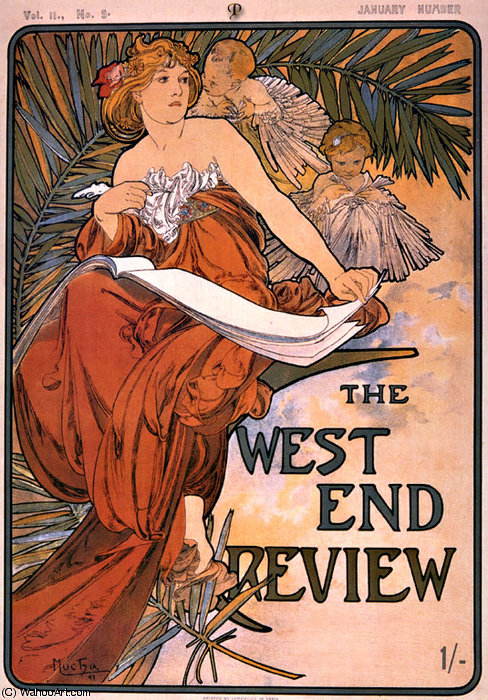
The Enigmatic Reader: Mucha’s ‘The West End Review’ – A Window into Late 19th Century Idleness
Alphonse Maria Mucha's “The West End Review,” painted in 1898, is more than a simple depiction of a woman reading; it’s a meticulously crafted tableau that encapsulates the languid elegance and burgeoning social anxieties of the late Victorian era. This artwork, now available as a hand-painted reproduction, offers a captivating glimpse into Mucha's distinctive Art Nouveau style – a style defined by its flowing lines, organic forms, and an almost palpable sense of movement. The scene unfolds with a quiet drama: a woman, rendered in rich reds and creams, sits on a delicately carved wooden branch, lost in the pages of a book. Above her, two ethereal angels, their features softened by a hazy light, observe her with a gentle curiosity. The painting’s power lies not just in its visual beauty but also in the subtle narrative it evokes – a story of contemplation, perhaps even a touch of melancholy, set against the backdrop of a society undergoing rapid transformation.
Art Nouveau and the Spirit of Mucha
Mucha's artistic journey was profoundly shaped by the prevailing currents of Art Nouveau. Emerging in reaction to the rigid formality of academic art, Art Nouveau sought to draw inspiration from nature – particularly the flowing lines of plants and flowers – translating them into decorative and pictorial forms. Influenced by artists like Pierre-Auguste Renoir’s impressionistic brushwork and Gustave Moreau's opulent symbolism, Mucha developed a unique visual language characterized by elongated figures, intricate patterns, and a masterful use of color. “The West End Review” exemplifies this perfectly; the woman’s flowing robes mimic the curves of vines, while the angels possess an almost dreamlike quality, their wings unfurling with graceful fluidity. This wasn't merely decorative; it was a deliberate attempt to capture a feeling, a mood – a sense of romantic escape.
Technique and Materiality: A Masterclass in Detail
The creation of “The West End Review” showcases Mucha’s exceptional technical skill and his dedication to meticulous detail. The painting is executed with oil paints on canvas, utilizing layering techniques that create a remarkable sense of depth and luminosity. Notice the subtle gradations of color within the woman's garments – the way light catches the folds of her dress, the delicate shading around her face. The angels are rendered with an almost translucent quality, achieved through careful glazing and blending. Mucha’s attention to texture is equally impressive; the rough grain of the wooden branch contrasts beautifully with the smooth fabric of the woman's robes. This level of detail speaks volumes about his commitment to creating a truly immersive artwork – one that invites the viewer to step into its world.
Symbolism and Social Commentary
Beyond its aesthetic beauty, “The West End Review” carries subtle symbolic weight. The act of reading itself represents intellectual pursuit and escape from the pressures of Victorian society. The angels, often associated with divine guidance, could be interpreted as representing a yearning for spiritual solace or perhaps a critique of the increasingly secularized world. Furthermore, the setting – a secluded branch – suggests a private moment of reflection, away from the bustling social scene of London’s West End. Mucha frequently depicted idealized women in flowing robes, often associated with innocence and virtue, reflecting societal ideals of femininity during this period. The painting subtly comments on the changing role of women within society, presenting them as both vulnerable and intellectually engaged.
Owning a Piece of Art Nouveau History
A hand-painted reproduction of “The West End Review” offers an unparalleled opportunity to bring this iconic artwork into your home or office. Each reproduction is created by skilled artisans who meticulously replicate Mucha’s original techniques, ensuring that the painting retains its full vibrancy and detail. This isn't just a print; it's a tangible connection to one of the most influential artists of the late 19th century – a testament to his vision and a beautiful addition to any art collection or interior design scheme. Allow yourself to be transported back to an era of elegance, contemplation, and artistic innovation with this exquisite reproduction.