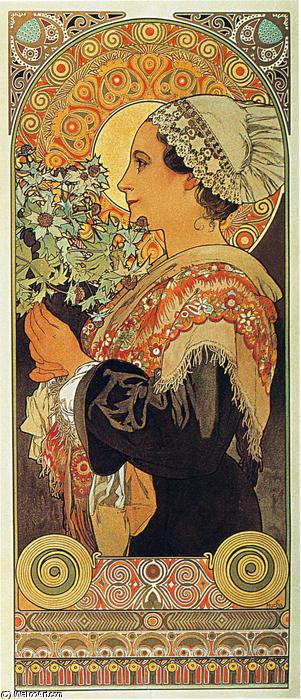
Thistle from the Sands - Alphonse Maria Mucha's Art Nouveau masterpiece captures flowing lines and vibrant colors, depicting a woman adorned with flowers against an orange-yellow backdrop. Inspired by Gustave Moreau and Renoir, it exemplifies the genre’s elegance and idealized femininity.
Discover Alphonse Mucha (1860-1939), the Art Nouveau master! Explore his iconic posters, beautiful women & the monumental 'Slav Epic'. A Czech artistic legend.
A Whisper of Bohemia: Alphonse Maria Mucha’s Thistle from the Sands
The scent of thyme drifts through the atelier as I gaze upon “Thistle from the Sands,” a monumental canvas by Alphonse Maria Mucha, currently residing in the Musée Beaux Arts de Nantes. More than just pigment on linen; it's an embodiment of Art Nouveau idealism—a testament to Prague’s artistic spirit and Mucha’s singular vision. Completed in 1903, this piece transcends mere decorative representation, delving into layers of symbolism that continue to fascinate scholars and inspire contemporary artists alike.
The Style: Fluidity Defined
Mucha's signature style is instantly recognizable—a deliberate rejection of academic rigidity in favor of organic forms and undulating lines. “Thistle from the Sands” exemplifies this ethos perfectly. The dominant motif, a woman draped in scarlet silk, dominates the composition, her gown swirling with an almost palpable grace. These flowing draperies aren’t merely aesthetically pleasing; they represent liberation—a departure from Victorian constraints and an embrace of feminine beauty unbound by societal expectations. Mucha meticulously crafted these lines using tempera paint on canvas, achieving a remarkable luminosity that captures the essence of Art Nouveau's fascination with light and color. The artist skillfully blended hues to create depth and texture, mirroring the natural world around him—specifically, the arid landscape depicted in muted ochres and browns.
Historical Context: Prague at the Dawn of Modernity
The painting emerged during a pivotal moment in Czech history – the Slavonic Uprising of 1897-98. This nationalist fervor fueled Mucha’s artistic endeavors, prompting him to fuse traditional Bohemian folklore with the avant-garde principles of Art Nouveau. The thistle itself—a prickly flower symbolizing resilience and perseverance—serves as a poignant reminder of Czech identity amidst Austro-Hungarian rule. It's a deliberate contrast between fragility and strength, mirroring the nation’s struggle for independence. Mucha drew inspiration from artists like Gustave Moreau and Pierre-Auguste Renoir, absorbing their techniques and stylistic sensibilities to forge his own distinctive path.
Symbolism: Blossoms of Idealized Femininity
Beyond its formal qualities, “Thistle from the Sands” is rich in symbolic meaning. The woman’s scarlet dress symbolizes passion and vitality—a vibrant hue chosen to convey optimism and confidence. Surrounding her are delicate orange blossoms, representing joy and enlightenment. These flowers aren't merely decorative; they symbolize spiritual aspiration—the pursuit of beauty and truth as guiding forces in life. Mucha’s meticulous attention to detail underscores the importance of symbolism within Art Nouveau aesthetics. Every element contributes to a larger narrative, inviting contemplation and fostering emotional resonance.
Emotional Impact: A Moment Frozen in Time
Standing before this canvas is akin to stepping back into a bygone era—a realm of romantic idealism and artistic experimentation. The painting evokes feelings of serenity, elegance, and wonder. It captures the spirit of Art Nouveau’s belief in the transformative power of beauty—its conviction that art could elevate human consciousness and inspire noble aspirations. “Thistle from the Sands” remains an enduring masterpiece, demonstrating Mucha's unparalleled ability to translate artistic vision into tangible form. Its luminous colors and graceful lines continue to captivate audiences today, cementing its place as a cornerstone of Art Nouveau heritage.