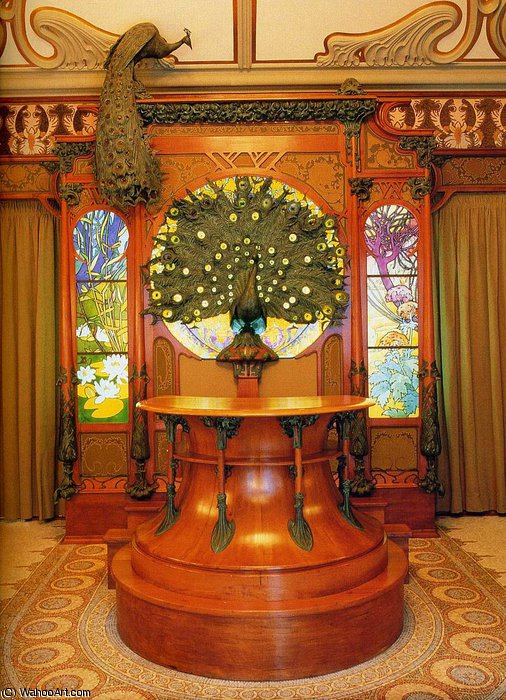
Exquisite Alphonse Mucha Art Nouveau interior scene! Lavish details, peacock motifs & warm tones in this unique decorative artwork. Discover a masterpiece of Czech design.
Discover Alphonse Mucha (1860-1939), the Art Nouveau master! Explore his iconic posters, beautiful women & the monumental 'Slav Epic'. A Czech artistic legend.
A Vision of Elegance: Exploring Alphonse Mucha’s “The Slavonic Uprising”
Alphonse Maria Mucha stands as one of the most recognizable figures of Art Nouveau, an artistic movement that flourished between 1890 and 1910. Born in Brno, Czech Republic, in 1860, Mucha rejected the academic conventions of his time, forging a path toward a uniquely expressive style rooted in organic forms and flowing lines—a stylistic hallmark that would define his enduring legacy. His fascination with decorative arts began early, fueled by an unwavering belief in the transformative power of visual imagery. This conviction propelled him to Paris in 1887 where he established himself as a celebrated illustrator and designer, quickly gaining renown for his captivating posters featuring idealized women draped in flowing robes—a motif that would become synonymous with Art Nouveau’s aesthetic ideals.
The Birth of Symbolism: Mucha's Artistic Influences
Mucha’s artistic sensibilities were profoundly shaped by the currents of Symbolist art, particularly the works of Gustave Moreau and Pierre-Auguste Renoir. Moreau’s opulent canvases—characterized by intricate detail and a mystical atmosphere—served as an inspiration for Mucha’s exploration of psychological depth and emotional resonance. Similarly, Renoir's Impressionistic techniques encouraged Mucha to capture fleeting moments of beauty with luminous color palettes and loose brushstrokes. These influences combined to forge a distinctive artistic voice that prioritized emotive expression over mere representation.
“The Slavonic Uprising”: A Fusion of Tradition and Innovation
Mucha’s monumental canvases, collectively known as “The Slavonic Uprising,” represent the apex of his Symbolist style and stand as a testament to his unwavering commitment to artistic experimentation. Completed in 1928, this ambitious project—commissioned by the Czechoslovak State Opera—saw Mucha blending traditional Czech folklore with the stylistic conventions of Art Nouveau. The artwork depicts a stylized depiction of the Slavic uprising against Austro-Hungarian rule, utilizing vibrant colors and intricate geometric patterns to convey both historical narrative and symbolic meaning. Noticeably, Mucha employed a technique combining oil paint with collage elements – incorporating fragments of textiles and printed matter—to enrich the textural surface and heighten visual impact.
Symbolism Unleashed: Decoding Mucha’s Artistic Language
The imagery within “The Slavonic Uprising” is laden with symbolic references that resonate deeply with Art Nouveau's core tenets. The central figure, a woman embodying Slavic femininity, dominates the composition—representing resilience, courage, and spiritual fortitude. Surrounding her are stylized floral motifs—symbolizing fertility and rebirth—further reinforcing the artwork’s overarching message of hope and liberation. Mucha’s masterful manipulation of color—particularly reds and golds—evokes feelings of passion and grandeur, mirroring the fervor of the uprising itself. The artist's deliberate use of flowing lines and curvilinear forms underscores Art Nouveau’s fascination with organic beauty and movement—creating a visual experience that transcends mere depiction.
An Enduring Legacy: Mucha’s Impact on Decorative Arts
Alphonse Mucha’s contribution to decorative arts remains unparalleled, securing his place as one of the most influential artists of the Art Nouveau era. His distinctive style continues to inspire designers and artists today—serving as a beacon of elegance and innovation. Reproductions of “The Slavonic Uprising,” alongside Mucha's iconic posters, adorn homes and galleries worldwide—testament to the enduring power of his artistic vision. More than just an artwork, it embodies the spirit of a movement that sought to elevate beauty and craftsmanship to new heights—leaving an indelible mark on the history of art and design.