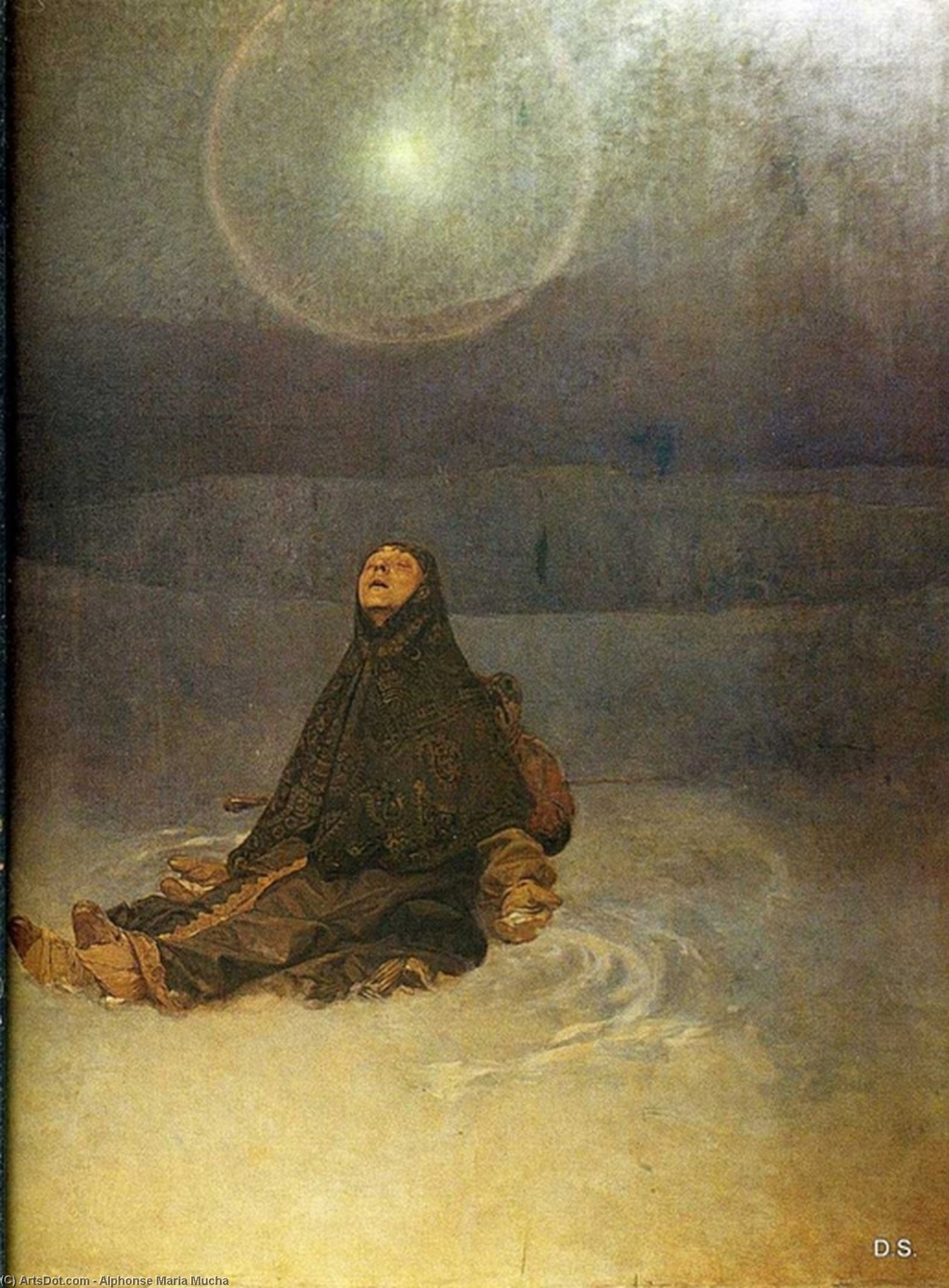
Discover Alphonse Mucha's 'Woman in the Wilderness,' an evocative Art Nouveau portrait capturing tranquility and introspection amidst a nighttime scene. Explore its beauty!
Discover Alphonse Mucha (1860-1939), the Art Nouveau master! Explore his iconic posters, beautiful women & the monumental 'Slav Epic'. A Czech artistic legend.
A Glimpse into Introspection: Alphonse Mucha's "Woman in the Wilderness"
This captivating painting, “Woman in the Wilderness” by Alphonse Mucha, offers a poignant and evocative scene steeped in the aesthetics of Art Nouveau. The artwork portrays a woman kneeling amidst a dark, nocturnal wilderness, her hands clasped in what appears to be prayer or deep contemplation. Her gaze is directed upwards, suggesting an engagement with something beyond the visible world – perhaps the heavens, a guiding spirit, or simply the vastness of existence. Two other figures are subtly present: one standing behind her and another further off to the right, adding layers of narrative intrigue without distracting from the central subject's solitude. The presence of a handbag near her knees hints at a life interrupted, a journey paused for reflection.
Art Nouveau Elegance and Decorative Technique
Mucha’s signature Art Nouveau style is immediately recognizable in this piece. Characterized by flowing lines, organic forms, and an emphasis on decorative beauty, the painting exemplifies the movement's rejection of industrial rigidity in favor of handcrafted artistry. While the exact technique used remains unknown without further documentation, it likely involved a combination of oil paints applied with meticulous detail to achieve the soft gradations of light and shadow that define the scene. The composition itself is carefully balanced; the woman’s figure anchors the foreground while the surrounding darkness creates an atmosphere of mystery and tranquility. Mucha's mastery lies in his ability to blend realism with stylized ornamentation, creating a visually stunning and emotionally resonant image.
Symbolism and Interpretation
The symbolism within "Woman in the Wilderness" is rich and open to interpretation. The wilderness itself can be seen as representing the unknown, the challenges of life, or even the inner landscape of the soul. The woman’s posture suggests vulnerability but also resilience – a willingness to confront difficult truths. Her upward gaze implies hope, faith, or a search for meaning in a seemingly desolate environment. The nighttime setting further amplifies the sense of introspection and solitude. While Mucha often incorporated overt allegorical elements into his work (particularly in his "Slav Epic"), this piece possesses a more subtle and nuanced symbolic language, inviting viewers to project their own interpretations onto the scene. The presence of other figures could represent support systems or perhaps internal struggles that accompany personal reflection.
Historical Context and Emotional Impact
Created during the height of the Art Nouveau period (late 19th – early 20th century), "Woman in the Wilderness" reflects a broader cultural shift towards individualism, spirituality, and an appreciation for natural beauty. The late 1800s saw a rise in interest in psychology and introspection, themes that resonate within this painting. The artwork evokes a profound sense of tranquility and contemplation. It invites viewers to pause, reflect on their own lives, and find solace in the face of uncertainty. Its emotional impact lies not in dramatic action but in its quiet portrayal of human vulnerability and the enduring search for meaning – making it an ideal piece for those seeking serenity and beauty within their living spaces.