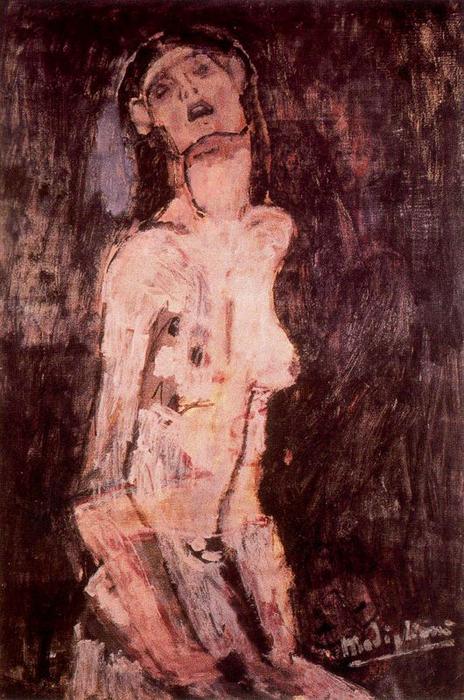
An intense expressionist portrayal of vulnerability features a distressed nude by Amedeo Modigliani from 1909, capturing raw human emotion through distorted forms and inviting you to explore this masterpiece.
Explore the captivating art of Amedeo Modigliani (1884-1920): iconic portraits & sculptures defined by elongated forms, expressive eyes, and a hauntingly beautiful style. Discover his legacy! #Modigliani #Expressionism
A Window Into Sorrow: The Visceral Presence of Modigliani
To gaze upon Amedeo Modigliani’s A Suffering Nude is to encounter a profound and unsettling dialogue between form and feeling. Completed in 1909, this work transcends the traditional boundaries of the nude genre, moving far beyond mere anatomical representation to capture the very essence of human vulnerability. The figure, draped upon the ground with arms outstretched, does not merely exist within the frame; she inhabits a state of profound psychological unrest. Her open mouth, captured in a moment of silent outcry, serves as a haunting focal point that draws the viewer into her private landscape of anguish. There is an undeniable intimacy in this encounter, a sense that we are witnessing a raw, unshielded moment of spiritual or physical distress that refuses to be ignored.
The painting stands as a cornerstone of the Expressionist movement, where Modigliani deliberately rejects the polished academic conventions of his era. Instead of seeking photographic accuracy, he employs a deliberate manipulation of proportion and perspective to amplify the internal narrative. The subtle elongation of the figure’s features—a hallmark of Modigliani’s signature style—serves as a visual metaphor for the stretching of the soul under the weight of sorrow. This distortion is not an error of technique but a revelation of truth, allowing the artist to communicate a subjective experience of isolation and pain that a more realistic approach could never achieve.
The Alchemy of Earth and Texture
The emotional gravity of the piece is anchored by Modigliani’s masterful command of palette and texture. The artist utilizes a muted, somber spectrum of earthy tones, where deep umbers and subtle ochres create an atmosphere of subdued melancholy. This restrained color choice prevents the eye from being distracted by superficial brightness, forcing a deeper engagement with the shadows and the weight of the composition. However, it is the tactile quality of the canvas that truly captivates the observer.
Through the use of thick impasto strokes, particularly evident in the textured wall behind the figure, Modigliani creates a palpable sense of instability and roughness. This heavy layering of paint adds a physical dimension to the psychological tension; the ruggedness of the background mirrors the internal turbulence of the subject. The interplay between the smooth, elongated lines of the flesh and the abrasive, built-up surface of the environment creates a sensory friction that keeps the viewer perpetually engaged, making the painting feel less like a static image and more like a living, breathing entity of textured emotion.
An Enduring Legacy for the Discerning Collector
For the art lover, the collector, or the interior designer, A Suffering Nude offers an unparalleled opportunity to introduce a sense of historical depth and intellectual rigor into a space. This is not merely a decorative element; it is a conversation piece that commands attention through its sheer emotional intensity. In a modern interior, such a work acts as a profound anchor, providing a focal point of gravity and contemplative stillness amidst the complexities of contemporary life.
Owning a high-quality reproduction of this masterpiece allows one to curate an environment steeped in the romanticism and tragedy of the École de Paris. It brings into a home or gallery the spirit of an era defined by the shattering of old conventions and the birth of modern subjectivity. Whether placed in a minimalist setting to provide a striking contrast or integrated into a classical collection to highlight its Expressionist roots, Modigliani’s work remains a timeless testament to the power of art to articulate the unspoken depths of the human condition.