Inspired by Nietzsche, Baudelaire, and Lautréamont, Modigliani's work explores themes of longing and fragility. See related artworks like ‘A Girl in Yellow Dress,’ ‘George ortiz,’ and ‘Girl in a Green Blouse’.
A Portrait of Quiet Contemplation: Exploring Modigliani’s ‘A Young Girl’
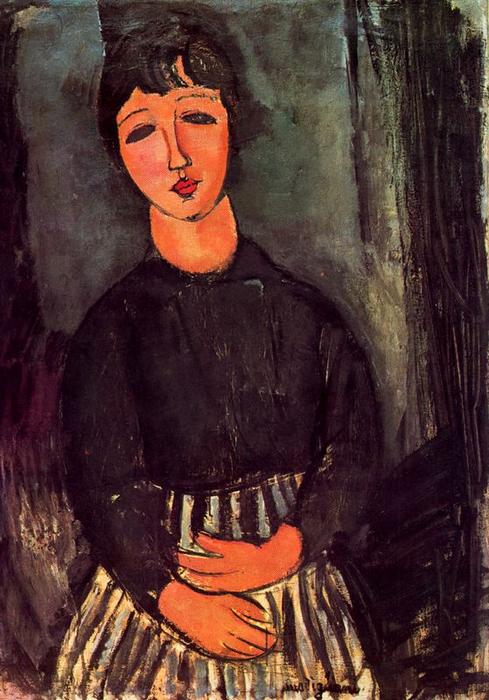
Amedeo Clemente Modigliani's “A Young Girl,” painted in 1916, transcends mere representation; it embodies the very essence of Expressionist artistry and speaks volumes about the artist’s profound engagement with human emotion. This captivating portrait, housed within a generous 100 x 65 cm canvas, depicts a woman draped in black, her gaze directed downwards—a posture that invites viewers to ponder upon unspoken thoughts and feelings. The painting's oil on canvas technique lends itself beautifully to Modigliani’s signature elongated forms and subtle shading, creating an image imbued with both stillness and palpable melancholy.
- Style & Technique: Modigliani’s stylistic approach firmly establishes him within the Expressionist movement. Rejecting academic conventions of realism, he prioritized conveying inner psychological states through distorted proportions—a deliberate departure from traditional portraiture. The elongated neck and stylized facial features are hallmarks of his distinctive style, reflecting a fascination with capturing the soul rather than simply mirroring physical appearance.
- Historical Context: Painted during the turbulent years following World War I, “A Young Girl” reflects the anxieties and uncertainties prevalent in European society at the time. The Expressionist movement arose as a reaction to the perceived superficiality of bourgeois culture, seeking instead to express raw emotion and confront existential dilemmas—themes powerfully conveyed in Modigliani’s oeuvre.
- Symbolism & Emotion: The woman's downward gaze is laden with symbolic significance. It suggests introspection, vulnerability, and perhaps a yearning for solace amidst the pervasive disillusionment of the postwar era. Modigliani skillfully utilizes muted tones—primarily blacks and browns—to heighten the emotional impact of the piece, fostering a sense of quiet contemplation and conveying a deep sensitivity to human experience.
Detailed Examination: Artistic Considerations
Modigliani’s meticulous attention to detail is evident in every brushstroke. The artist employs a glazing technique—applying thin layers of translucent oil paint over subsequent coats—to achieve remarkable luminosity and depth. This method allows for subtle gradations of color, enhancing the painting's textural quality and contributing to its overall atmosphere. Furthermore, Modigliani’s masterful manipulation of light creates an illusionistic effect that draws the viewer into the scene, fostering a connection with the subject’s inner world.
- Color Palette: The predominantly monochrome palette—dominated by shades of black and brown—serves to emphasize the painting's emotional core. These muted tones evoke feelings of sadness, solitude, and contemplation, mirroring the psychological complexities explored by Modigliani.
- Composition & Form: The composition is deliberately understated, prioritizing balance and harmony over dramatic visual impact. Modigliani’s elongated neck and stylized facial features are central to the artwork's expressive power—they serve as conduits for conveying emotion and capturing the essence of human vulnerability.
A Legacy of Beauty & Melancholy: Why This Reproduction Matters
“A Young Girl” remains a testament to Modigliani’s artistic genius and his unwavering commitment to exploring the depths of human emotion. Its enduring appeal lies in its ability to resonate with viewers across generations, prompting reflection on themes of identity, vulnerability, and the pursuit of inner peace. A high-quality reproduction offers an opportunity to experience this iconic artwork firsthand—to appreciate Modigliani’s masterful technique and to immerse oneself in the painting's evocative atmosphere.