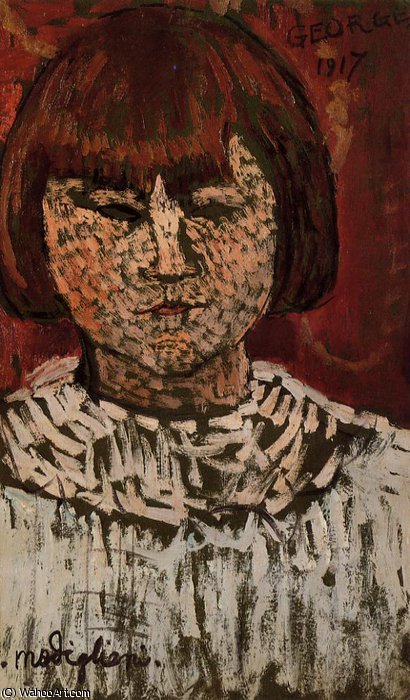
A Portrait of Intimacy: Modigliani’s ‘George Ortiz’
This captivating portrait, *George Ortiz*, by Amedeo Modigliani is a striking example of his signature style – a blend of elegant elongation, expressive emotion, and subtle vulnerability. Painted around 1918-1919, it depicts the young George Ortiz, a Spanish art dealer who befriended Modigliani in Paris during a particularly challenging period for the artist. The painting is more than just a likeness; it’s an intimate study of character rendered with remarkable sensitivity and stylistic innovation.
Stylistic Characteristics & Technique
Modigliani's approach to portraiture was revolutionary. He deliberately moved away from strict realism, favoring simplified forms and elongated features – particularly the neck and face – that became his trademark. In *George Ortiz*, this is immediately apparent. The subject’s facial structure is subtly stretched, lending a sense of melancholy and introspection.
- Expressive Lines: Notice how Modigliani employs flowing, sinuous lines to define the contours of the face and clothing. These aren't merely descriptive; they contribute significantly to the painting’s emotional resonance.
- Color Palette & Texture: The muted color palette – dominated by pale flesh tones contrasted against a dark, mottled red-brown background – enhances the sense of intimacy and quietude. Modigliani’s application of paint is visible and textured, with brushstrokes adding depth and dynamism.
- Impasto & Palette Knife: The artist skillfully uses impasto (thickly applied paint) and likely a palette knife to create textural effects, particularly in the clothing and background. This technique adds a tactile quality to the work, inviting closer inspection.
Historical Context & Modigliani’s Oeuvre
Amedeo Modigliani (1884-1920) was an Italian painter and sculptor who spent most of his artistic career in Paris. He arrived during a period of intense artistic experimentation, encountering the likes of Picasso and Brâncuși. While briefly experimenting with Cubism, he quickly developed his own unique style – one that drew inspiration from African sculpture, Renaissance art, and Mannerism.
George Ortiz falls within Modigliani’s most celebrated period of portraiture, a time when he was producing some of his most iconic works despite facing financial hardship and declining health. His portraits were often of friends, fellow artists, and acquaintances, capturing the bohemian spirit of early 20th-century Paris.
Symbolism & Emotional Impact
The power of *George Ortiz* lies in its ability to convey a profound sense of psychological depth. The subject’s gaze is direct yet distant, suggesting an inner life filled with contemplation. The simplicity of the composition – focusing almost entirely on the face and upper body – intensifies this effect.
- Vulnerability & Intimacy: The pale skin tones and soft lighting contribute to a feeling of vulnerability, while the close-up perspective creates a sense of intimacy between the viewer and the subject.
- The Dark Background: The dark, ambiguous background can be interpreted as representing the uncertainties and anxieties of the era, or perhaps simply serving to emphasize the figure’s presence.
A Timeless Appeal for Modern Interiors
*George Ortiz* is a compelling artwork that transcends its historical context. Its elegant simplicity and emotional depth make it a versatile addition to any interior space. The muted color palette complements a range of décor styles, from modern minimalist to classic traditional. A high-quality reproduction of this painting would serve as a sophisticated focal point in a living room, bedroom, or study – a testament to the enduring power of Modigliani’s artistic vision and a conversation starter for any art enthusiast.