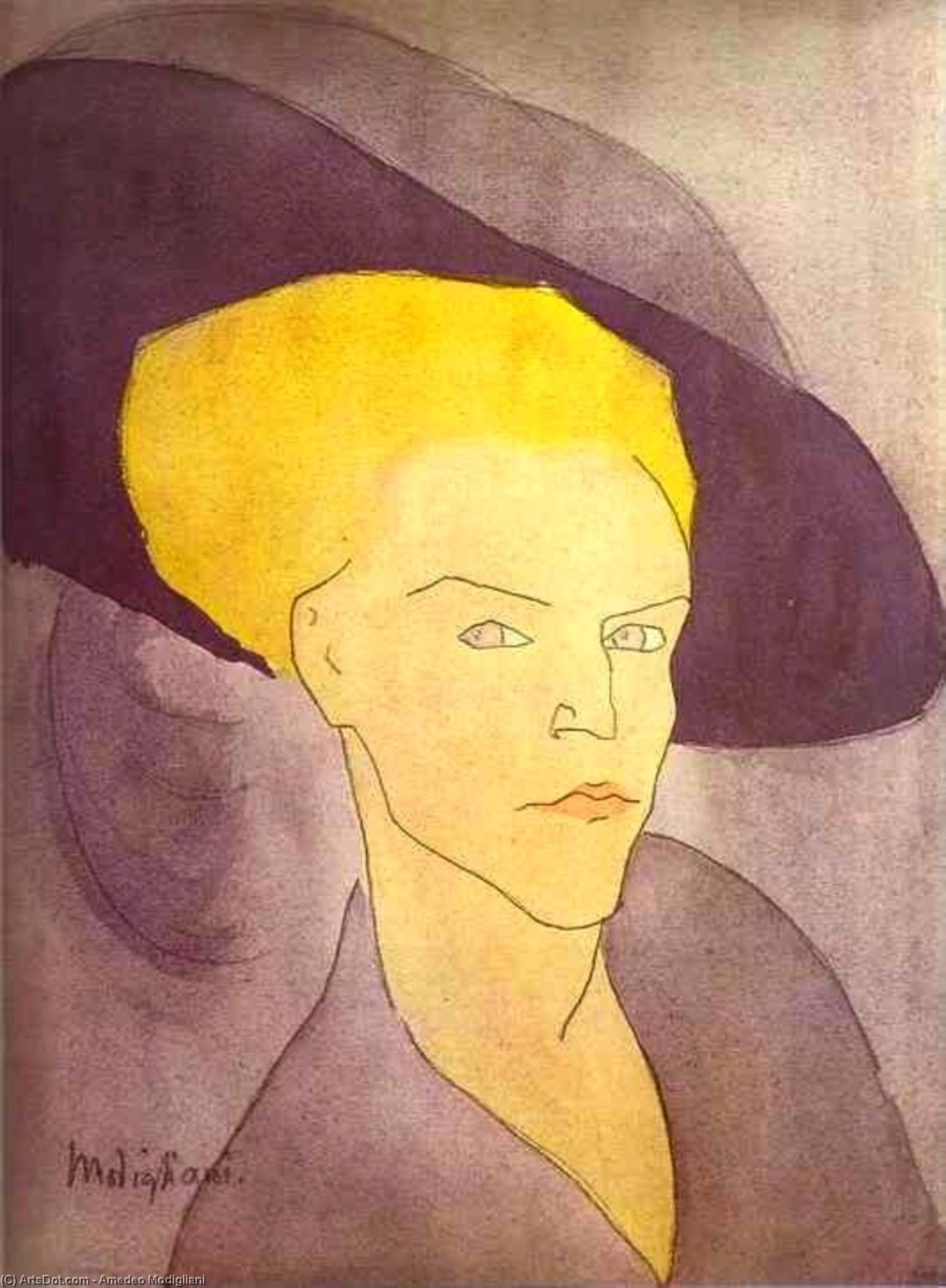
Experience the melancholic elegance of Amedeo Modigliani's Head of a Woman with a Hat, a masterpiece of stylized portraiture from the early 20th century that invites you to bring timeless modern art into your home.
Explore the captivating art of Amedeo Modigliani (1884-1920): iconic portraits & sculptures defined by elongated forms, expressive eyes, and a hauntingly beautiful style. Discover his legacy! #Modigliani #Expressionism
A Study in Quiet Elegance: Decoding Modigliani’s “Head with Hat”
Amedeo Clemente Modigliani's "Head with Hat," painted circa 1918-1919, stands as a testament to the artist’s singular vision – a distillation of African art influences and Cubist tendencies into an exquisitely stylized portrait that continues to captivate audiences today. More than just a depiction of a woman’s face, it's an exploration of form, emotion, and the subtle interplay between observation and imagination. The artwork embodies Modigliani’s characteristic approach: prioritizing expressive gesture over realistic representation, resulting in an image imbued with palpable melancholy and profound stillness.
Composition & Style – Simplifying Reality
The painting’s compositional simplicity is striking. Rather than striving for photographic accuracy, Modigliani employs a flattened plane of color against a muted backdrop—primarily shades of grey and beige—to emphasize the contours of the subject's head and shoulders. The woman’s gaze directs outwards, establishing an immediate connection with the viewer, while the oversized hat dominates the upper portion of the canvas, acting as both framing device and symbolic element. This deliberate reduction in detail aligns perfectly with Modigliani’s broader artistic project: rejecting academic conventions in favor of a more visceral engagement with visual experience. The elongated proportions of the face—a hallmark of his style—are subtly unsettling yet undeniably beautiful, reflecting a fascination with African sculpture and its expressive distortions.
Color Palette & Technique – Watercolor's Delicate Touch
The color palette is deliberately restrained, dominated by muted hues of purple, yellow, beige, and grey. The woman’s skin tone is rendered in pale beige, contrasted by a vibrant yellow for her hair—a bold choice that draws attention to the subject’s vitality despite the overall somber mood. Purple saturates the hat itself, creating a powerful visual counterpoint and hinting at an inner richness. Modigliani skillfully utilized watercolor or gouache on paper, achieving a remarkably smooth surface texture through minimal brushstrokes. This technique lends itself perfectly to conveying subtle tonal variations and capturing the ethereal quality of light—a crucial element in establishing mood and atmosphere.
Symbolism & Emotional Resonance – A Portrait Beyond Appearance
Beyond its formal qualities, “Head with Hat” resonates deeply with emotional significance. The woman’s unwavering gaze speaks volumes about inner contemplation and resilience, suggesting a quiet dignity that transcends mere physical likeness. The hat—a symbol of status and sophistication—could also represent protection from the outside world, shielding her face from judgment and fostering introspection. Ultimately, Modigliani's masterpiece invites viewers to contemplate themes of beauty, vulnerability, and the enduring power of artistic expression. It’s a portrait that lingers in the mind long after viewing, prompting reflection on the complexities of human experience.
Historical Context & Legacy – Echoes of Modern Art Movements
Painted during Modigliani’s formative years—a period marked by experimentation with Cubist influences and an unwavering devotion to African art—the artwork embodies the spirit of its time. Artists like Picasso and Matisse were actively exploring new visual languages, rejecting traditional realism in favor of abstraction and expressive distortion. Modigliani's work stands as a pivotal contribution to this artistic revolution, demonstrating how simplified forms could convey profound emotional depth. Today, reproductions of “Head with Hat” continue to inspire artists and collectors alike—a testament to its enduring beauty and timeless relevance.