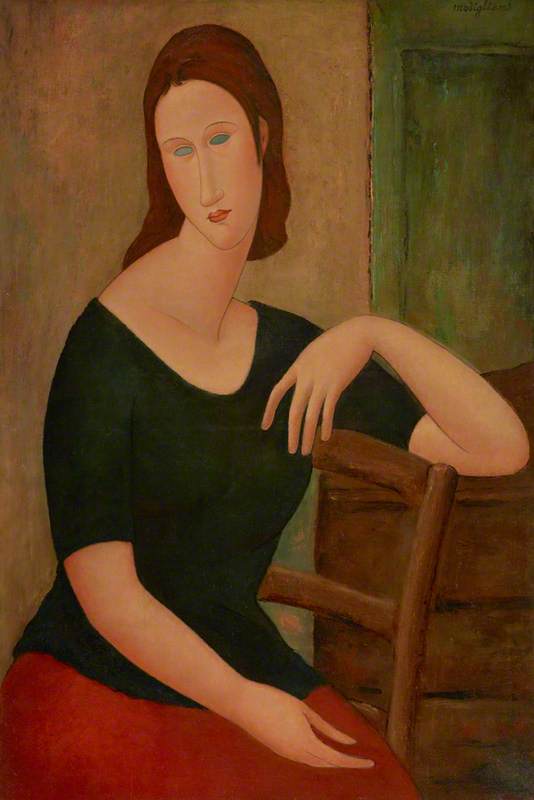
Explore Amedeo Modigliani’s ‘Jeanne Hebuterne,’ a captivating portrait in a stylized Cubist manner. Discover smooth oil paint, dark tones & red accents – a timeless piece of modern art.
Explore the captivating art of Amedeo Modigliani (1884-1920): iconic portraits & sculptures defined by elongated forms, expressive eyes, and a hauntingly beautiful style. Discover his legacy! #Modigliani #Expressionism
A Portrait of Intimacy: Exploring Modigliani’s Jeanne Hebuterne
This captivating portrait by Amedeo Modigliani offers a poignant glimpse into both the artistic style of one of the 20th century's most celebrated painters and his deeply personal relationship with his muse, Jeanne Hebuterne. Measuring 81 x 55 cm, this work exemplifies Modigliani’s signature approach to portraiture – an elegant distillation of form and emotion.
Stylistic Innovation & Artistic Influences
The painting is firmly rooted in the early Modernist movement, displaying clear influences from Cubism and Expressionism, yet forging its own distinct path. Modigliani’s style is immediately recognizable through his elongated figures, particularly evident in the neck and facial features of Jeanne Hebuterne. The simplification of forms, flattened perspective, and geometric shapes – especially within the chair and background – demonstrate a deliberate departure from traditional representational painting. While acknowledging Cubist fragmentation, Modigliani softens its harsh angles, imbuing his subjects with a lyrical grace.
Technique & Materiality
Executed in oil paint on canvas, the artwork showcases Modigliani’s masterful technique. The smooth application of paint creates a polished surface, devoid of heavy impasto or visible brushstrokes. This contributes to the painting's overall sense of stillness and refinement. The limited color palette – dominated by dark tones punctuated by strategic pops of red – enhances the dramatic effect and draws attention to Jeanne’s face. Directional lighting subtly models her features, creating delicate shadows that define her form without sacrificing the painting’s inherent flatness.
Jeanne Hebuterne: Muse & Beloved
The subject, Jeanne Hebuterne, was not merely a model but Modigliani's lifelong companion and the mother of his children. She appears frequently in his work, becoming almost synonymous with his artistic output during his tragically short life. This portrait captures her quiet dignity and introspective nature. Her gaze is direct yet melancholic, inviting viewers to contemplate her inner world. The simplicity of her pose and attire further emphasizes the focus on her psychological state.
Symbolism & Emotional Resonance
Beyond a simple likeness, this portrait carries symbolic weight. The muted color palette and Jeanne’s somber expression hint at an underlying sense of sadness – perhaps foreshadowing the tragic circumstances surrounding both their lives (Jeanne tragically died by suicide shortly after Modigliani's death). The painting evokes themes of love, loss, and the fleeting nature of beauty. It is a testament to the power of art to capture not only physical appearance but also the complexities of human emotion.
Historical Context & Legacy
Created during a period of radical artistic experimentation in Paris (early 20th century), this work reflects the broader cultural shifts occurring at the time. Modigliani, alongside artists like Picasso and Brâncuși, challenged conventional notions of beauty and representation. Though initially met with limited critical acclaim, his work gained posthumous recognition and profoundly influenced subsequent generations of artists. Today, Modigliani’s portraits are highly sought after by collectors and admired for their unique blend of elegance, emotion, and modern sensibility. This piece offers a compelling example of his enduring artistic vision – a timeless exploration of the human spirit.